
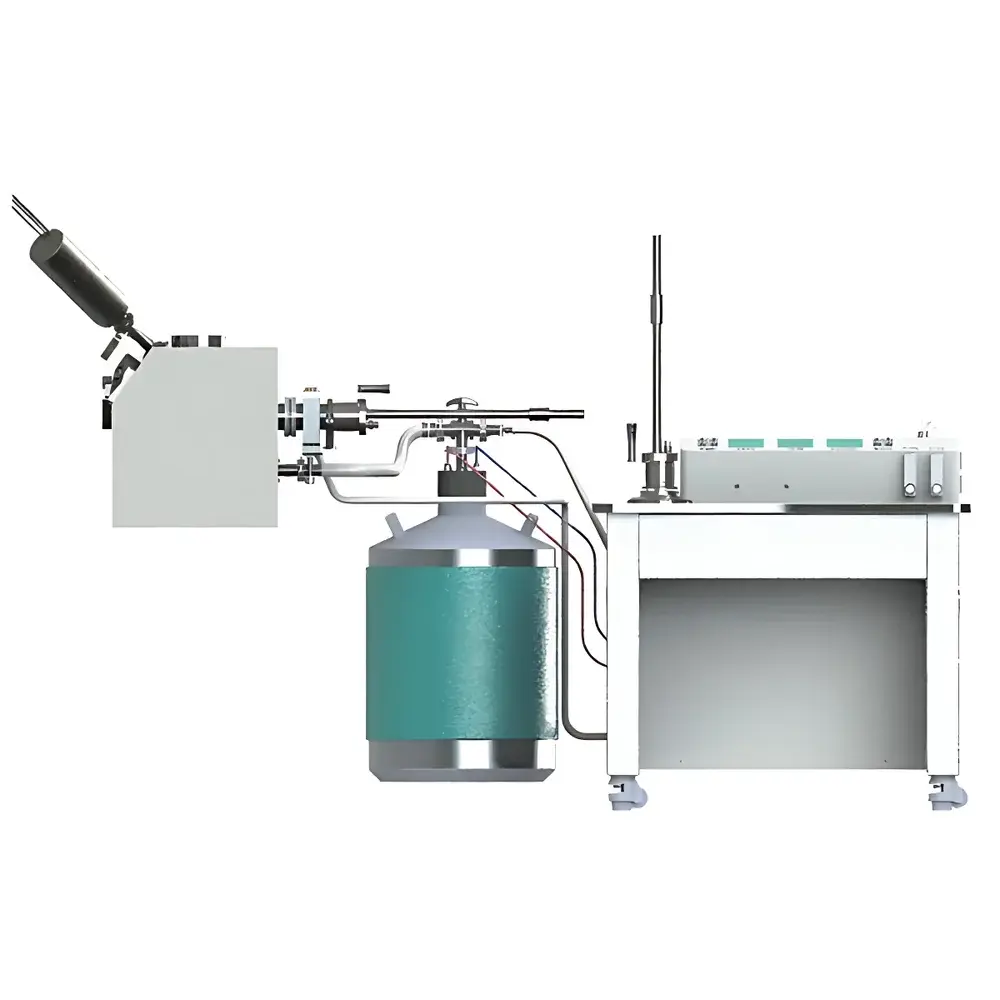
ZEPTOOLS SEM Cryogenic Vacuum Transfer System
| Brand | ZEPTOOLS |
|---|---|
| Origin | Guangdong, China |
| Manufacturer Type | OEM/ODM Manufacturer |
| Origin Category | Domestic (China) |
| Model | SEM Cryogenic Vacuum Transfer System |
| Pricing | Upon Request |
| Cooling Stage Temperature Range | −170 °C to +100 °C |
| Cooling Stage Temperature Stability | ≤ ±0.1 °C |
| Cooling Stage Rotation | 0–360° continuous |
| Cooling Stage Tilt Angle | ≥55° |
| Cold Trap Temperature | ≤ −190 °C |
| Cold Trap Temperature Stability | ≤ ±0.5 °C |
| Cooling Stage Cool-down Time to −170 °C | ≤35 min |
| Cold Trap Cool-down Time to −190 °C | ≤20 min |
| Bake-out Capability | ≥100 °C |
| Liquid Nitrogen Capacity | 35 L |
| Continuous Operation Duration | >8 h |
| LN₂ Refill Port | Hot-swap compatible (no system shutdown required) |
| Vacuum Transfer Chamber | Enables glovebox ↔ FIB ↔ SEM cryo-transfer |
| Vacuum Load Lock | Integrated for rapid, contamination-controlled SEM insertion |
| Control System | Integrated PLC-based HMI with real-time temperature/vacuum monitoring and logging |
Overview
The ZEPTOOLS SEM Cryogenic Vacuum Transfer System is an engineered solution for high-fidelity structural and compositional analysis of beam-sensitive, volatile, or hydrated specimens in scanning electron microscopy (SEM). It implements a fully integrated cryo-transfer architecture grounded in ultra-high vacuum (UHV) compatibility and precise thermal management. By maintaining samples at cryogenic temperatures—from liquid nitrogen temperatures (−196 °C) down to ≤−170 °C on the stage and ≤−190 °C at the cold trap—the system preserves native morphology, inhibits ice recrystallization, suppresses hydrocarbon contamination, and prevents beam-induced damage during imaging and focused ion beam (FIB) milling. Designed for seamless integration into multi-instrument workflows, it supports bidirectional transfer between inert-atmosphere gloveboxes, FIB-SEM dual-beam systems, and high-resolution SEMs—ensuring sample integrity from preparation through final characterization.
Key Features
- 360° continuous rotation cryo-stage with tilt capability (≥55°), enabling multi-angle imaging and cross-sectional milling without mechanical repositioning.
- High-stability temperature control: stage precision ≤±0.1 °C; cold trap precision ≤±0.5 °C—critical for reproducible cryo-SEM protocols.
- Dual-stage cooling architecture: independent cryo-stage and cold trap, each with dedicated thermal regulation and bake-out functionality (≥100 °C) for UHV-compatible cleaning and residual gas reduction.
- 35 L liquid nitrogen reservoir with hot-swap refill port—enabling uninterrupted operation for >8 hours, essential for extended acquisition sessions or automated multi-sample workflows.
- Modular vacuum transfer chamber compliant with standard CF-100 and CF-63 flange interfaces, supporting direct integration with commercial FIB-SEM platforms and glovebox antechambers (O₂/H₂O <0.1 ppm).
- Integrated PLC-based control system with touchscreen HMI, real-time graphical display of pressure (1×10⁻⁷–1×10⁻¹⁰ mbar range), stage/cold trap temperatures, and system interlocks—fully loggable for GLP/GMP traceability.
Sample Compatibility & Compliance
The system accommodates a broad spectrum of cryo-sensitive specimens—including lithium-ion battery separators, polymer membranes, biological tissues, frozen-hydrated nanoparticles, and soft organic thin films—without requiring conductive coating or chemical fixation. Its vacuum architecture meets ISO 20483:2022 (cryo-SEM specimen handling), ASTM E3075-21 (cryogenic specimen transfer for electron microscopy), and aligns with USP and FDA 21 CFR Part 11 requirements when paired with optional audit-trail-enabled software modules. All wetted surfaces are electropolished stainless steel (316L), and the system achieves base pressures <5×10⁻⁹ mbar after bake-out—ensuring minimal hydrocarbon adsorption and long-term vacuum stability.
Software & Data Management
The embedded control firmware supports timestamped parameter logging (temperature setpoints, actual values, vacuum levels, stage position, tilt angle) with CSV export via USB or Ethernet. Optional ZEPTOOLS CryoLink™ software extends functionality with remote monitoring, scheduled cooldown sequences, alarm escalation (email/SNMP), and integration into laboratory information management systems (LIMS) via OPC UA. All data records include digital signatures and immutable timestamps—meeting ALCOA+ principles for regulated environments including pharmaceutical QC and advanced materials R&D.
Applications
- Cryo-FIB-SEM tomography of battery separator microstructure across thermal states (e.g., −140 °C vs. −80 °C) to quantify pore collapse and electrolyte wetting behavior.
- High-resolution imaging of glassy polymer phase separation without thermal drift or surface relaxation artifacts.
- In situ cryo-transfer of air-sensitive MOFs and perovskite precursors from argon gloveboxes into SEM for morphology assessment prior to device fabrication.
- Correlative cryo-SEM/FIB-EDS mapping of frozen cellular ultrastructure, preserving elemental distributions under cryo-vacuum conditions.
- Quality control of freeze-dried biopharmaceutical formulations, verifying cake homogeneity and collapse temperature thresholds.
FAQ
Does this system support automated transfer between a glovebox and a Thermo Fisher Helios Hydra or Zeiss Crossbeam platform?
Yes—it uses standardized CF-100/KF-40 vacuum interfaces and includes configurable motion sequencing to synchronize with vendor-specific load-lock protocols.
Can the cryo-stage be used for in situ heating experiments up to 100 °C while maintaining vacuum integrity?
Yes—the stage features dual-mode Peltier-plus-resistive heating with active thermal shielding and differential pumping, validated for stable operation from −170 °C to +100 °C under ≤1×10⁻⁶ mbar.
Is vacuum bake-out functionality included, and what is the maximum safe bake temperature?
Yes—integrated resistive heaters enable uniform bake-out to ≥100 °C across all vacuum chambers, with real-time temperature monitoring and overheat cutoff per ISO 14644-1 Class 4 compliance.
What level of vacuum integrity is maintained during LN₂ refilling?
The hot-swap port employs a double-isolation valve manifold; vacuum loss during refill is limited to <1×10⁻⁶ mbar transient rise, with full recovery within 90 seconds.
Are calibration certificates available for temperature and pressure sensors?
Yes—NIST-traceable calibration reports (ISO/IEC 17025 accredited) are provided for all primary sensors, with optional annual recalibration service contracts.



