
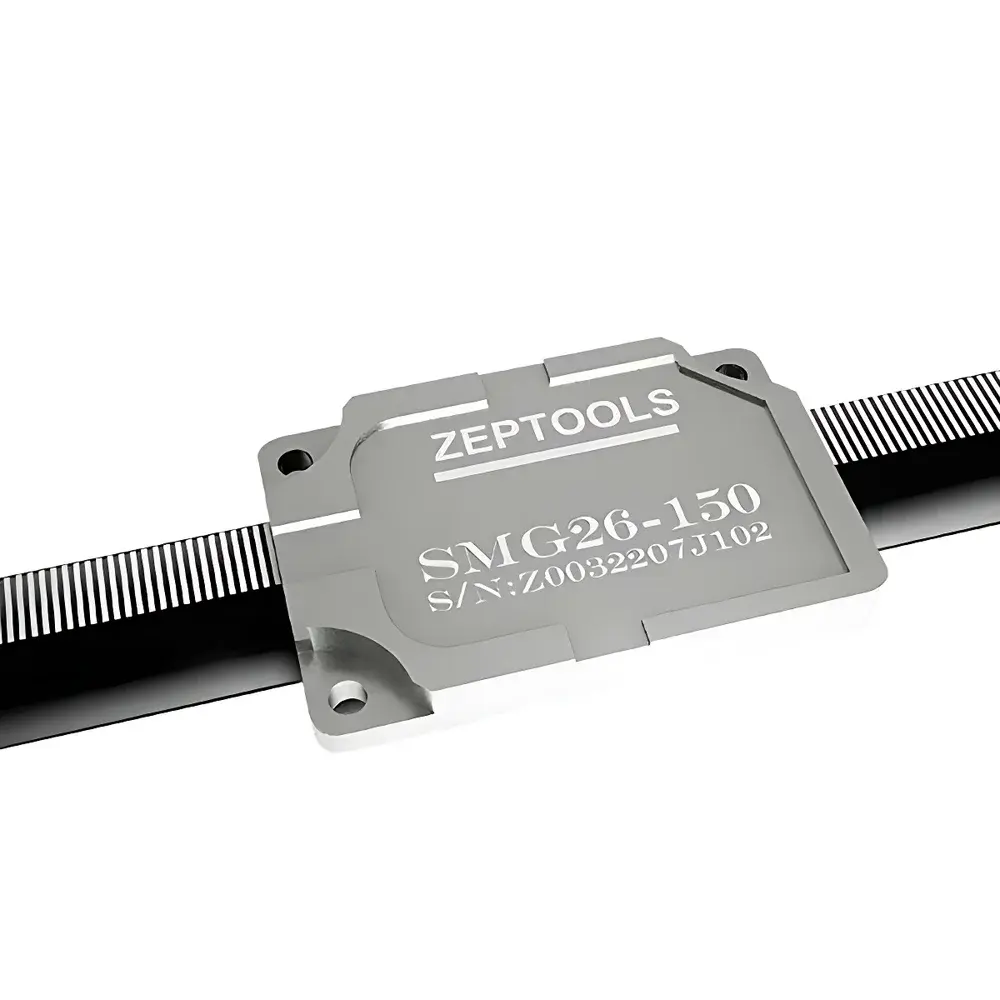
ZEPTOOLS SMG26 Ultra-High Vacuum Miniature Optical Encoder Scale
| Brand | ZEPTOOLS |
|---|---|
| Origin | Guangdong, China |
| Manufacturer Type | Direct Manufacturer |
| Product Category | Optical Component |
| Model | SMG26 |
| Grating Pitch | 256 µm |
| Absolute Accuracy | ±3 µm @ 20 °C |
| Operating Temperature Range | up to 100 °C |
| Subdivision Resolution (with TF15 interface) | 1 nm |
| Material | Low-Thermal-Expansion Glass |
| Installation Tolerance | ±0.1 mm |
| Vacuum Compatibility | UHV (≤10⁻⁹ mbar) |
| Compliance | Designed for UHV-compatible bake-out protocols (≤100 °C) |
Overview
The ZEPTOOLS SMG26 Ultra-High Vacuum Miniature Optical Encoder Scale is a precision position feedback device engineered specifically for integration into ultra-high vacuum (UHV) systems operating at pressures down to 10⁻⁹ mbar. Unlike conventional optical encoders, the SMG26 employs a monolithic low-thermal-expansion glass substrate with a photolithographically defined periodic grating structure (pitch = 256 µm), eliminating outgassing risks associated with adhesives, polymers, or metal substrates. Its measurement principle relies on Moiré interference generated between the fixed scale and a matching readhead—typically used in conjunction with the ZEPTOOLS TF15 interpolation interface—to produce high-fidelity sinusoidal signals. The resulting position data supports both incremental and absolute positioning modes, with thermal stability ensured by the glass substrate’s coefficient of thermal expansion (CTE) < 5 × 10⁻⁷ /°C. This architecture enables stable metrology under sustained UHV bake-out conditions up to 100 °C—a critical requirement for electron microscopy stages, synchrotron beamline components, and cryogenic UHV manipulators.
Key Features
- UHV-compatible construction: All materials—including glass scale, gold-plated copper traces, and ceramic mounting features—meet ASTM E595 total mass loss (TML) < 1.0% and collected volatile condensable materials (CVCM) < 0.10%, validated per ESA/SCC Basic Specification for Space Materials.
- Compact form factor: Dimensions of 26 mm × 8 mm × 2.5 mm (L × W × H) enable integration into space-constrained motion platforms without compromising mechanical rigidity.
- Thermally robust performance: Rated for continuous operation from –20 °C to +100 °C; minimal zero-shift (< ±0.5 µm over full range) due to matched CTE design between scale and compatible readheads.
- High-resolution capability: With the optional TF15 4096× digital interpolation unit, the system delivers 1 nm effective resolution over travel lengths up to 50 mm (custom lengths available).
- Large installation tolerance: ±0.1 mm lateral misalignment allowance simplifies mechanical integration and reduces alignment time during UHV chamber assembly.
- No internal electronics or power requirements on the scale itself—passive, purely optical functionality ensures immunity to electromagnetic interference (EMI) and eliminates heat generation at the measurement point.
Sample Compatibility & Compliance
The SMG26 is compatible with standard UHV-compatible motion stages using linear or rotary encoder interfaces compliant with RS422 differential signaling. It is routinely deployed in scanning tunneling microscope (STM) sample scanners, UHV-compatible nanopositioning piezo stages, and beamline mirror alignment systems. The scale meets ISO 14644-1 Class 1 cleanroom handling protocols and is compatible with standard UHV cleaning procedures including ultrasonic acetone/IPA rinsing and 200 °C inert-gas purged bake-out (though operational rating is limited to 100 °C). While not certified to a specific ISO or IEC standard as a standalone component, its material selection and fabrication process align with ISO 17025-accredited calibration laboratories’ requirements for traceable displacement metrology in vacuum environments.
Software & Data Management
As a passive analog encoder scale, the SMG26 does not include embedded firmware or onboard memory. Position data acquisition is performed externally via industry-standard motion controllers (e.g., Aerotech A3200, PI Mercury Step, or Newport XPS-D series) supporting quadrature or SSI protocols. When paired with the TF15 interface, real-time interpolation and error mapping are handled by the controller’s FPGA layer. All raw signal outputs support GLP-compliant audit trails when integrated with controllers featuring 21 CFR Part 11–compliant logging (e.g., via NI VeriStand or MATLAB Real-Time Workshop). Calibration certificates—including thermal drift characterization and linearity error maps—are provided with each unit and traceable to NIM (National Institute of Metrology, China) standards.
Applications
- Precision positioning in UHV scanning probe microscopy (SPM), including atomic force microscopy (AFM) and scanning tunneling microscopy (STM) coarse/fine approach mechanisms.
- Beamline diagnostics and mirror alignment systems in synchrotron and free-electron laser (FEL) facilities where thermal stability and vacuum integrity are non-negotiable.
- Nanofabrication tool stages requiring sub-micron repeatability under bake-out cycles—e.g., electron-beam lithography column alignment and mask stage metrology.
- Cryogenic UHV experiments involving dilution refrigerators or superconducting quantum devices, where low-outgassing metrology components minimize base-pressure degradation.
- Research-grade vacuum deposition systems requiring closed-loop feedback for shutter, substrate holder, or effusion cell positioning.
FAQ
Is the SMG26 compatible with magnetic or RF-intensive environments?
Yes—the all-glass, passive optical design provides inherent immunity to magnetic fields and RF noise. No ferromagnetic materials or active circuitry are present on the scale.
Can the SMG26 be used in cryogenic UHV systems below 4 K?
While the scale has been tested down to 77 K (liquid nitrogen), long-term performance below 20 K requires validation against thermal contraction mismatch with mounting hardware; contact ZEPTOOLS for application-specific qualification reports.
What is the maximum recommended travel length for the SMG26?
Standard configurations support up to 50 mm; custom lengths up to 200 mm are available with revised linearity compensation and extended calibration documentation.
Does the SMG26 require periodic recalibration?
No—its passive, thermally stable glass substrate ensures long-term zero-point retention. However, end-user system-level calibration (including readhead alignment and interpolation offset) is recommended after any mechanical rework or thermal cycling beyond specification limits.
Is the TF15 interface required to achieve 1 nm resolution?
Yes—1 nm resolution is only attainable when the SMG26 is used with the ZEPTOOLS TF15 4096× interpolation module and a compatible controller supporting 32-bit position counters and sub-nanometer phase tracking algorithms.



