
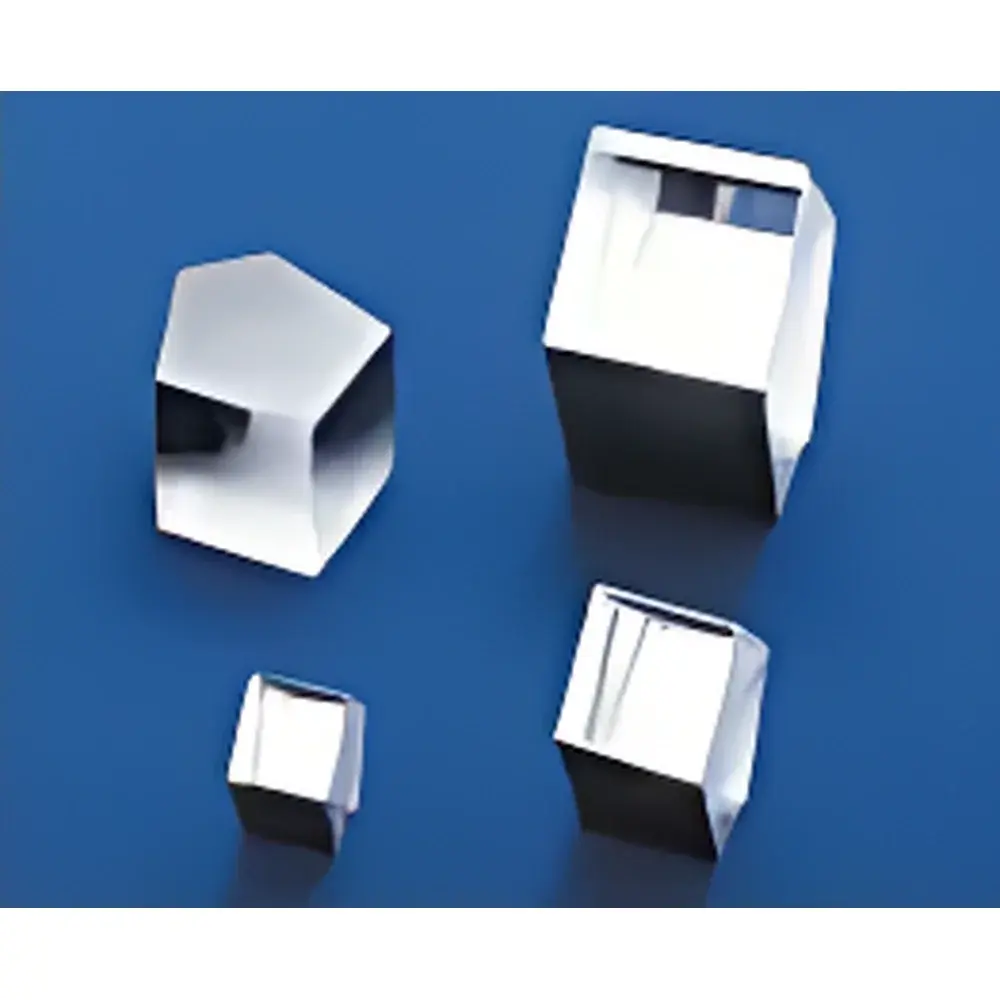
ZOLIX Optical Prisms (OPR Series, OPRM Series, OPRC Series, and Imported Dove / Pentaprism / Corner Cube Components)
| Brand | ZOLIX |
|---|---|
| Origin | Beijing, China |
| Manufacturer Type | Direct Manufacturer |
| Origin Category | Domestic |
| Models | OPR Series (Right-Angle, Equilateral, Pentaprism, Corner Cube), OPRM20-20, OPRC25.4-19, PPB-10-4 to PPB-25-4, SIGMA Dove Prism, CCH-25.4-1-LEBG, etc. |
| Material Options | K9, ZF2, BK7 optical glass |
| Surface Accuracy | λ/4 typical |
| Reflective Coating | Enhanced aluminum + black paint (PPB series), uncoated or custom AR/HR options available |
| Angular Tolerance | ≤3 arcminutes (pentaprisms), ≤5 arcseconds (corner cubes) |
| Beam Deviation | ≤5″ for corner cube retroreflectors |
| Compliance | ISO 10110-7, MIL-PRF-13830B surface quality standards |
Overview
ZOLIX optical prisms are precision-engineered passive optical components designed for beam steering, image inversion, polarization management, spectral dispersion, and retroreflection in laboratory, industrial, and metrological applications. Based on fundamental principles of total internal reflection (TIR) and Snell’s law, these prisms leverage high-homogeneity optical substrates—primarily K9, ZF2, and BK7—to achieve predictable ray deviation with minimal wavefront distortion. The OPR series includes right-angle, equilateral, pentaprism, and corner-cube configurations, each optimized for specific functional roles: right-angle prisms (OPRA) provide 90° beam folding; equilateral prisms (OPRE) enable wavelength-dependent dispersion for spectroscopic setups; pentaprisms (OPRM) deliver stable 90° deflection independent of rotational alignment; and corner-cube retroreflectors (OPRC, CCH) ensure precise 180° return of incident light regardless of input angle—critical in interferometry, laser alignment, and distance measurement systems.
Key Features
- Manufactured to ISO 10110-7 surface quality specifications (scratch-dig 20–10 typical) and MIL-PRF-13830B compliance for demanding optical environments.
- High-precision angular tolerances: ≤3′ for pentaprisms (PPB series), ≤5″ for corner-cube retroreflectors—ensuring sub-arcsecond beam stability in alignment-critical applications.
- Standard surface flatness of λ/4 at 632.8 nm, verified via interferometric testing; optional λ/10 or λ/20 available upon request.
- Material selection aligned with application requirements: K9 for general-purpose visible transmission, ZF2 for enhanced dispersion in spectroscopy, BK7 for imported-grade corner cubes and Dove prisms.
- Robust mechanical design with chamfered edges and stress-relieved mounting interfaces—compatible with standard kinematic mounts and lens tubes (e.g., Thorlabs SM1, RMS threads).
- Custom coating options include broadband anti-reflection (BBAR) coatings (350–1100 nm), high-reflection (HR) dielectric stacks, and protected aluminum with black epoxy masking for stray-light suppression.
Sample Compatibility & Compliance
ZOLIX prisms are compatible with collimated beams ranging from UV (250 nm) to NIR (1100 nm), depending on substrate and coating selection. Right-angle and pentaprism variants support continuous-wave and pulsed laser sources up to 5 J/cm² (10 ns, 1064 nm) when uncoated or AR-coated. Corner-cube retroreflectors (OPRC, CCH series) maintain specified angular deviation under thermal cycling (−20 °C to +60 °C) and mechanical shock (50 g, 11 ms half-sine pulse), meeting IEC 60068-2 environmental test standards. All domestically manufactured units comply with China’s GB/T 2828.1 sampling inspection protocols; imported SIGMA components meet EU RoHS Directive 2011/65/EU and REACH Annex XVII requirements. Documentation includes traceable calibration certificates (NIST-traceable interferometry), material certification (ASTM F273), and surface quality reports per ISO 10110-5.
Software & Data Management
While ZOLIX prisms are passive components requiring no embedded firmware or driver software, comprehensive optical design integration is supported via industry-standard file formats. Zemax OpticStudio (.zmx), CODE V (.seq), and FRED (.frd) models are available for all standard OPR and PPB geometries—including exact vertex coordinates, refractive index data (Schott catalog nd, νd), and coating spectral reflectance curves. Design libraries include paraxial ray-trace validation scripts and tolerance analysis templates compliant with ISO 10110-8. For GMP/GLP-regulated environments, full traceability documentation—including lot-specific material certificates, interferogram archives, and QC inspection logs—is provided in PDF/A-1b format with digital signatures adhering to FDA 21 CFR Part 11 electronic record requirements.
Applications
- Spectroscopy: Equilateral prisms (OPRE32-22, ZF2) serve as dispersive elements in monochromators and compact spectrometers, enabling resolution down to 0.5 nm FWHM in Czerny–Turner configurations.
- Laser Interferometry: Corner-cube retroreflectors (OPRC25.4-19, CCH-63.5-5-LEBG) function as reference targets in heterodyne and homodyne interferometers, maintaining phase coherence across ±5° incidence angles.
- Imaging Systems: Dove prisms rotate inverted images by 2× the prism rotation angle—enabling real-time field-rotation correction in astronomical telescopes and endoscopic imaging platforms.
- Industrial Metrology: Pentaprisms (PPB-25-4) stabilize beam paths in coordinate measuring machines (CMMs) and laser trackers, eliminating sensitivity to mount misalignment during multi-axis scanning.
- Defense & Aerospace: Hermetically sealed corner-cube arrays (CCH series) operate in vacuum environments (10⁻⁶ Torr) and survive vibration spectra per MIL-STD-810H Method 514.7, Category 24.
FAQ
What is the difference between a right-angle prism and a pentaprism?
A right-angle prism uses a single internal reflection to deviate light by 90°, but its output direction shifts with small rotational errors. A pentaprism employs two non-orthogonal reflections to produce a fixed 90° deviation independent of angular orientation—making it ideal for alignment-critical applications.
Can ZOLIX corner-cube prisms be used with femtosecond lasers?
Yes—when specified with fused silica substrates and chirped mirror coatings, ZOLIX retroreflectors support pulse durations down to 30 fs without measurable group delay dispersion (GDD) accumulation.
Do you provide interferometric test reports for each prism shipment?
Yes—every batch undergoes full-aperture Twyman–Green interferometry; reports include PV wavefront error, RMS slope error, and fringe contrast ratio—all archived for 10 years per ISO 9001:2015 clause 8.5.2.
Is custom AR coating available for UV applications below 250 nm?
Yes—MgF₂-based single-layer or multilayer coatings can be applied to CaF₂ or synthetic fused silica substrates, with reflectance 10 J/cm² (20 ns pulse).
How is thermal stability characterized for high-power laser use?
Thermal lensing coefficients (dn/dT) and coefficient of thermal expansion (CTE) are measured per ASTM E228; data sheets include predicted focal shift versus power load for CW operation up to 500 W/cm².





