
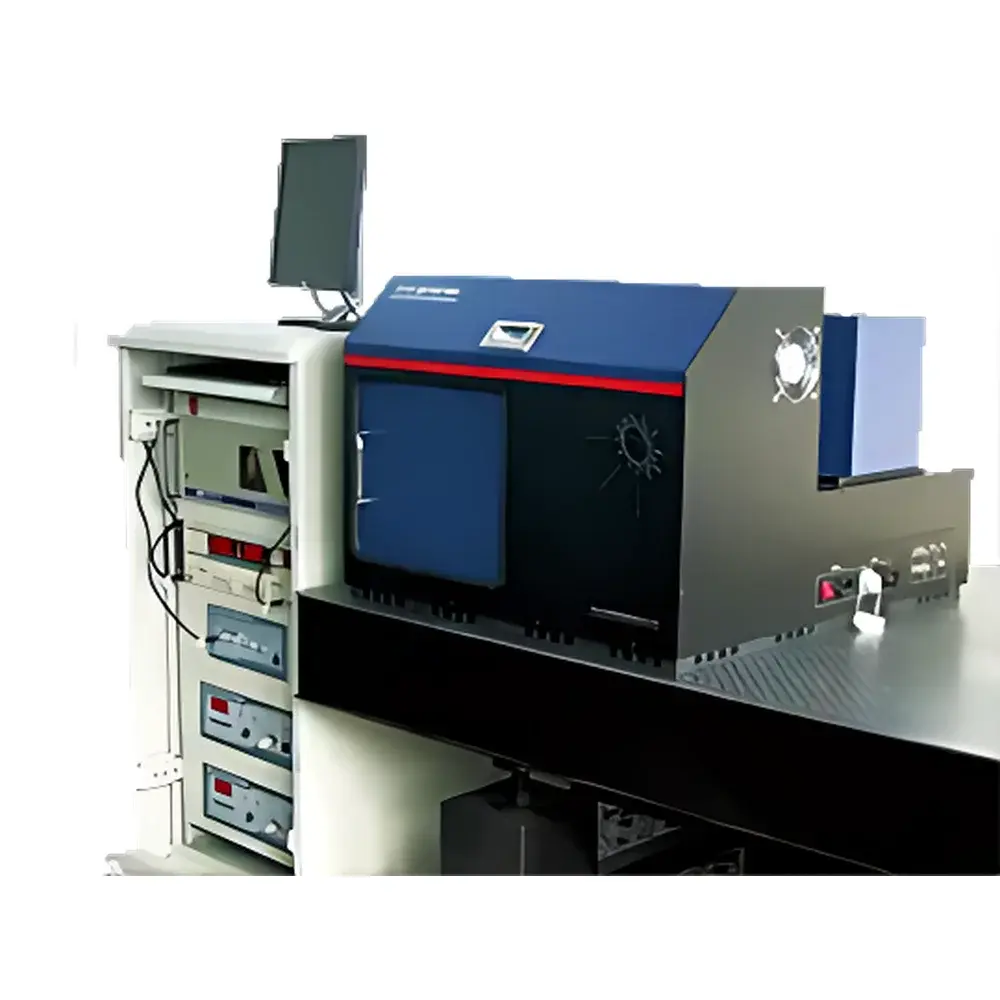
ZOLIX SCS100 Series Quantum Efficiency Measurement System
| Brand | ZOLIX |
|---|---|
| Origin | Beijing, China |
| Manufacturer Type | Original Equipment Manufacturer (OEM) |
| Product Line | SCS100 Series |
| Measurement Mode | DC |
| Spectral Range | 300–1100 nm (extendable to 1700 nm) |
| Max Sample Size | 156 mm × 156 mm |
| Compliance | IEC 60904-8, IEC 60904-9, ASTM E1021 |
| Data Export Formats | ASCII, CSV, Excel (.xlsx), XML |
| Software Architecture | Windows-based GUI with configuration file portability and audit-ready data logging |
Overview
The ZOLIX SCS100 Series Quantum Efficiency Measurement System is a precision optical-electronic characterization platform engineered for quantitative spectral responsivity analysis of photovoltaic devices. Based on monochromatic photon flux calibration and lock-in amplified photocurrent detection under controlled bias conditions, the system implements standardized external quantum efficiency (EQE), internal quantum efficiency (IQE), and spectral responsivity (SR) measurements in accordance with IEC 60904-8 (measurement of spectral response of PV devices) and IEC 60904-9 (classification of solar simulators). Its dual-lamp illumination architecture—comprising a high-stability xenon arc lamp for UV–visible coverage (300–800 nm) and a tungsten-halogen lamp for near-infrared extension (700–1700 nm)—ensures spectrally continuous, IEC-compliant irradiance across the full operational range of crystalline silicon, perovskite, CIGS, organic, and tandem solar cells. The system operates exclusively in DC measurement mode, enabling stable, low-noise current integration without phase-sensitive demodulation artifacts—ideal for laboratory-grade EQE validation, process development, and R&D benchmarking where absolute photocurrent linearity and long-term repeatability are critical.
Key Features
- Dual-source spectral illumination: Xenon and tungsten-halogen lamps with automatic spectral band switching; <0.8% irradiance instability over 1000 s per wavelength step
- High-fidelity monochromator: Grating-based wavelength selection with ±0.2 nm wavelength repeatability and <1 nm bandwidth (FWHM)
- DC-mode photocurrent acquisition: Precision electrometer-grade current measurement with 10 fA resolution and 6½-digit digitization
- Integrated reflectance/absorptance correction: Simultaneous measurement of sample reflectance (R) and transmittance (T) enables accurate IQE derivation via IQE = EQE / (1 − R − T)
- Modular sample stage: Motorized XYZ translation with vacuum chuck support for rigid 156 mm × 156 mm wafers or modules; compatible with front- and rear-illumination configurations
- Calibration traceability: NIST-traceable Si and InGaAs reference detectors for absolute photon flux calibration at discrete wavelengths (300–1700 nm)
Sample Compatibility & Compliance
The SCS100 supports all mainstream photovoltaic technologies—including monocrystalline and multicrystalline silicon, thin-film CdTe and CIGS, perovskite single-junction and tandem cells, and organic photovoltaics (OPV). It accommodates both bare wafers and encapsulated mini-modules up to 156 mm square. All measurement protocols adhere to international photovoltaic standards: IEC 60904-8 for spectral responsivity, IEC 60904-3 for reference cell calibration, and ASTM E1021 for quantum efficiency data reporting. The system’s optical design satisfies Class AAA requirements per IEC 60904-9 for spatial uniformity (>95%), temporal stability (<2%), and spectral match (±12.5% deviation from AM1.5G). Full compliance documentation—including calibration certificates, uncertainty budgets, and test reports—is provided for GLP/GMP-aligned laboratories requiring audit readiness.
Software & Data Management
The Windows-native control software features a modular, tabbed interface: one panel for real-time instrument control (lamp selection, monochromator scan, bias voltage sweep), another for parameter configuration (integration time, averaging cycles, wavelength step size, dark current subtraction). Each test configuration is saved as an encrypted .cfg file—portable across identical SCS100 installations and version-controlled for SOP adherence. Raw data streams (wavelength, incident photon flux, measured photocurrent, reflectance, bias voltage) are timestamped and stored with metadata (operator ID, sample ID, ambient temperature/humidity, calibration date). Export options include ASCII (tab-delimited), Excel (.xlsx), and XML schema-compliant files for seamless ingestion into MATLAB, Python (Pandas), OriginLab, or JMP. Audit trails record all user actions, parameter changes, and calibration events—fully compliant with FDA 21 CFR Part 11 requirements when configured with electronic signature modules.
Applications
- Quantitative EQE/IQE mapping for defect localization and minority carrier diffusion length estimation
- Process optimization of anti-reflection coatings, emitter doping profiles, and passivation layers
- Validation of tandem cell subcell current matching via integrated Jsc calculation
- Reflectance and LBIC (Light Beam Induced Current) spatial profiling for non-destructive wafer-level quality screening
- Material characterization of novel absorbers (e.g., perovskites, quantum dots) under monochromatic excitation
- Interlaboratory round-robin testing and certified reference material verification
FAQ
What standards does the SCS100 comply with for quantum efficiency measurement?
The system conforms to IEC 60904-8 (spectral responsivity), IEC 60904-9 (solar simulator classification), ASTM E1021 (QE data reporting), and ISO/IEC 17025 for calibration traceability.
Can the system measure both EQE and IQE simultaneously?
Yes—integrated reflectance and transmittance measurements enable real-time IQE calculation using the standard formula IQE(λ) = EQE(λ) / [1 − R(λ) − T(λ)].
Is the software compatible with automated data analysis pipelines?
Yes—ASCII and XML exports support direct ingestion into Python, MATLAB, and statistical analysis platforms; configuration files (.cfg) ensure reproducible test setups across instruments.
What is the maximum sample size supported?
The standard stage accommodates samples up to 156 mm × 156 mm; custom stages for larger substrates (e.g., 210 mm wafers) are available upon request.
Does the system support bias light illumination during QE measurement?
Yes—it includes programmable DC bias light control (white or monochromatic) for quasi-steady-state EQE under realistic operating conditions, in accordance with IEC 60904-8 Annex B.





