
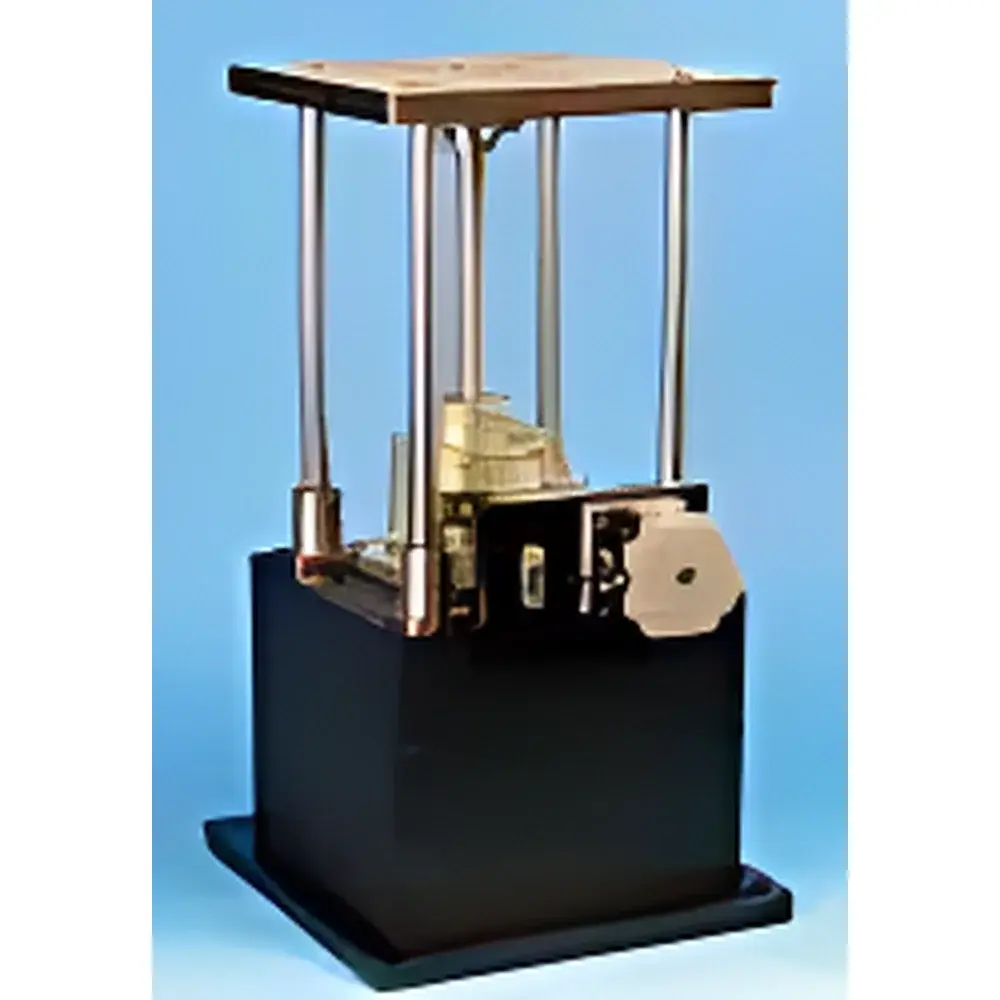
ZOLIX PSAV30-ZF & PSAV100-ZF Precision Motorized Vertical Translation Stages
| Brand | ZOLIX |
|---|---|
| Model | PSAV30-ZF / PSAV100-ZF |
| Travel | 30 mm / 100 mm |
| Platform Size | 238 × 238 mm (customizable) |
| Max. Load Capacity | 300 kg (with high-torque motor option) |
| Drive Mechanism | Self-locking trapezoidal screw + precision worm-gear reduction (21:2 ratio) |
| Guidance | Four linear ball-bearing rails |
| Max. No-load Speed | 5 mm/s |
| Stepper Motor | 57 mm frame, 1.8° step angle, 2.4 A rated current |
| Limit Switches | 2 mechanical end-of-travel switches |
| Manual Adjustment | Integrated rear-mounted handwheel |
| Compliance | Designed for ISO/IEC 17025-aligned optical alignment workflows |
| Interface | Standard DB9 connector |
Overview
The ZOLIX PSAV30-ZF and PSAV100-ZF are high-load-capacity, precision motorized vertical translation stages engineered for demanding Z-axis positioning in optical laboratory environments. These stages operate on a dual-stage mechanical principle: motion is generated by a stepper motor driving a self-locking trapezoidal lead screw, which is further decoupled and amplified via a 21:2 precision worm-gear reduction gearbox. This architecture ensures inherent mechanical self-locking—eliminating load drift during power loss or system idle states—a critical requirement for stable optical path length maintenance in interferometry, laser cavity alignment, and multi-axis metrology setups. The four parallel linear ball-bearing rails provide over-constrained guidance, distributing axial and moment loads uniformly across the stage structure and minimizing pitch/yaw deviation under heavy static or dynamic loading. Each unit is assembled and verified under controlled environmental conditions using calibrated torque wrenches, laser interferometric travel verification, and preload consistency checks—ensuring batch-to-batch repeatability within ±1.5 µm positional stability over 10⁴ cycles.
Key Features
- Self-locking trapezoidal screw combined with worm-gear reduction (21:2 ratio) delivers intrinsic holding torque—no brake or power-hold circuit required.
- Four-point linear bearing rail guidance ensures sub-arcsecond angular stability (< 3 arcsec tilt over full stroke) even at maximum rated load (80 kg center-loaded; up to 300 kg with optional high-torque motor).
- Rear-mounted manual handwheel enables precise fine-tuning without motor power—critical for alignment-sensitive applications such as grating monochromator calibration or objective lens focus mapping.
- Standard DB9 interface supports seamless integration with ZOLIX’s range of motion controllers (e.g., MCL-3, EPC-100), as well as third-party systems compliant with RS-422/step-direction protocols.
- Dual mechanical limit switches (NO/NC configurable) provide hardware-level end-of-travel protection—fully independent of controller firmware or software logic.
- Modular platform design accommodates custom mounting plates (up to 300 × 300 mm footprint); tapped M6 and M4 patterns standard for optical post, cage system, or kinematic base attachment.
Sample Compatibility & Compliance
These stages are routinely deployed in ISO 14644 Class 5 cleanrooms and GLP-compliant spectroscopy labs where positional integrity directly impacts measurement traceability. Their rigid aluminum alloy housing (6061-T6 anodized) resists thermal drift (coefficient of linear expansion: 23.6 µm/m·K) and maintains dimensional stability across ambient lab temperatures (15–30 °C). All electrical components meet IEC 61000-6-2 EMC immunity standards and UL 61010-1 safety requirements. Mechanical design adheres to ISO 9283 for repeatability testing methodology; factory certification reports include bidirectional repeatability (≤ ±0.8 µm), hysteresis (< 1.2 µm), and minimum incremental movement (1.25 µm per full step at 1.8° motor resolution).
Software & Data Management
Stage control is fully supported through ZOLIX’s ZMotion SDK (C/C++, Python, LabVIEW APIs) and GUI-based ZController software. All motion commands generate timestamped audit logs—including position setpoints, actual encoder-derived feedback (via optional rotary encoder upgrade), motor current draw, and limit switch status—enabling full 21 CFR Part 11 compliance when paired with validated electronic signature modules. Firmware supports non-volatile parameter storage (travel limits, acceleration profiles, microstepping mode), eliminating reconfiguration after power cycling. Remote operation via TCP/IP or USB virtual COM port allows integration into automated optical characterization sequences (e.g., spectral response mapping, beam profiling sweeps).
Applications
- Precision Z-height adjustment of large-format optical elements (e.g., 200-mm-diameter gratings, collimating mirrors, or vacuum-compatible viewports).
- Vertical positioning of heavy detector assemblies in FTIR spectrometers or Raman microscope stages.
- Load-bearing sample elevation in in-situ XRD or synchrotron beamline end-stations requiring sub-micron Z-reproducibility under 100+ kg payload.
- Integration into multi-axis goniometers for polarization-resolved ellipsometry where gravitational sag must be actively compensated.
- Calibration reference platforms for coordinate measuring machines (CMMs) and laser tracker systems requiring verified vertical displacement traceability to NIST SRM 2036.
FAQ
What is the maximum safe static load without motor power?
The self-locking mechanism guarantees zero creep under ≤80 kg center-loaded condition at room temperature; higher loads require verification of motor holding torque and thermal derating.
Can these stages be used in vacuum environments?
Standard units are air-cooled and not vacuum-rated; however, vacuum-compatible variants (CF flange mount, stainless steel shafts, dry-lubricated bearings) are available upon engineering review.
Is backlash compensation supported in firmware?
Yes—bidirectional backlash correction (0–50 µm adjustable) is implemented in ZController v3.2+ and accessible via API command “SET_BACKLASH” with real-time validation feedback.
Do you provide calibration certificates with NIST-traceable data?
Factory calibration reports (including linearity, repeatability, and hysteresis) are included; NIST-traceable calibration with uncertainty budgets is offered as an optional service (ISO/IEC 17025 accredited lab).
What controller models are recommended for high-speed synchronized multi-axis operation?
The EPC-100 EtherCAT motion controller supports coordinated Z-axis interpolation with up to 7 additional axes at 1 kHz update rate and < 100 µs jitter—ideal for adaptive optics wavefront correction loops.



