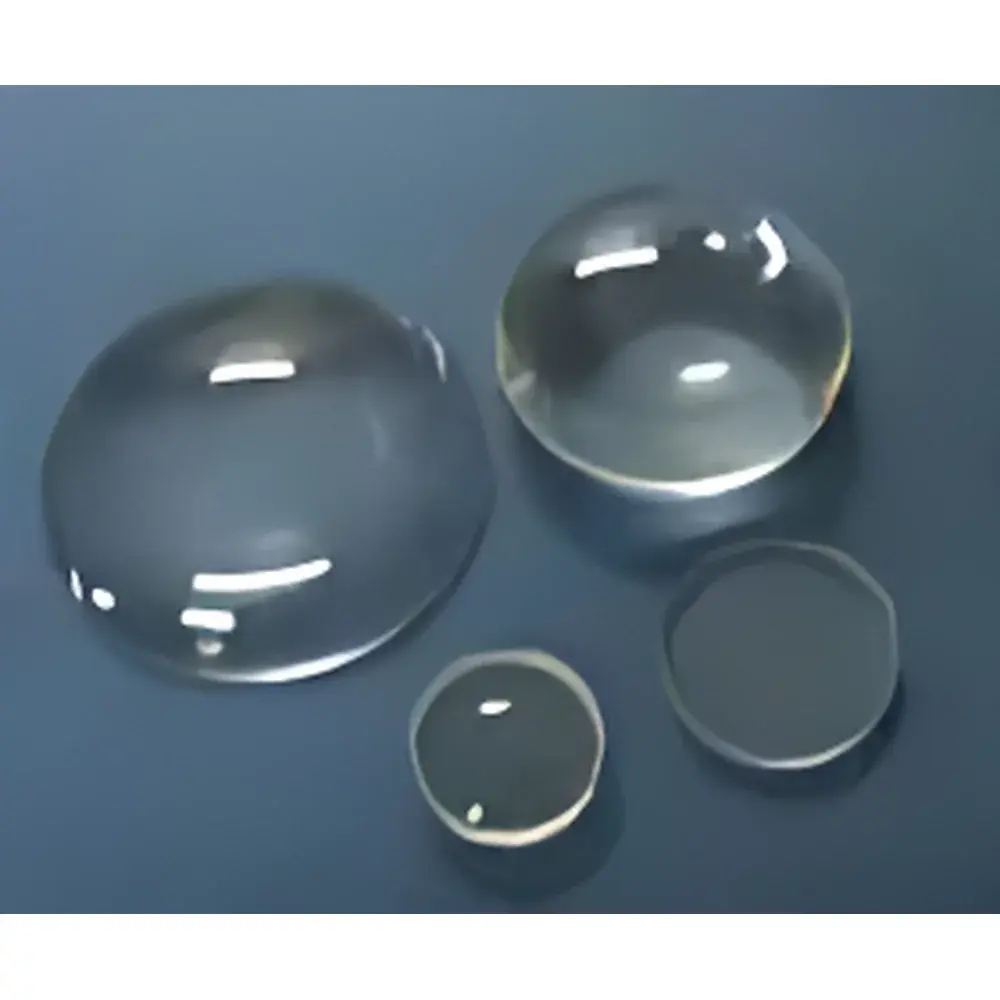
ZOLIX OLB Series Plano-Convex and Bi-Convex Lenses (K9 Glass & Fused Silica)
| Brand | ZOLIX |
|---|---|
| Origin | Beijing, China |
| Manufacturer Type | Original Equipment Manufacturer (OEM) |
| Product Origin | Domestic (China) |
| Model | OLB / OLA / OLBQ / OLAQ / OLBC |
| Pricing | Available Upon Request |
Overview
The ZOLIX OLB, OLA, OLBQ, OLAQ, and OLBC series comprise precision-crafted plano-convex and bi-convex optical lenses engineered for laboratory-grade imaging, beam shaping, collimation, focusing, and spectral system integration. These lenses operate on the fundamental principle of refraction—governed by Snell’s law—and are optimized for minimal spherical aberration in monochromatic or broadband visible-to-near-UV applications. All plano-convex variants feature a flat surface on one side and a spherical convex surface on the other, providing asymmetric power distribution ideal for collimating divergent sources or focusing parallel beams. Bi-convex lenses (OLA/OLAQ), with symmetrical curvature on both surfaces, deliver balanced focal performance and are preferred where object and image distances are comparable. Designed to ISO 10110-1 and ISO 10110-2 standards for surface form and surface quality, these components support rigorous optical prototyping, educational labs, OEM instrumentation, and research-grade setups requiring traceable geometric and material fidelity.
Key Features
- Two high-purity substrate options: K9 optical crown glass (refractive index nd = 1.5168 @ 587.6 nm) and UV-grade fused silica (nd = 1.4585 @ 587.6 nm), enabling operation from 350 nm to 2.0 µm (K9) or 185 nm to 2.2 µm (fused silica)
- Precision-ground and polished surfaces meeting λ/4 wavefront accuracy (RMS) and scratch-dig specification of 60–40 per MIL-PRF-13830B
- Tight dimensional tolerances: diameter tolerance +0.0 / −0.1 mm; center thickness tolerance ±0.2 mm; effective focal length (EFL) tolerance ±2% (verified at design wavelength 587.6 nm)
- Standard edge treatment: 0.2 mm × 45° chamfer to prevent chipping and reduce stray light
- Uncoated configuration as standard—compatible with custom AR, V-coat, or broadband anti-reflection coatings upon request (e.g., MgF₂, SiO₂/TiO₂ multilayer, or ion-beam-sputtered stacks)
- Comprehensive modular catalog covering diameters from Φ12.7 mm to Φ76.2 mm and focal lengths ranging from 25 mm to 2000 mm across plano-convex, bi-convex, and plano-convex cylindrical configurations
Sample Compatibility & Compliance
These lenses are compatible with standard optomechanical mounts (e.g., SM1- and SM2-threaded lens tubes, kinematic lens holders, and translation stages) and integrate seamlessly into laser cavities, spectrometer input optics, fluorescence microscope relay paths, and Fourier-transform optical benches. All K9 and fused silica substrates comply with RoHS Directive 2011/65/EU and REACH Regulation (EC) No. 1907/2006. Manufacturing adheres to ISO 9001:2015 quality management systems. While not certified to ISO/IEC 17025, dimensional and EFL verification is performed using calibrated interferometric and auto-collimation test stations traceable to NIM (National Institute of Metrology, China). Documentation includes individual lens certificates listing measured EFL, radius of curvature (ROC), and surface irregularity.
Software & Data Management
No embedded firmware or proprietary software is required—these are passive optical components. However, full technical specifications—including paraxial ray transfer matrices, Gaussian beam propagation data, and spot diagram simulations—are provided in standardized PDF datasheets compliant with IEC 61000-4-3 EMC immunity guidelines for documentation integrity. Lens prescription files (.zmx, .seq) for Zemax OpticStudio and CODE V are available upon request for system-level modeling. For traceability in regulated environments (e.g., GLP-compliant spectroscopy labs), batch-level calibration records and material lot traceability can be supplied under NDA.
Applications
- Laser beam expansion and collimation in DPSS, diode, and fiber-coupled systems
- Focusing optics in confocal microscopy, Raman spectroscopy, and LIBS excitation pathways
- Imaging relays and field flattening elements in custom-designed telescopes and endoscopes
- Optical pumping and cavity mode matching in ultrafast amplifier systems
- Educational use in undergraduate optics laboratories for Abbe number measurement, focal length verification, and aberration analysis
- Cylindrical variants (OLBC) enable line generation, anamorphic beam correction, and astigmatic focus control in laser scanning and lithography alignment subsystems
FAQ
What is the difference between plano-convex and bi-convex lenses in terms of optical performance?
Plano-convex lenses minimize spherical aberration when oriented with the convex surface toward the collimated input beam; they are optimal for focusing parallel light. Bi-convex lenses offer symmetric performance and are preferred when object and image distances are similar—such as in 1:1 imaging or finite-conjugate applications.
Can these lenses be used in vacuum or high-temperature environments?
Fused silica variants (OLBQ/OLAQ) exhibit low thermal expansion (α ≈ 0.55 × 10⁻⁶ /K) and outgas minimally, making them suitable for UHV-compatible optical trains up to 300 °C. K9 lenses are rated for ambient operation only (−10 °C to +50 °C).
Is custom coating available, and what wavelengths are supported?
Yes—single-layer MgF₂ (broadband 400–700 nm), V-coats (±5 nm bandwidth at specified λ), and multi-layer AR stacks (e.g., 350–1100 nm, R<0.25% avg) can be applied. Coating specifications conform to ISO 9211-3 for durability and environmental stability.
Do you provide mounting solutions or lens cells?
Standard SM-threaded lens mounts (SM1A10, SM2A10) and kinematic cage plates (e.g., CP33/M) are recommended and widely available through global optical distributors; ZOLIX does not supply mechanical housings but provides mechanical drawings for third-party integration.
How is focal length verified, and what uncertainty is associated with the ±2% tolerance?
EFL is measured via nodal slide method using a collimated HeNe laser (632.8 nm) and autocollimator; the ±2% reflects combined uncertainty from instrument repeatability (±0.3%), environmental drift (±0.2%), and lens centering error (±1.5%), per GUM (JCGM 100:2018).