
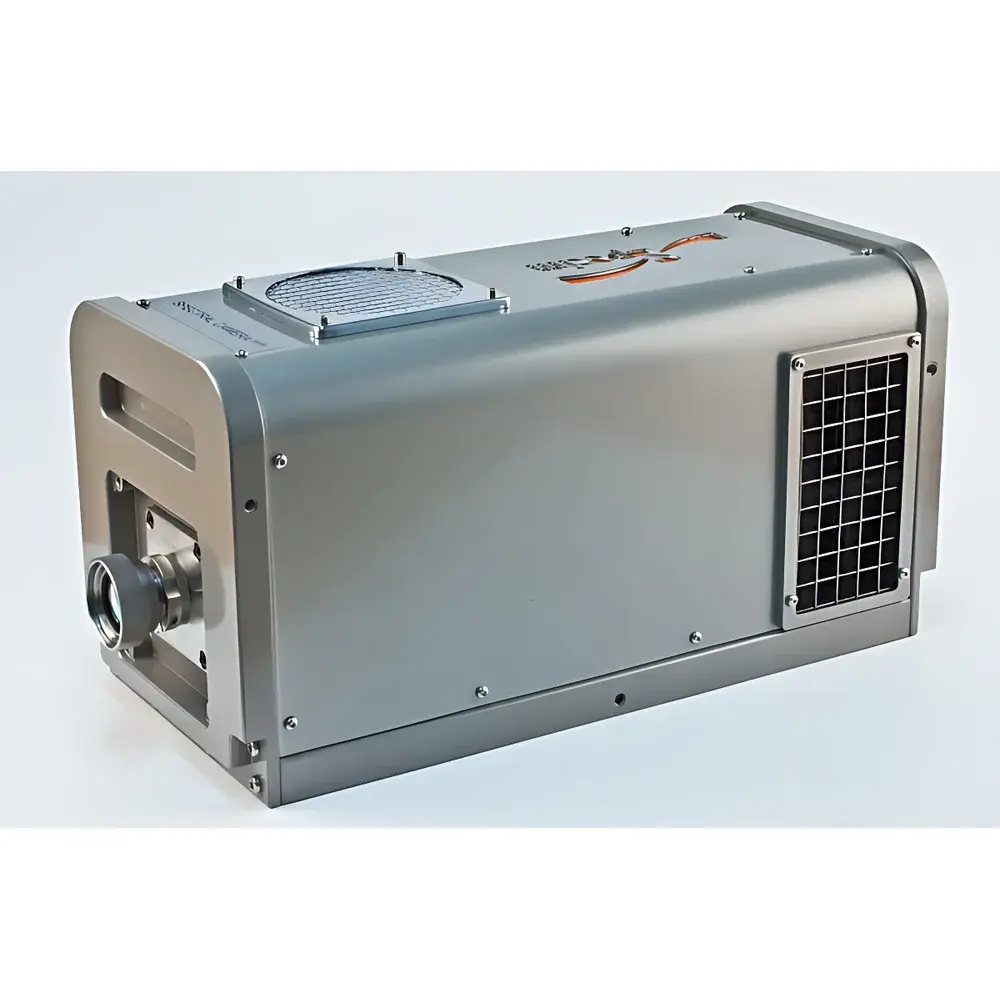
Specim SWIR Spectral Camera
| Origin | Beijing, China |
|---|---|
| Manufacturer Type | Authorized Distributor |
| Origin Category | Domestic (China) |
| Model | SWIR Spectral Camera |
| Pricing | Upon Request |
| Spectral Range | 1000–2500 nm |
| Spectral Resolution | 12 nm (with 30 µm slit) |
| Spectral Sampling Interval | 5.6 nm |
| Spatial Resolution | <15 µm (RMS) |
| F/# | F/2.0 |
| Slit Width | 30 µm (50 µm and 80 µm optional) |
| Effective Slit Length | 9.2 mm |
| Sensor | Stirling-cooled MCT |
| Spectral Channels | 288 |
| Max Frame Rate | 400 fps |
| Spatial Dimension | 384 pixels |
| Output Format | 16-bit Camera Link |
| SNR (peak) | 900:1 |
| Exposure Time | 0.1–20 ms |
| Power Consumption | <50 W (24 V DC input) |
| Operating Temperature | +5 to +40 °C |
| Storage Temperature | −20 to +50 °C |
Overview
The Specim SWIR Spectral Camera is a high-performance, push-broom hyperspectral imaging system engineered for quantitative spectral analysis in the short-wave infrared (SWIR) range (1000–2500 nm). Based on cooled mercury cadmium telluride (MCT) detector technology and integrated with a Stirling micro-cooler, this camera delivers exceptional signal fidelity and thermal stability—enabling precise material identification and compositional mapping under demanding field and laboratory conditions. Unlike uncooled InGaAs alternatives, the Stirling-cooled architecture ensures consistent dark current suppression and minimizes thermal drift over extended acquisition periods, making it suitable for applications requiring high reproducibility and long-term calibration stability. Released in 2014 as part of Specim’s next-generation spectral imaging platform, it represents a significant advancement in frame rate, spatial sampling density, and system-level power efficiency within the SWIR domain.
Key Features
- High-speed hyperspectral acquisition: Supports up to 400 full-frame spectra per second at native 384 × 288 spatial-spectral resolution—enabling real-time process monitoring and dynamic scene capture.
- Enhanced spatial fidelity: 384-pixel spatial dimension provides ~20% greater linear sampling density than conventional 320-pixel SWIR line sensors, improving edge definition and sub-pixel feature discrimination.
- Stirling-cooled MCT detector: Maintains detector operating temperature below −196 °C, achieving peak signal-to-noise ratio (SNR) of 900:1—critical for low-contrast spectral differentiation in reflective or low-emissivity samples.
- Optimized optical design: F/2.0 aperture and selectable slit widths (30 µm standard; 50 µm and 80 µm optional) allow flexible trade-offs between spectral resolution (12 nm @ 30 µm), light throughput, and depth-of-field requirements.
- Low-power embedded architecture: Total system power draw <50 W at 24 V DC enables integration into mobile platforms, UAV-mounted payloads, and battery-operated field instruments without thermal or logistical compromise.
- Robust mechanical and thermal design: Rated for continuous operation between +5 °C and +40 °C, with storage tolerance from −20 °C to +50 °C—validated for industrial environments and outdoor deployment.
Sample Compatibility & Compliance
The SWIR Spectral Camera is compatible with solid, granular, and semi-solid samples exhibiting characteristic absorption features in the 1000–2500 nm region—including C–H, O–H, and N–H vibrational overtones. It supports non-contact, non-destructive analysis across diverse substrates such as polymers, pharmaceutical tablets, mineral surfaces, agricultural biomass, and pigment layers in cultural heritage objects. The system adheres to IEC 61000-6-2 (immunity) and IEC 61000-6-4 (emissions) standards for industrial electromagnetic compatibility. While not intrinsically certified for hazardous locations, its sealed optical path and low-voltage operation support integration into Class I, Division 2 compliant enclosures when deployed in regulated manufacturing settings.
Software & Data Management
Data acquisition and preprocessing are supported via Specim’s proprietary IQ Engine software suite, which provides real-time spectral cube streaming, radiometric calibration, and geometric correction tools. Raw 16-bit Camera Link output is fully compatible with third-party platforms including MATLAB, ENVI, Python (via hyperspy and scikit-image), and LabVIEW. The system supports time-stamped metadata embedding (exposure, integration time, temperature, shutter status) and is compatible with audit-trail-enabled workflows aligned with FDA 21 CFR Part 11 requirements when deployed with validated software configurations and electronic signature controls. Calibration certificates traceable to NIST standards are available upon request for GLP/GMP-compliant laboratories.
Applications
- Industrial sorting & recycling: Real-time discrimination of polymer types (e.g., PET vs. PVC, black plastics) based on overtone absorption signatures at 1200–1800 nm.
- Pharmaceutical QA/QC: Blend uniformity assessment, coating thickness verification, and API quantification in tablet cores using multivariate regression models trained on reference spectra.
- Mining & geosciences: Hyperspectral mineral mapping (e.g., kaolinite, montmorillonite, gypsum) via diagnostic absorption features near 1400, 1900, and 2200 nm.
- Precision agriculture: Crop stress detection (water deficit, nitrogen deficiency) through reflectance indices derived from SWIR band ratios.
- Cultural heritage science: Non-invasive pigment identification, underdrawing visualization, and varnish layer characterization in paintings and manuscripts.
- Food safety & quality: Detection of adulterants (e.g., melamine in milk powder), moisture content estimation, and bruise/sunburn classification in fruits and vegetables.
FAQ
Is the SWIR Spectral Camera compatible with existing Specim optics and illumination systems?
Yes—it shares mechanical and electrical interfaces with Specim’s FX and IQ series, supporting interchangeable fore-optics (e.g., VNIR-SWIR telecentric lenses, macro objectives) and synchronized halogen or quartz-tungsten-halogen (QTH) illumination modules.
What calibration options are available?
Factory-provided radiometric and spectral calibration files are included. Optional NIST-traceable reflectance standards (e.g., Spectralon® panels) and custom calibration services for application-specific spectral libraries are available.
Can the camera operate continuously for extended periods?
Yes—the Stirling cooler is rated for >10,000 hours MTBF, and thermal management has been validated for uninterrupted operation up to 8 hours at ambient +35 °C with standard airflow.
Does the system support external triggering and synchronization?
Yes—TTL-compatible trigger input/output ports enable precise synchronization with conveyor belts, robotic stages, or multi-sensor fusion setups (e.g., combined with VNIR or thermal cameras).
Is SDK support available for custom integration?
Yes—C++, C#, and Python SDKs are provided, including source examples for Camera Link frame capture, metadata parsing, and real-time spectral library matching.






