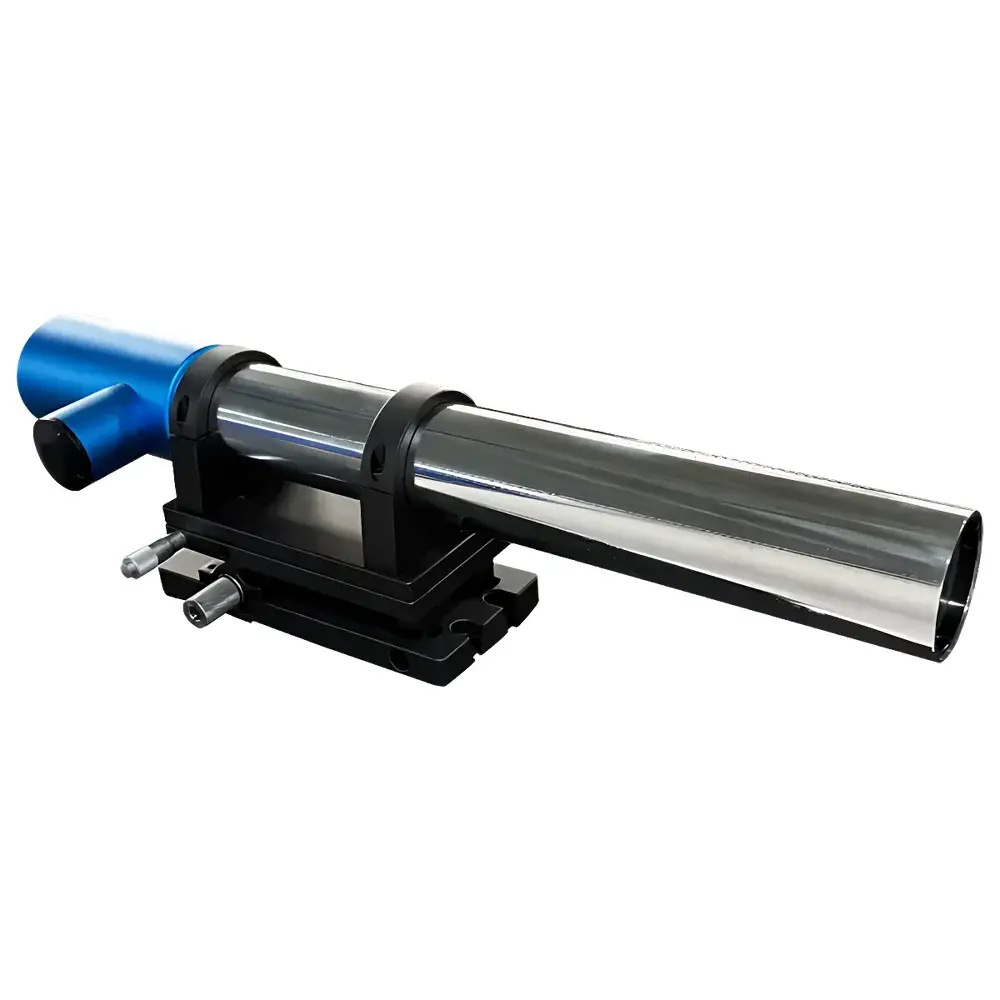
YANRUN MC030-ZJUH5000/0.1 Photoelectric Autocollimator
| Brand | YANRUN |
|---|---|
| Origin | Shanghai, China |
| Manufacturer Type | Manufacturer |
| Product Origin | Domestic (China) |
| Model | MC030-ZJUH5000/0.1 |
| Dimensions | 580 × 140 × 140 mm |
Overview
The YANRUN MC030-ZJUH5000/0.1 is a high-precision photoelectric autocollimator engineered for non-contact angular metrology in industrial metrology, optical alignment, and precision mechanical verification. It operates on the fundamental principle of optical autocollimation: a collimated beam—generated by projecting a reticle located at the focal plane of a high-stability objective lens—is directed toward a reflective surface (e.g., a mirror or polished workpiece). Upon reflection, the beam returns through the same objective and is reimaged onto a calibrated photodetector array positioned at the identical focal plane. A mirror tilt of angle α induces a linear displacement ΔS = 2f·α (where f is the effective focal length) on the detector, enabling sub-arcsecond angular resolution via precise centroid detection algorithms. This dual-axis (X/Y) measurement architecture eliminates sequential reorientation, supporting simultaneous orthogonal angular deviation analysis—critical for evaluating straightness, flatness, squareness, and parallelism in accordance with ISO 230-1, ISO 10360, and ASME B89.3.7 standards.
Key Features
- Dual-axis real-time angular measurement (X and Y) with synchronous acquisition and independent calibration
- Integrated electronic eyepiece system with live digital display, eliminating parallax and observer-dependent aiming errors inherent in manual optical autocollimators
- High-resolution linear CCD/CMOS photodetector array optimized for centroid-based displacement calculation and thermal drift compensation
- Stable long-life LED illumination source with constant-current drive and spectral stabilization—ensuring consistent reticle contrast over >20,000 hours of operation
- Modular design supporting interchangeable accessories: retroreflector mounts, precision mirror stages, rotary table adapters, and multi-surface alignment kits
- Onboard real-time curve fitting and error evaluation (e.g., least-squares line, best-fit plane, perpendicularity deviation) with automated tolerance flagging
- Multi-language UI (English, Chinese, Russian, Korean) compliant with international lab and factory floor deployment requirements
Sample Compatibility & Compliance
The MC030-ZJUH5000/0.1 accommodates reflective surfaces with minimum reflectivity ≥70% (at 520–580 nm), including ground, lapped, or coated mirrors; precision-ground steel or granite reference surfaces; and optically polished optics (e.g., laser cavity mirrors, interferometer beamsplitters). It is routinely deployed in environments meeting ISO 17025-accredited calibration labs and GMP-compliant aerospace component manufacturing lines. The instrument complies with electromagnetic compatibility (EMC) per IEC 61326-1 and safety requirements under IEC 61010-1. Its measurement traceability chain aligns with national metrology institutes (NIM, NIST, PTB) via certified angular reference standards and inter-laboratory comparison protocols.
Software & Data Management
The bundled YANRUN AutoAlign Suite v3.2 provides full control, analysis, and reporting functionality under Windows 10/11. It supports raw pixel displacement logging at up to 50 Hz, batch processing of multi-point alignment sequences, and statistical process control (SPC) charting (X̄–R, Cp/Cpk). All measurement data—including timestamps, operator ID, environmental metadata (optional temperature/humidity input), and calibration certificate references—are exported directly to standardized Excel (.xlsx) files with embedded formula validation and audit-ready formatting. The software implements role-based access control and optional 21 CFR Part 11 compliance modules (electronic signatures, audit trails, data integrity safeguards) for regulated industries.
Applications
- Precision installation and in-situ alignment of CNC machine tools, coordinate measuring machines (CMMs), and hydrostatic bearing spindles
- Verification of geometric tolerances per ISO 1101: straightness, flatness, perpendicularity, parallelism, and angularity of guideways, bases, and fixtures
- Dynamic angular stability assessment of air-bearing and motorized rotation stages used in lithography and synchrotron beamline instrumentation
- Optical assembly and collimation of telescope objectives, laser resonators, and free-space quantum optics setups
- Calibration of angle encoders, inclinometers, and servo-driven goniometers against primary angular standards
- Teaching and research applications in university physics and optical engineering laboratories requiring quantitative wavefront tilt analysis
FAQ
What is the angular resolution and measurement range of the MC030-ZJUH5000/0.1?
The instrument achieves ≤0.1 arcsecond resolution over a ±1500 arcsecond (±0.42°) full-scale range in each axis, subject to focal length configuration and detector sampling density.
Does it support external triggering or synchronization with other metrology systems?
Yes—TTL-compatible trigger input/output ports enable hardware-synchronized data capture with laser trackers, interferometers, or motion controllers.
Can the system be integrated into automated production line inspection cells?
Absolutely—the device offers Ethernet/IP and Modbus TCP communication protocols, allowing seamless integration with PLC-based MES and SCADA platforms.
Is factory calibration traceable to national standards?
Each unit ships with a NIM-traceable calibration certificate (valid for 12 months), including uncertainty budgets per GUM (JCGM 100:2008) and documented measurement procedures.
What environmental conditions are recommended for optimal performance?
Operating temperature: 15–25°C (±0.5°C/h stability); relative humidity: 30–70% RH non-condensing; vibration isolation recommended for sub-arcsecond repeatability.