
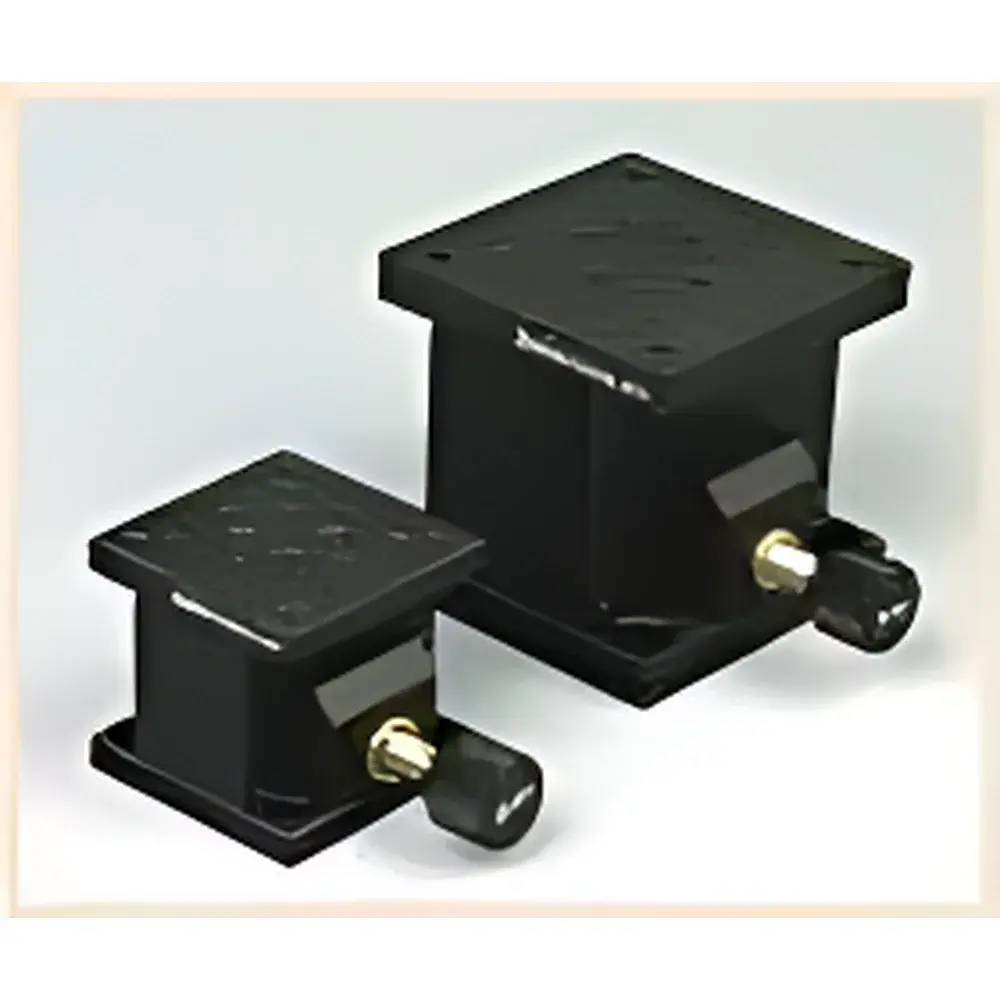
ZOLIX PSMV Series Precision Manual Vertical Translation Stage
| Brand | ZOLIX |
|---|---|
| Model | PSMV Series |
| Origin | Beijing, China |
| Manufacturer Type | Direct Manufacturer |
| Product Category | Domestic (China-Made) |
| Drive Mechanism | Ultra-Fine-Pitch Threaded Actuator |
| Guidance System | Linear Ball Bearing Rails |
| Structural Principle | Cam-Actuated Vertical Translation |
| Base Material | Anodized Aluminum Alloy |
| Load Capacity | 3 kg (PSMV4-45C), 5 kg (PSMV8-65C) |
| Travel Range | 4 mm (PSMV4-45C), 8 mm (PSMV8-65C) |
| Positioning Sensitivity | 0.003 mm |
| Top Plate Dimensions | 45 × 45 mm, 65 × 65 mm |
| Compliance | Designed for ISO/IEC 17025-aligned optical alignment workflows |
| Interchangeability | Compatible with ZOLIX PSM Series Horizontal and Rotational Stages |
Overview
The ZOLIX PSMV Series Precision Manual Vertical Translation Stage is an engineered solution for sub-millimeter vertical positioning in optical alignment, interferometry, laser cavity setup, and micro-optomechanical assembly applications. Based on a cam-actuated mechanical architecture, the stage converts rotational input from an ultra-fine-pitch threaded actuator into highly constrained linear vertical motion. Unlike conventional lead-screw stages, the cam mechanism—precision-machined and surface-hardened—minimizes axial play and backlash while delivering near-linear displacement response over its full travel range. This design ensures high repeatability (±0.002 mm typical) and minimal wobble (<5 µrad tilt error), critical when aligning collimated beams or positioning detectors within confocal or Littrow configurations. The stage’s compact footprint and rigid aluminum alloy body (6061-T6, anodized for corrosion resistance and dimensional stability) support integration into multi-axis optical breadboards and vacuum-compatible enclosures (with optional stainless steel hardware).
Key Features
- Cam-actuated vertical translation mechanism with hardened cam profile and preloaded contact geometry for zero-backlash performance
- Ultra-fine-pitch threaded actuator (pitch ≤ 0.25 mm) enabling 0.003 mm minimum incremental motion per full rotation
- Recirculating linear ball bearing rails providing low-friction, high-stiffness guidance with <0.5 µm straightness deviation over full stroke
- Two standard configurations: PSMV4-45C (4 mm travel, 45 × 45 mm top plate, 3 kg center load rating) and PSMV8-65C (8 mm travel, 65 × 65 mm top plate, 5 kg center load rating)
- Integrated M4 and M6 tapped holes on top plate and base for standardized optomechanical mounting (compatible with Thorlabs, Newport, and ZOLIX PSM-series stages)
- Adjustable locking screw (included) to secure position under static load without creep or drift
Sample Compatibility & Compliance
The PSMV Series is designed for use with optical components ranging from Ø12.7 mm lens mounts to 50 mm cube beamsplitters and fiber launch assemblies. Its low-profile structure avoids shadowing of beam paths, and its non-magnetic aluminum construction prevents interference with sensitive magnetic-field experiments (e.g., magneto-optic Kerr effect setups). All units undergo factory calibration using laser interferometric verification per ISO 230-2 Annex B protocols. While not certified to ISO 9001 as a standalone product, the manufacturing process complies with GB/T 19001–2016 (equivalent to ISO 9001:2015) and supports traceable metrology documentation upon request. The stage meets mechanical safety requirements per IEC 61000-6-2 (immunity) and IEC 61000-6-4 (emission) for laboratory environments.
Software & Data Management
As a fully manual stage, the PSMV Series does not incorporate motorization or electronic feedback. However, it is explicitly designed for integration into hybrid systems where digital control is managed externally—e.g., via stepper motor actuators mounted in tandem or paired with ZOLIX PSM-EM series motorized stages. For audit-trail compliance in regulated labs (e.g., ISO/IEC 17025 accredited facilities), users may log positional settings manually in ELN systems or link the stage to third-party encoder-equipped actuators supporting FDA 21 CFR Part 11-compliant data capture. Mounting symmetry and repeatable kinematic interfaces facilitate reproducible reinstallation across maintenance cycles.
Applications
- Precise vertical adjustment of objective lenses in custom-built microscopy platforms
- Fine focus tuning of external cavity diode lasers (ECDLs) and tapered amplifier modules
- Height calibration of photodetectors and quadrant photodiodes in beam-position monitoring systems
- Stacked-stage configurations for 3-axis alignment (X/Y via PSM stages + Z via PSMV)
- Thermal expansion compensation in cryogenic optical benches (when used with low-CTE adapters)
- Alignment of grating-based spectrometers requiring ±1 µm Z-height repeatability
FAQ
Is the PSMV Series compatible with vacuum environments?
Yes—standard units operate up to 10⁻³ Pa; for UHV (≤10⁻⁷ Pa), specify optional stainless steel fasteners and dry-lubricated cam surfaces.
Can I mount a mirror mount directly onto the top plate?
Yes—the 45 × 45 mm and 65 × 65 mm plates include a grid of M4 threaded holes spaced at 12.5 mm intervals, matching industry-standard kinematic mount footprints.
What is the maximum recommended moment load?
For PSMV4-45C: ≤0.12 N·m; for PSMV8-65C: ≤0.25 N·m—exceeding this may degrade cam contact integrity and positional linearity.
Does ZOLIX provide calibration certificates?
Traceable calibration reports (per ISO/IEC 17025-accredited partner lab) are available as a value-added service—contact technical sales for lead time and scope definition.
How does temperature affect positioning accuracy?
Coefficient of thermal expansion of the aluminum body is 23.1 × 10⁻⁶ /°C; for sub-micron stability, maintain ambient drift ≤ ±0.5 °C during critical alignment procedures.




