
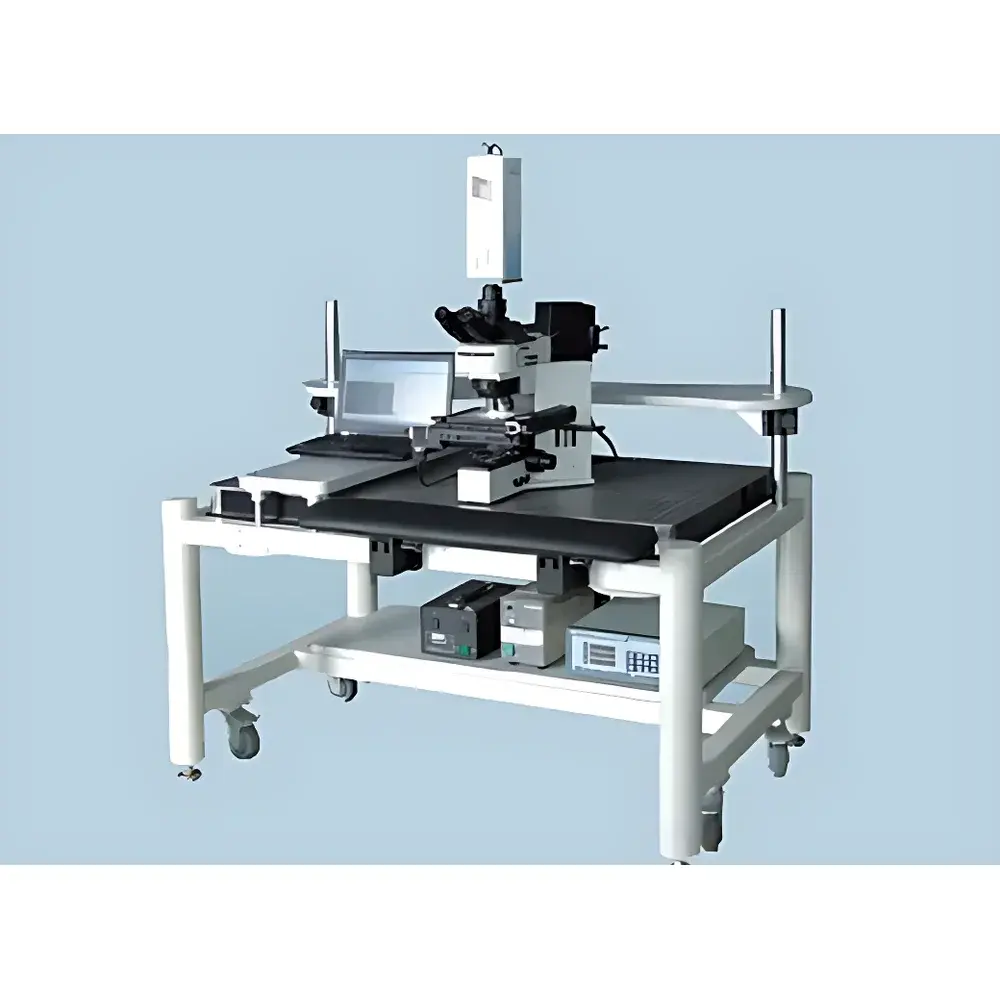
Dualix Spectral Imaging GaiaMicro-G Series Microscopic Hyperspectral Imaging System
| Brand | Dualix Spectral Imaging |
|---|---|
| Origin | Sichuan, China |
| Model | GaiaMicro-G |
| Spectral Range | 400–1000 nm (Visible-NIR) / 900–1700 nm (NIR) |
| Spectral Resolution | 2.8–5.0 nm |
| Spatial Resolution | Configurable via interchangeable infinity-corrected objectives (5×–100×) |
| Numerical Aperture | F/2.0–F/2.8 |
| Detector | CCD / sCMOS / InGaAs |
| Pixel Array | Up to 2048 × 2048 (spatial × spectral) |
| Bit Depth | 14–16 bits |
| Interface | USB 2.0 / USB 3.0 / GigE |
| Imaging Mode | Push-broom scanning with motorized XY stage |
| FOV & IFOV | Objective-dependent (e.g., 10× objective: ~1.0 mm FOV, ~0.5 µm IFOV at diffraction limit) |
| Frame Rate | Variable (up to 60 fps for snapshot LCTF variants |
Overview
The Dualix Spectral Imaging GaiaMicro-G Series Microscopic Hyperspectral Imaging System integrates a push-broom hyperspectral camera with a precision optical microscope platform to enable spatially resolved spectral analysis at the microscopic scale. Designed for laboratory-based material characterization, the system operates on the principle of line-scan hyperspectral imaging—where spectral data is acquired one spatial line at a time while the sample is translated under the fixed optical path. This architecture ensures high-fidelity spectral fidelity and spatial registration across the full spectral range. The GaiaMicro-G supports dual optical configurations: a transmissive visible–near-infrared (VNIR: 400–1000 nm) pathway optimized for transparent or semi-transparent specimens (e.g., biological tissue sections, polymer films, semiconductor wafers), and a reflective near-infrared (NIR: 900–1700 nm) pathway using off-axis parabolic or Cassegrain-style reflective objectives suitable for opaque, scattering, or thermally sensitive samples. Both configurations maintain diffraction-limited performance through infinity-corrected, apochromatic optical design and are fully compatible with standard microscope mounting interfaces (e.g., C-mount, F-mount).
Key Features
- Motorized XY precision translation stage with sub-micron repeatability (±0.5 µm) for automated raster scanning and focus stacking.
- Auto-exposure and auto-focus routines synchronized with spectral acquisition to maintain optimal signal-to-noise ratio (SNR) and depth-of-field consistency across heterogeneous samples.
- Dual optical path architecture: transmissive VNIR mode (using long-working-distance achromatic metallurgical objectives) and reflective NIR mode (with broadband reflective objectives covering 350 nm–7 µm).
- Modular detector options: scientific-grade sCMOS (2048 × 2048, 16-bit) for VNIR; thermoelectrically cooled InGaAs (640 × 512, 14-bit) for NIR, enabling low-noise operation at ambient or stabilized temperatures.
- Calibration-ready optical train supporting reflectance calibration (via NIST-traceable reference tiles), flat-field correction, and region-of-interest (ROI)-based radiometric normalization.
- Interchangeable objective turret (5×, 10×, 20×, 50×, optional 100× reflective) with standardized mechanical tube length (160 mm or infinity-corrected) for compatibility with Olympus, Zeiss, and Nikon microscope bodies.
Sample Compatibility & Compliance
The GaiaMicro-G accommodates solid, thin-sectioned, and mounted specimens up to 75 mm × 50 mm in footprint and 30 mm in height. It supports both upright and inverted microscope configurations when integrated with third-party platforms. Sample illumination is configurable: halogen broadband source for VNIR transmittance; high-power tungsten-halogen or quartz-tungsten-halogen (QTH) lamp with cold mirror filtering for NIR reflectance. All optical components comply with ISO 10110 surface quality standards; detector electronics conform to CE and FCC Class B emission limits. The system supports GLP/GMP-aligned workflows through metadata-embedded acquisition logs—including timestamp, objective ID, exposure parameters, stage coordinates, and calibration state—enabling traceability per FDA 21 CFR Part 11 requirements when used with validated software environments.
Software & Data Management
Acquisition and processing are managed via Dualix’s proprietary HyperSpectra Studio v4.x, a Windows-based application supporting real-time preview, spectral library matching (USGS, JPL, ASTM E1710), and multivariate analysis (PCA, MCR-ALS, SAM). Raw data is stored in IEEE-compliant BSQ/BIL format with embedded ENVI header metadata. Export options include HDF5 (for MATLAB/Python interoperability), TIFF stacks (per-band), and CSV spectral profiles. The software includes built-in tools for spectral unmixing, endmember extraction, and false-color mapping with user-defined indices (e.g., NDVI, NDWI analogs adapted for microscale). Audit trails record all processing steps, parameter changes, and user logins—essential for regulated QC/QA environments.
Applications
- Pharmaceutical solid dosage form analysis: identification of API distribution, excipient homogeneity, and coating thickness uniformity in tablets and granules.
- Geological thin-section mineral mapping: discrimination of clay species, iron oxides, and hydroxides via diagnostic absorption features in the 900–1700 nm range.
- Microelectronics failure analysis: detection of oxidation states on copper interconnects, solder joint composition gradients, and dielectric layer delamination signatures.
- Biomedical histopathology: label-free discrimination of collagen subtypes, lipid accumulation, and hemoglobin oxygenation states in unstained tissue sections.
- Polymer blend morphology: quantification of phase separation, filler dispersion, and degradation-induced chromophore formation at micron-scale resolution.
FAQ
What microscope brands and models are compatible with the GaiaMicro-G?
The system is designed for universal integration with standard finite-conjugate or infinity-corrected microscopes from Olympus, Zeiss, Leica, and Nikon via C-mount or F-mount adapters. Custom optical coupling solutions are available upon request.
Can the GaiaMicro-G perform real-time hyperspectral imaging without scanning?
The GaiaMicro-G push-broom variant requires stage scanning for full-frame acquisition. However, Dualix also offers the GaiaMicro-F series—based on liquid crystal tunable filter (LCTF) technology—which enables snapshot hyperspectral imaging at video rates without mechanical scanning.
Is spectral calibration traceable to national standards?
Yes. Factory calibration uses NIST-traceable tungsten halogen and deuterium lamps. Users may perform routine verification using calibrated reflectance standards (e.g., Labsphere Spectralon®) with documented uncertainty budgets.
How is spatial resolution determined in this system?
Spatial resolution is governed by the diffraction limit of the selected objective lens, pixel pitch of the detector, and magnification factor. For example, a 50× F/0.55 objective with 6.5 µm pixels yields theoretical IFOV ≈ 0.23 µm at the sample plane, subject to optical aberrations and alignment precision.
Does the system support automated batch acquisition for multi-sample workflows?
Yes. HyperSpectra Studio supports script-driven acquisition sequences, including stage coordinate lists, objective change commands, exposure presets, and file-naming templates—enabling unattended overnight runs across slide libraries or wafer maps.





