
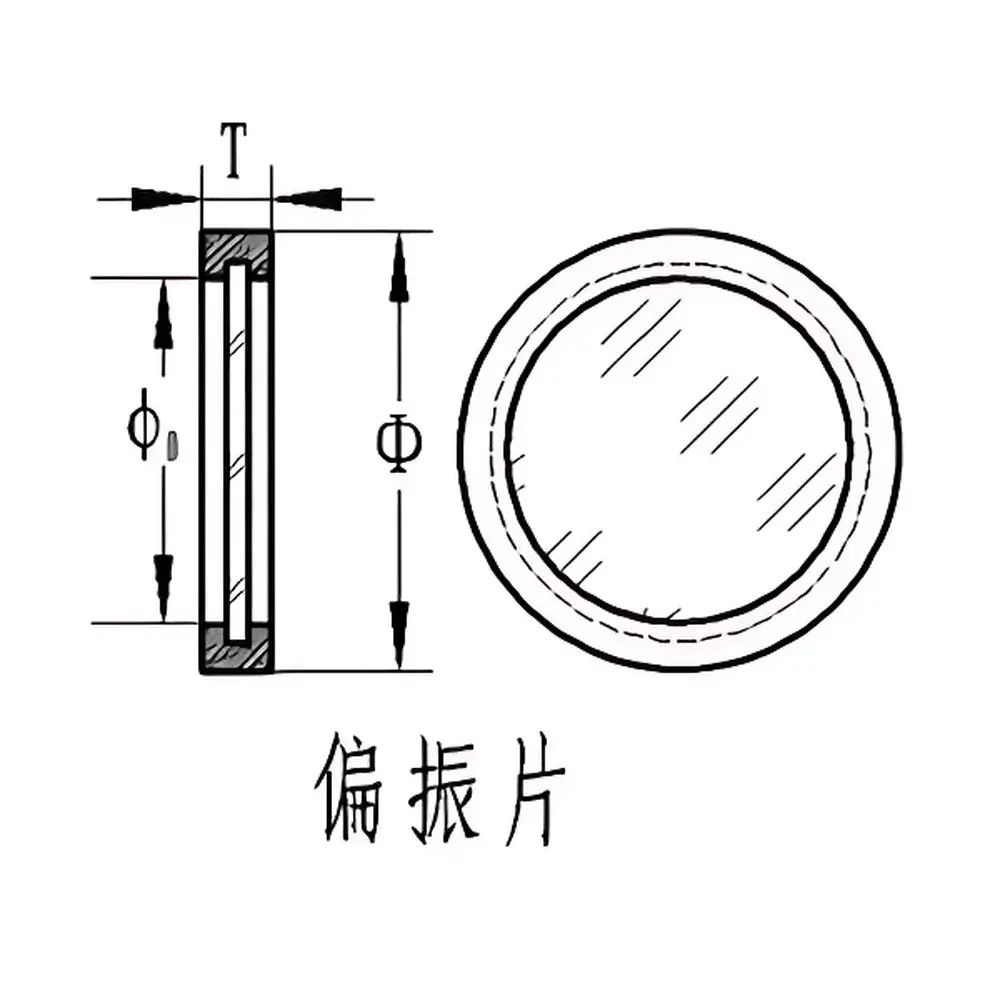
ZOLIX OPSP Series Plastic Sheet Polarizers
| Brand | ZOLIX |
|---|---|
| Origin | Beijing, China |
| Manufacturer Type | OEM/ODM Producer |
| Country of Origin | China |
| Model Range | OPSP12.7, OPSP25.4, and Custom Sizes |
| Optical Aperture | Ø8.9 mm (OPSP12.7), Ø20.3 mm (OPSP25.4) |
| Wavelength Range | 400–700 nm |
| Substrate Thickness | 4 mm |
| Polarization Efficiency | >99.9% (typical extinction ratio ≥1000:1) |
| Damage Threshold (CW) | ≤100 W/cm² |
| Damage Threshold (Pulsed, 13 ns) | ≤6 J/cm² |
| Mounting | Unmounted or Optional Aluminum Ring Mount |
Overview
ZOLIX OPSP Series Plastic Sheet Polarizers are high-performance, cost-effective linear polarizing elements engineered for precision optical alignment, laser beam conditioning, ellipsometry, and general laboratory polarization control. Based on stretched polyvinyl alcohol (PVA) film impregnated with iodine or dichroic dyes, these polarizers operate via selective absorption—transmitting light whose electric field vector aligns with the transmission axis while absorbing orthogonal components. Unlike wire-grid or crystalline polarizers, plastic sheet polarizers offer broad spectral coverage, lightweight form factors, and excellent uniformity across the aperture. They are not designed for p-/s-polarization separation (e.g., in Brewster-angle applications), but excel in intensity-based polarization filtering where high extinction ratio, low wavefront distortion, and mechanical robustness are required.
Key Features
- High dichroic contrast: Typical extinction ratio ≥1000:1 (measured at 532 nm with collimated HeNe or diode laser source)
- Broadband visible transmission: Optimized for 400–700 nm spectral range; minimal absorption peaks within band
- Low birefringence substrate: Minimal retardance (<λ/100 @ 633 nm), preserving polarization purity in interferometric setups
- Standard geometries: Ø12.7 × 4 mm (OPSP12.7) and Ø25.4 × 4 mm (OPSP25.4) with centered clear apertures of Ø8.9 mm and Ø20.3 mm respectively
- Customizable mounting: Available unmounted or with precision-machined aluminum retaining rings (M12.7 or M25.4 thread compatible)
- Thermal stability: Operates reliably from −10 °C to +60 °C; no delamination or dye migration under standard lab conditions
- RoHS-compliant materials: Halogen-free PVA base and non-toxic dopants meet EU Directive 2011/65/EU
Sample Compatibility & Compliance
The OPSP series is compatible with continuous-wave (CW) and nanosecond-pulsed laser sources operating within its specified wavelength and power density limits. It supports ISO 11146-compliant beam profiling, ASTM E1331 spectrophotometric measurements, and USP particulate matter testing when integrated into optical train assemblies. While not certified to IEC 61000-4-x EMC standards (as a passive optical component), all units undergo batch-level spectral transmittance verification per ISO 9001:2015-controlled QC protocols. Documentation includes traceable calibration reports (wavelength-dependent Tp/Ts curves) and material safety data sheets (MSDS). For GLP/GMP environments, serial-numbered units support audit-ready traceability through ZOLIX’s manufacturing log system.
Software & Data Management
As a passive optical component, the OPSP polarizer requires no firmware or driver software. However, it integrates seamlessly into automated optical platforms using standard kinematic mounts (e.g., Thorlabs KM100, Newport U100). When used with motorized rotation stages (e.g., Zaber T-LSM series), polarization angle can be controlled programmatically via ASCII command sets compliant with SCPI 1999. Extinction ratio validation data—recorded using calibrated photodiodes and lock-in amplifiers—is exportable in CSV or HDF5 format for MATLAB, Python (NumPy/Pandas), or LabVIEW analysis. All performance specifications adhere to NIST-traceable reference standards (SRM 2069 for spectral transmittance).
Applications
- Laser cavity polarization control and intracavity loss modulation
- Polarimetric imaging in biomedical microscopy (e.g., Mueller matrix acquisition)
- Optical isolation in fiber-coupled systems using crossed polarizer configurations
- Stress analysis in transparent polymers and glass via photoelasticity
- Educational optics labs: Malus’ law verification, Brewster angle approximation, and quarter-wave plate characterization
- Machine vision lighting control to suppress specular glare from metallic or glossy surfaces
- Calibration reference for polarimeter and ellipsometer systems (per ASTM F2733 and ISO 15529)
FAQ
What is the maximum CW power density this polarizer can withstand?
The OPSP series is rated for ≤100 W/cm² under continuous illumination at 532 nm with uniform beam profile and adequate heat sinking. Exceeding this threshold may induce thermal bleaching of the dichroic layer.
Can these polarizers be used with femtosecond lasers?
No. The OPSP series is not optimized for ultrashort pulses (<1 ps). For ultrafast applications, consider ZOLIX’s fused silica-based thin-film polarizers (e.g., TFPL series) with damage thresholds exceeding 0.5 J/cm² at 800 nm, 35 fs.
Is the transmission axis marked on the polarizer?
Yes. Each unit features a permanent, laser-etched arrow indicating the nominal transmission axis orientation, verified via crossed-polarizer null testing prior to shipment.
Do you offer custom cut shapes or non-standard wavelengths?
Yes. ZOLIX provides OEM cutting (rectangular, elliptical, annular) and spectral tuning (UV-enhanced or NIR-shifted variants) under NDA. Lead time: 4–6 weeks.
How should I clean the surface without damaging the dichroic film?
Use nitrogen blow-off followed by lens tissue moistened with spectroscopic-grade isopropanol. Never use acetone, ethanol, or abrasive wipes—these may swell or dissolve the PVA matrix.



