
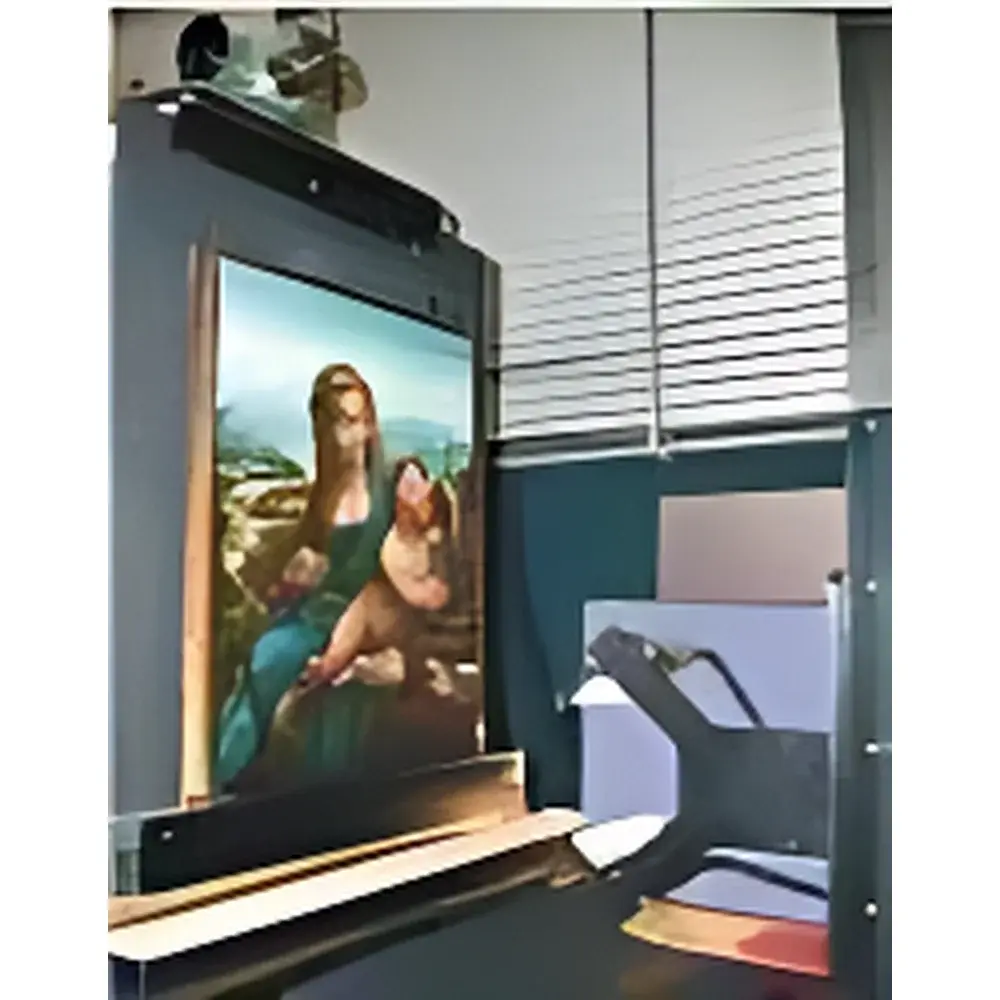
ArtScanner Art Authentication Hyperspectral Imaging System
| Origin | Finland |
|---|---|
| Manufacturer Type | Authorized Distributor |
| Origin Category | Imported Instrument |
| Model | ArtScanner |
| Pricing | Available Upon Request |
Overview
The ArtScanner Art Authentication Hyperspectral Imaging System is a precision optical instrumentation platform engineered for non-invasive, spatially resolved spectral analysis of cultural heritage objects. Operating on the principle of push-broom hyperspectral imaging in the visible to near-infrared (VNIR) range—typically 400–800 nm, extendable to 400–1000 nm—the system captures contiguous spectral bands (e.g., ≤5 nm bandwidth) across each pixel of a two-dimensional scene. Unlike conventional RGB or multispectral imaging, ArtScanner acquires full reflectance spectra (300+ bands) per spatial location, enabling quantitative pigment identification, layer stratigraphy inference, and material mapping based on spectral signature libraries. Its optical architecture incorporates a high-stability diffraction grating spectrometer, scientific-grade CMOS sensor with >60 dB dynamic range, and calibrated illumination modules compliant with CIE standard illuminants (D65, A). Designed specifically for conservation science laboratories and museum analytical departments, the system supports both macro-scale wall painting documentation and micro-scale manuscript or pigment sample interrogation.
Key Features
- Full VNIR hyperspectral acquisition from 400 nm to 800 nm (optional extension to 1000 nm) with spectral sampling interval ≤5 nm
- Push-broom scanning mode ensuring high spatial fidelity and radiometric consistency across large-area targets (up to 5 m × 3 m with motorized gantry integration)
- Integrated calibration suite including NIST-traceable white reference tiles, dark current compensation, and geometric distortion correction
- Modular optical design supporting interchangeable objectives (12 mm to 100 mm focal length), field-of-view adapters, and polarization filters for subsurface scattering suppression
- Ruggedized aluminum chassis with vibration-damped mounting interface, optimized for deployment in historic buildings and conservation studios without environmental control
- Real-time preview mode with spectral index overlays (e.g., NDVI, Pigment Ratio Indices) for rapid on-site decision support during condition surveys
Sample Compatibility & Compliance
The ArtScanner accommodates heterogeneous cultural materials—including oil and tempera paintings, inked manuscripts, polychrome sculptures, ceramic glazes, textile dyes, and mural plasters—without physical contact or ambient light interference. Its non-destructive measurement protocol conforms to ICOM-CC (International Council of Museums – Committee for Conservation) guidelines for preventive conservation and aligns with ASTM E2847–21 (“Standard Guide for Spectral Imaging in Conservation Science”). All spectral data files are stored in ENVI-compatible BIL format with embedded metadata (wavelength array, exposure time, integration time, illumination geometry), satisfying ISO 16067-2:2022 requirements for digital archival integrity. The system supports audit-ready workflows compliant with GLP principles, including user authentication logs, instrument calibration history tracking, and version-controlled spectral library management.
Software & Data Management
The bundled ArtVision™ software suite provides end-to-end processing: raw cube correction, atmospheric compensation (using empirical line method), spectral unmixing via constrained non-negative matrix factorization (cNMF), and pigment classification using Euclidean distance matching against curated reference libraries (e.g., FORS Database, MOLAB Spectral Atlas). Data export options include CSV (per-pixel spectra), GeoTIFF (georeferenced false-color maps), and PDF reports embedding spectral plots, spatial masks, and uncertainty metrics. For regulated environments, optional FDA 21 CFR Part 11 compliance modules enable electronic signatures, audit trails, and role-based access control. All software updates are delivered via secure HTTPS repository with SHA-256 integrity verification.
Applications
- Authentication of paintings, drawings, and prints through pigment chronology analysis and binder identification
- Mapping of retouching, overpainting, and previous restoration interventions in historical artworks
- Stratigraphic analysis of layered paint systems using spectral derivative features and absorption edge detection
- Documentation and monitoring of mural degradation processes (e.g., efflorescence, varnish yellowing, pigment fading)
- Forensic examination of packaging materials and security printing elements (e.g., UV-fluorescent inks, metameric pigments)
- Quantitative colorimetric validation of reproduction fidelity in digital archiving projects (CIELAB ΔE*₀₀ reporting)
FAQ
What spectral resolution and spatial sampling does the ArtScanner achieve?
The standard configuration delivers ≤5 nm spectral resolution at 400–800 nm with spatial sampling adjustable from 25 µm/pixel (micro-scanning mode) to 2 mm/pixel (macro-documentation mode), depending on working distance and lens selection.
Can the system operate under ambient lighting conditions?
Yes—integrated LED illumination units provide stable, spectrally flat output synchronized with sensor integration timing, enabling reliable measurements even in low-light or mixed-light museum environments.
Is spectral library customization supported?
Yes. Users may import proprietary reference spectra (in ASCII or ENVI format), assign metadata (material ID, provenance, dating), and deploy custom classifiers within ArtVision™ using supervised machine learning (SVM or Random Forest) modules.
Does the system comply with museum transport and installation standards?
The ArtScanner meets ISTA 3A packaging certification for air freight and includes shock-absorbing transit cases rated for Class II conservation equipment handling. On-site commissioning includes ISO 17025-aligned performance verification per manufacturer’s SOP-ART-001.





