
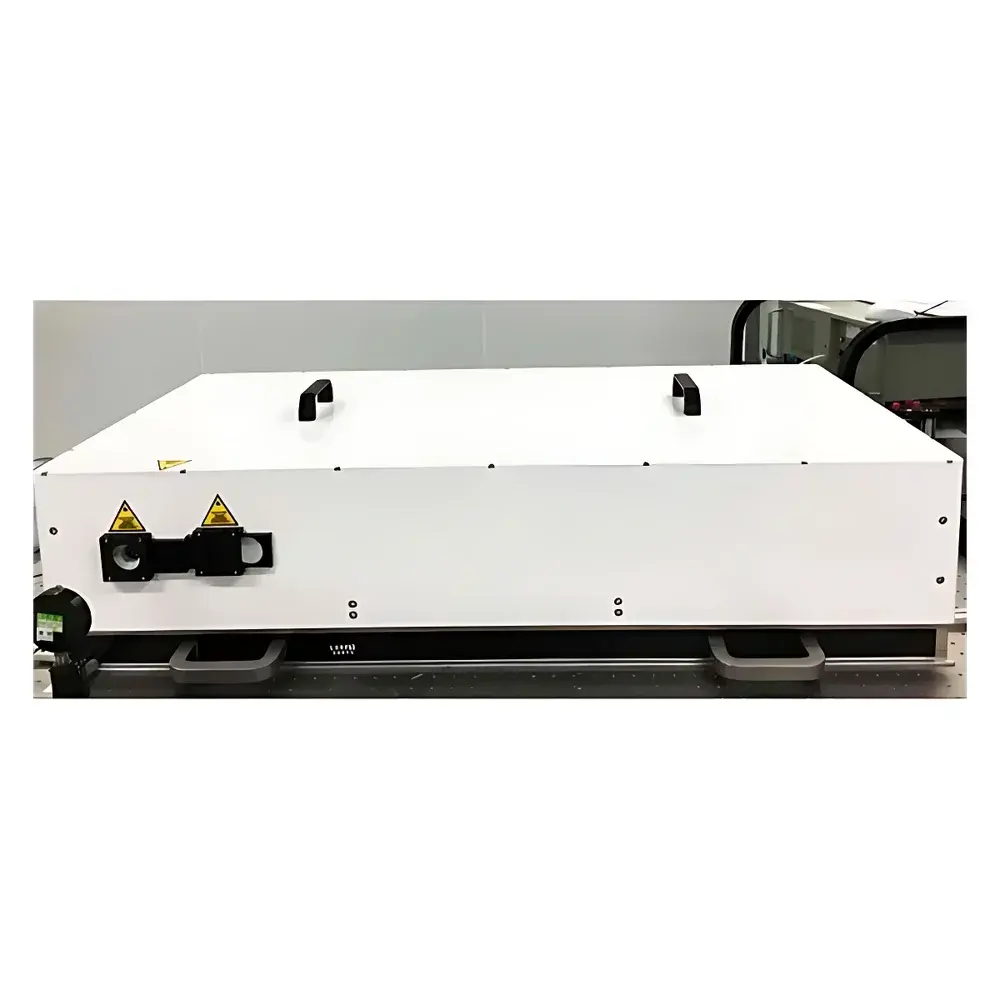
ZOLIX Deep-Ultraviolet Femtosecond Laser System
| Brand | ZOLIX |
|---|---|
| Origin | Beijing, China |
| Manufacturer Type | Original Equipment Manufacturer (OEM) |
| Product Category | Domestic |
| Model | DUV-FS Series |
| Pricing | Available Upon Request |
| Wavelength Range | 192–300 nm (continuously tunable) |
| Fundamental Options | Ti:Sapphire (780 nm, tunable), Yb-based (1030/1064 nm) |
| Pulse Width | ≤500 fs (at DUV output, dependent on harmonic generation stage) |
| Repetition Rate | 80 MHz |
| Beam Pointing Stability | <5 µrad RMS over 8 hours |
| Control Interface | Motorized wavelength tuning with GUI-based software |
| Output Power | Up to ~4 mW at 195 nm (with ≥2.5 W fundamental @ 780 nm) |
| Dimensions (L×W×H) | 1300 × 600 × 200 mm³ (laser head only, excluding fundamental source) |
Overview
The ZOLIX DUV-FS Series is a turnkey deep-ultraviolet (DUV) femtosecond laser system engineered for ultrafast spectroscopy, time-resolved photochemistry, and precision ablation applications requiring sub-200 nm photon energy. It operates on a cascaded nonlinear optical architecture: a mode-locked Ti:sapphire or Yb-doped solid-state oscillator serves as the fundamental source, followed by multi-stage harmonic generation (SHG, THG, FHG) and sum-frequency mixing (SFM) in nonlinear crystals (e.g., BBO, CLBO, KBBF). This design enables continuous, motorized wavelength tuning across 192–300 nm — a spectral region critical for probing electronic transitions in wide-bandgap semiconductors, vacuum-ultraviolet (VUV) photoelectron spectroscopy, and resonant excitation of biomolecular chromophores. Unlike fixed-wavelength DUV sources, the DUV-FS Series maintains femtosecond temporal fidelity (<500 fs pulse duration at 195 nm) while delivering high beam pointing stability (<5 µrad RMS), essential for long-term pump-probe alignment and interferometric experiments.
Key Features
- Continuously tunable deep-UV output from 192 nm to 300 nm, with discrete access to SHG (375–500 nm), THG (230–300 nm), FHG (~260 nm), and 5HG (~210 nm) bands
- Motorized wavelength selection via precision crystal angle control and harmonic stage sequencing, integrated into a graphical user interface (GUI)
- Optimized thermal and mechanical design ensures <5 µrad beam pointing stability over 8-hour operation — validated under laboratory-grade environmental conditions (±0.5°C, low-vibration optical table)
- Modular architecture supports multiple fundamental sources: Coherent Chameleon Ultra II or Spectra-Physics Mai Tai HP (Ti:sapphire, 780 nm, 100 fs, 80 MHz); or Yb-fiber/Yb:YAG oscillators (1030/1064 nm) for enhanced reliability and reduced maintenance
- Pre-aligned harmonic generation stages with automated crystal positioning and real-time power feedback for reproducible DUV output calibration
- Compliance-ready mechanical housing (IP20-rated) with interlock-compatible safety shutter and Class 4 laser enclosure interfaces
Sample Compatibility & Compliance
The DUV-FS Series is designed for integration into ultra-high-vacuum (UHV) chambers (base pressure ≤1×10⁻⁹ mbar) and synchrotron beamline endstations. Its 192–200 nm output enables direct ionization of gas-phase molecules without fragmentation — compatible with time-of-flight mass spectrometry (TOF-MS) and velocity-map imaging (VMI) setups. All optical paths are purged with dry nitrogen or argon to minimize ozone absorption and hydrocarbon deposition. The system conforms to IEC 60825-1:2014 (Edition 3) for Class 4 laser safety, includes redundant hardware interlocks, and meets CE marking requirements for electromagnetic compatibility (EN 61326-1) and low-voltage directive (2014/35/EU). Optional documentation packages support GLP/GMP audit trails per ISO/IEC 17025 and FDA 21 CFR Part 11 when paired with ZOLIX’s compliant data acquisition modules.
Software & Data Management
ZOLIX LaserControl Suite v3.x provides full system orchestration via USB 3.0 or Ethernet. The GUI enables wavelength scanning with user-defined step resolution (0.1 nm minimum), real-time power monitoring (via calibrated photodiode + thermopile hybrid sensor), and synchronized TTL triggers for external detectors (e.g., streak cameras, gated ICCDs). All parameter sets — including crystal angles, delay stage positions, and harmonic selection — are saved as XML-based experiment profiles. Audit logs record timestamped operator actions, hardware state changes, and environmental sensor inputs (temperature, humidity, purge gas flow). Raw intensity vs. wavelength traces are exportable in HDF5 format for MATLAB, Python (h5py), or Igor Pro analysis — ensuring traceability in peer-reviewed publications and regulatory submissions.
Applications
- Ultrafast Photoelectron Spectroscopy (PES): 193–195 nm photons provide >6.4 eV kinetic energy resolution for mapping valence band dynamics in 2D materials and topological insulators
- Time-Resolved Fluorescence Lifetime Imaging (TR-FLIM): Sub-200 nm excitation eliminates autofluorescence background in UV-native proteins (e.g., tryptophan, tyrosine), enabling picosecond-resolved decay kinetics in live-cell environments
- Nonlinear Optical Characterization: Phase-matching verification of novel DUV-transparent crystals (e.g., KBe₂BO₃F₂, RbBe₂BO₃F₂) using degenerate four-wave mixing (FWM) and third-harmonic generation efficiency mapping
- Precision Micromachining: Ablation threshold studies of fused silica, CaF₂, and sapphire with minimal heat-affected zones (<100 nm lateral thermal diffusion at 195 nm, 80 MHz)
- Atmospheric Chemistry Simulation: Photolysis of NO₂, O₃, and HONO at stratospheric-relevant wavelengths (192–200 nm) under controlled pressure and temperature conditions
FAQ
What fundamental laser sources are compatible with the DUV-FS Series?
The system accepts Ti:sapphire oscillators (780 nm, 80 MHz, ≥100 fs) such as the Coherent Chameleon Ultra II or Spectra-Physics Mai Tai HP, as well as Yb-based sources (1030/1064 nm, ≥50 fs) for extended UV coverage via fourth- and fifth-harmonic generation.
Is vacuum compatibility supported for in-chamber integration?
Yes — the laser head features ConFlat flange options (DN40/KF40) and bake-out rated components (≤150°C). Optional differential pumping stages enable direct coupling to UHV chambers without compromising base pressure.
How is pulse duration characterized at the DUV output?
Pulse width is measured via frequency-resolved optical gating (FROG) using a collinear geometry with a β-BaB₂O₄ (BBO) crystal; typical values range from 450–550 fs at 195 nm when seeded by a 100-fs fundamental.
Can the system be upgraded to include automated alignment diagnostics?
Yes — optional beam profiling modules (193 nm CMOS camera + M² measurement kit) and wavefront sensors (Shack-Hartmann, DUV-optimized) are available for remote alignment validation and predictive maintenance logging.
What documentation is provided for regulatory compliance in pharmaceutical or academic core facilities?
ZOLIX supplies IQ/OQ protocols, traceable calibration certificates (NIST-traceable photodiode standards), and a full 21 CFR Part 11-compliant software validation package upon request — including electronic signature workflows and change control records.




