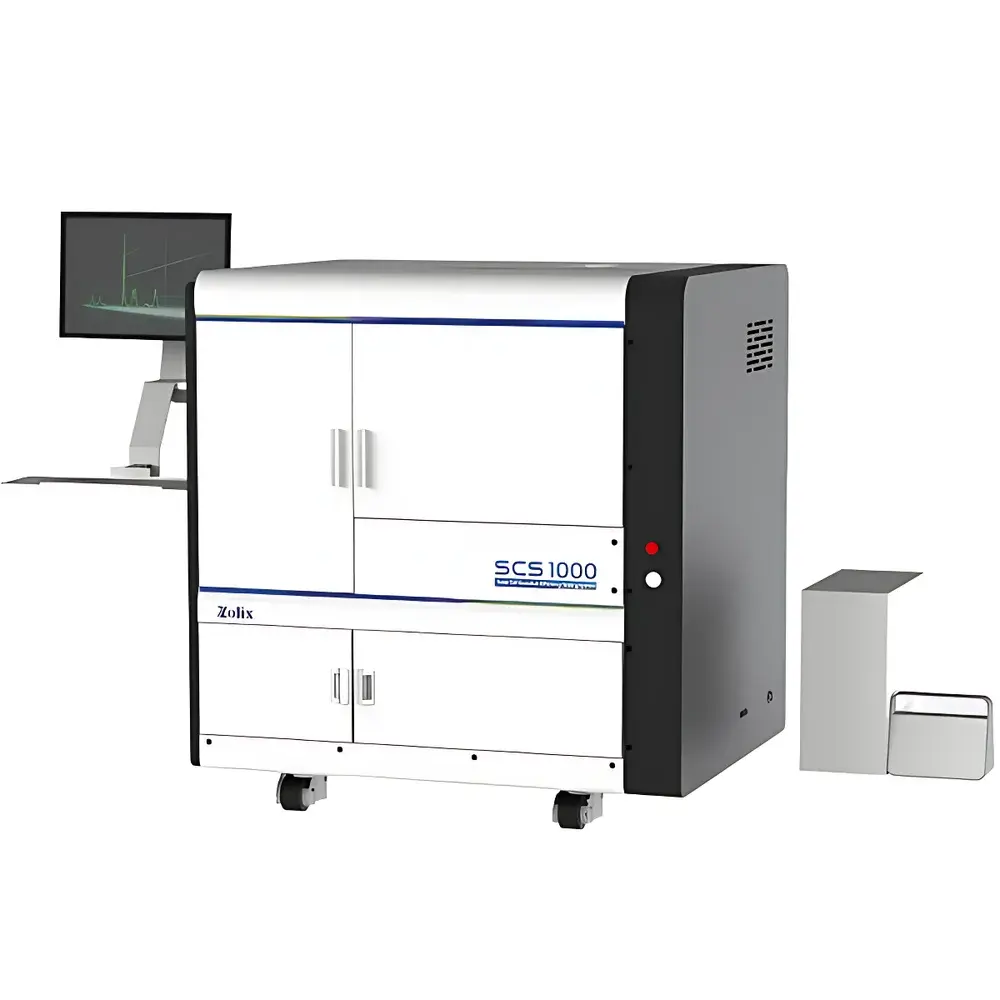
ZOLIX SCS1000 Quantum Efficiency Measurement System
| Brand | ZOLIX |
|---|---|
| Origin | Beijing, China |
| Manufacturer Type | Original Equipment Manufacturer (OEM) |
| Model | SCS1000 |
| Compliance | IEC 60904-8 |
| Light Source Stability | >99% |
| Minimum Spot Diameter | <1 mm |
| Dimensions | 800 mm × 900 mm × 1400 mm |
| Spectral Range | 200–2500 nm (configurable via detector & grating selection) |
| Dynamic Range | Up to 10⁶ (AC mode) |
| Mapping Capability | QE, Reflectance, LBIC with spatial resolution down to 10 µm |
Overview
The ZOLIX SCS1000 Quantum Efficiency Measurement System is a fully integrated, high-precision photometric platform engineered for absolute spectral responsivity (SR), external quantum efficiency (EQE), internal quantum efficiency (IQE), incident photon-to-electron conversion efficiency (IPCE), reflectance (R), and transmittance (T) characterization of optoelectronic devices. Based on monochromator-driven, lock-in amplified photocurrent detection under calibrated broadband illumination, the system implements a dual-beam, reflection-corrected optical architecture to eliminate chromatic aberration—ensuring consistent spot size and intensity profile across its full 200–2500 nm spectral range. Unlike refractive optical paths, the all-reflective design guarantees diffraction-limited beam quality independent of wavelength, critical for reproducible micro-scale measurements on small-area or patterned devices such as perovskite mini-modules, organic photovoltaic (OPV) sub-cells, and Ga₂O₃ UV detectors. The system complies with IEC 60904-8 for EQE measurement uncertainty control and supports traceable calibration against NIST-traceable standard detectors (e.g., OPE-B3 UV-Vis, OPE-B4 NIR).
Key Features
- Automated test sequencing: One-click initiation with full software-controlled execution—including AC/DC mode switching, standard detector auto-selection, spot size adjustment (1 mm to 5 mm), and simultaneous IPCE/laser beam path routing.
- Stable, broadband illumination: Dual-source configuration (150 W xenon arc + tungsten-halogen) with active power stabilization (>99% RMS stability over 1 h), enabling low-drift, high-SNR measurements even at sub-picoampere current levels.
- Real-time optical monitoring: Integrated CCD-based beam visualization system with digital zoom and live centroid tracking—enabling precise sample alignment and verification of illumination uniformity within ±2% across the measurement area.
- Modular electrical interface: Six DC and three AC configurations (SCS1000-DC-A through -DC-F; SCS1000-AC-A through -AC-D) support dark current down to 1 pA, current resolution to 0.1 fA, voltage bias up to ±200 V, and dual-channel synchronized acquisition for multi-junction device analysis.
- Compact, mobile footprint: Integrated casters and 800 × 900 × 1400 mm form factor allow deployment on standard lab benches without optical table dependency—ideal for shared core facilities and production QA labs.
Sample Compatibility & Compliance
The SCS1000 accommodates single-junction and multi-junction solar cells—including crystalline Si, CIGS, CdTe, dye-sensitized (DSSC), quantum dot (QDSC), organic (OPV), polymer, and perovskite architectures—as well as photodetectors (Si, InGaAs, Ga₂O₃, HgCdTe) and emerging wide-bandgap semiconductors. Its modular probe stations (QE-F4, QE-F6-C, QE-F6-H, etc.) support front-contact, back-contact, gas-sealed, and vacuum-compatible configurations with positional accuracy ≤0.7 µm and leakage current <1 pA. All measurement protocols adhere to IEC 60904-8:2017 for spectral mismatch correction, light biasing conditions, and data reporting format. Optional GLP/GMP-compliant audit trail logging (via ZOLIX QEMaster v4.x) meets FDA 21 CFR Part 11 requirements for regulated R&D environments.
Software & Data Management
ZOLIX QEMaster v4.x provides unified control of optical, electrical, and mechanical subsystems via a deterministic real-time kernel. It enables automated wavelength scanning with user-defined step intervals (down to 0.1 nm), dynamic integration time adjustment per wavelength, and simultaneous acquisition of photocurrent, bias voltage, and reference detector signal. Raw data are stored in HDF5 format with embedded metadata (calibration coefficients, slit width, grating position, detector gain). Built-in modules compute integrated JSC, EQE/IPCE error propagation (based on ISO/IEC Guide 98-3), linear dynamic range (LDR), and spatial QE mapping with pixel registration accuracy ≤5 µm. Export options include CSV, MATLAB .mat, and ASTM E2848-compliant XML for inter-laboratory comparison.
Applications
- Perovskite solar cell development: Quantifying carrier collection losses via IQE/R ratio analysis and identifying interfacial recombination through voltage-dependent EQE roll-off.
- Multi-junction tandem optimization: Spectrally resolved current matching assessment using integrated JSC calculation across sub-cell bandgaps (e.g., 1.68 eV top cell + 1.12 eV bottom cell).
- UV photodetector validation: High-sensitivity EQE mapping at 240 nm under variable bias to characterize trap-assisted transport and surface states.
- Thin-film process control: LBIC and reflectance mapping (10 µm resolution) for detecting shunt pathways, edge recombination, and coating non-uniformity in roll-to-roll fabricated OPVs.
- Standard detector calibration: Traceable SR measurement against OPE-B3 (200–1100 nm) and OPE-B4 (900–2500 nm) reference detectors with NIST-traceable certificates.
FAQ
What standards does the SCS1000 comply with for quantum efficiency measurement?
The system implements IEC 60904-8:2017 for spectral responsivity and EQE testing, including mandatory spectral mismatch correction, light biasing protocols, and uncertainty budgeting. Optional software modules support ASTM E2848 and ISO 18550 compliance reporting.
Can the SCS1000 measure internal quantum efficiency (IQE)?
Yes—by integrating synchronized reflectance (R) and transmittance (T) measurements at each wavelength, the system computes IQE = EQE / (1 − R − T) with full error propagation. Reflectance mapping is performed using the same optical path to ensure spatial registration.
How is light spot size controlled and verified?
Spot size is adjusted via motorized aperture and relay optics; real-time CCD imaging confirms diameter (<1 mm minimum) and Gaussian profile uniformity. Beam centroid drift is monitored continuously and corrected via closed-loop stage feedback if enabled.
Is the system suitable for production-line QA?
With its push-button automation, mobile chassis, and configurable pass/fail thresholds in QEMaster, the SCS1000 supports high-throughput screening in manufacturing environments—particularly for perovskite module qualification and OPV batch release testing.
What detector options are available for extended NIR coverage?
NIR-optimized configurations include the OPE-B4 (900–2500 nm, 10 nm steps, NIST-traceable) and optional liquid-nitrogen-cooled InSb detectors for 1–5.5 µm extension, both compatible with the SCS1000’s dual-grating monochromator and thermally stabilized optical bench.