
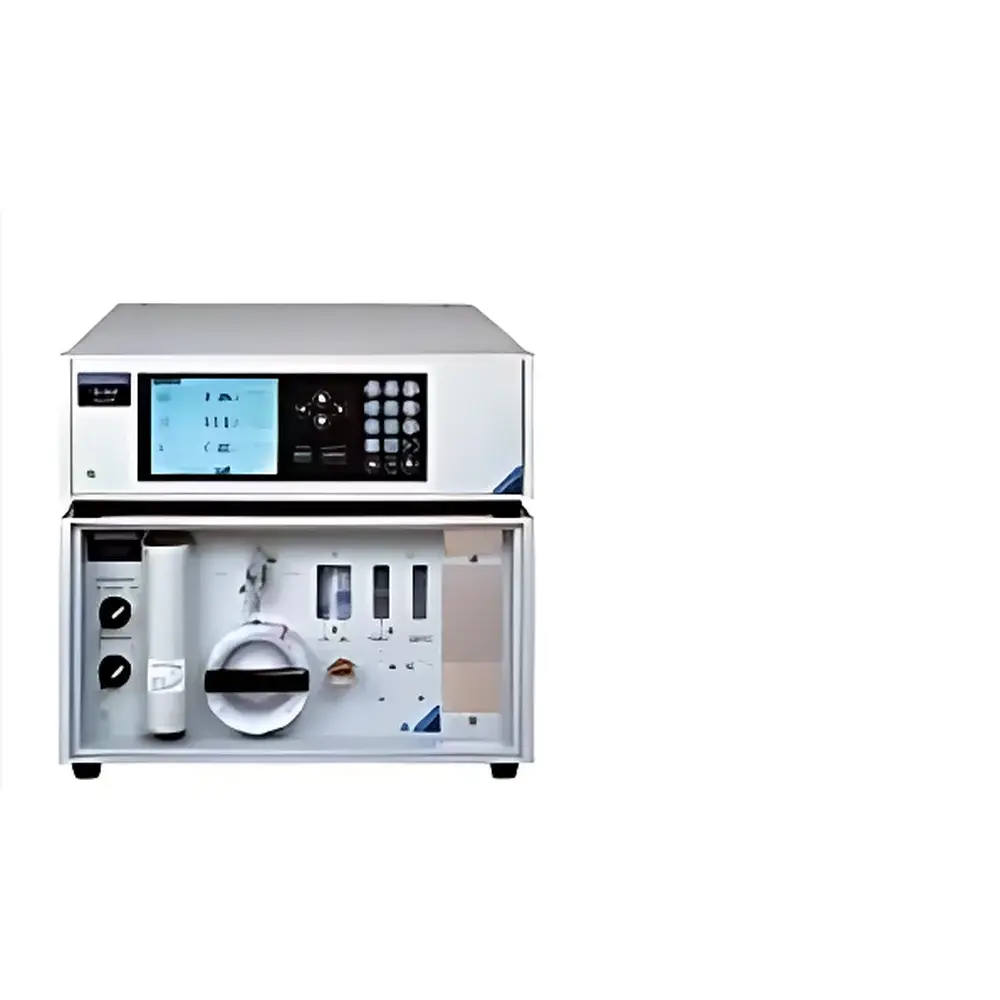
HORIBA VA-3000/VS-3000 Multi-Gas Analyzer
| Brand | HORIBA |
|---|---|
| Origin | Japan |
| Model | VA-3000 / VS-3000 |
| Repeatability | ±0.5% FS |
| Response Time (T90) | ≤30 s |
| Stability | ±2.0% FS/week |
| Detection Principles | NDIR, CLA, MPA, Electrochemical (Galvanic), Zirconia |
| Gas Compatibility | CO, CO₂, NOₓ, SO₂, CH₄, N₂O, C₂H₄, O₂ |
| Max Integrated Sensor Modules | 3 |
| Analog Outputs | DC 0–1 V / 4–20 mA (optional) |
| Communication Interface | RS-232C |
| Operating Temperature | 0–40 °C |
| Power Supply | AC 100–120 V or 200–240 V, 50/60 Hz |
| Weight (VA-3000) | ~20 kg |
| Enclosure | 19-inch rack-mount chassis |
Overview
The HORIBA VA-3000/VS-3000 Multi-Gas Analyzer is a modular, high-precision benchtop gas analysis system engineered for continuous, real-time measurement of multiple gaseous components in environmental monitoring, combustion process control, emissions compliance, and R&D applications. It integrates up to three interchangeable sensor modules—each based on a dedicated physical or electrochemical detection principle—within a single 19-inch rack-mount chassis. The VA-3000 serves as the analytical unit housing NDIR (Non-Dispersive Infrared), CLA (Chemiluminescence Analyzer), MPA (Magnetic Pressure Analyzer), galvanic electrochemical, and zirconia-based oxygen sensors. The companion VS-3000 series sampling units (VS-3001 to VS-3004) provide conditioned sample introduction with temperature-controlled dry extraction, particulate filtration, and pressure regulation—ensuring representative, stable gas delivery under ISO 12039, EN 15267, and EPA Method 6C/7E-compliant operating conditions.
Key Features
- Modular architecture supporting up to three simultaneously active sensor modules—enabling simultaneous quantification of CO, CO₂, NOₓ, SO₂, CH₄, N₂O, C₂H₄, and O₂ in a single instrument platform.
- Multi-principle detection: NDIR for CO, CO₂, CH₄, and N₂O; CLA for NOₓ (NO/NO₂); MPA for O₂; galvanic and zirconia cells for O₂ across differing concentration ranges and interference profiles.
- Wide dynamic range coverage: Programmable span selection across up to eight discrete ranges per gas (e.g., 0–20 ppm to 0–5,000 ppm for NOₓ via CLA; 0–5 vol% to 0–100 vol% for O₂ via zirconia), with optional extended-range configurations achieving up to 20× span ratio for NDIR channels.
- High metrological performance: Repeatability ±0.5% full scale (FS), linearity ±1.0% FS (±1.5% FS beyond 10× span), zero and span drift ≤±2.0% FS/week (≤±1.0% FS/day for galvanic O₂).
- Ruggedized sampling interface: VS-3000 series units feature SUS316, PTFE, PVDF, and FKM-wetted materials; flow-controlled at 0.5 L/min (analysis) and 1.5–5.0 L/min (extraction); dew point maintained below 5 °C saturation.
- Standard RS-232C serial interface and analog outputs (0–1 V DC, 4–20 mA optional) enable seamless integration into SCADA, DCS, and laboratory data acquisition systems.
Sample Compatibility & Compliance
The VA-3000/VS-3000 system is validated for use with clean, dry, non-corrosive, non-explosive sample streams meeting strict conditioning criteria: particulate load <0.1 mg/m³, moisture content 50 ppm), NO₂ (>6 ppm), H₂S, Cl₂, HF, or halogenated hydrocarbons. For zirconia O₂ measurement, coexistence of H₂O and O₂ is mandatory when reducing gases (CO, H₂, THC) are present—governed by the stoichiometric constraint [THC + CO + H₂] < [H₂O + O₂]. Applications include stack gas monitoring per EN 14181 QAL1/QAL2, ambient air quality networks (EU Directive 2008/50/EC), biogas composition verification (ISO 17225-2), and catalytic converter R&D. All configurations support GLP/GMP-aligned audit trails when paired with HORIBA’s certified data logging software.
Software & Data Management
The analyzer supports direct PC connectivity via RS-232C using HORIBA’s proprietary WinCT software (Windows-based), which provides real-time waveform display, multi-channel trend logging, calibration history tracking, alarm threshold configuration, and CSV export compliant with ASTM D6216 and USP . Data integrity is maintained through timestamped records, user-access-level controls, and electronic signature capability—meeting FDA 21 CFR Part 11 requirements when deployed in regulated pharmaceutical or energy-sector QA environments. Raw analog outputs allow integration with third-party PLCs or historian systems without protocol translation.
Applications
- Continuous emissions monitoring (CEMS) for thermal power plants, waste incinerators, and cement kilns—measuring CO, NOₓ, SO₂, O₂, and CO₂ against EU IED BREF and U.S. EPA 40 CFR Part 60 standards.
- Biogas and syngas process optimization—quantifying CH₄, CO₂, H₂S (via optional add-on), and O₂ to assess digester efficiency and upgrading readiness.
- Automotive exhaust aftertreatment development—tracking transient NOₓ breakthrough, NH₃ slip (with CLA upgrade), and O₂ lambda feedback during catalyst light-off studies.
- Environmental research laboratories—long-term ambient trace gas profiling (N₂O, CH₄) with sub-ppm sensitivity and low-drift stability over weekly calibration cycles.
- Industrial hygiene and confined-space safety—multi-gas screening for CO, O₂ deficiency/enrichment, and combustible gas (CH₄) in petrochemical facilities.
FAQ
What gas detection principles are implemented in the VA-3000 platform?
NDIR (CO, CO₂, CH₄, N₂O), Chemiluminescence (NOₓ), Magnetic Pressure (O₂), Galvanic Electrochemical (O₂), and Zirconia (O₂)—each selected based on required sensitivity, cross-sensitivity profile, and operational lifetime.
Can the VA-3000 measure NH₃ or H₂S?
NH₃ and H₂S are not supported by standard sensor modules. Custom configurations—including tunable diode laser (TDLAS) or electrochemical variants—may be evaluated upon technical consultation with HORIBA Application Engineering.
How is calibration performed and how often is it required?
Zero and span calibration is executed using certified reference gases introduced via the dedicated RC1/8 inlet. Recommended frequency is daily for critical compliance applications; weekly for R&D monitoring—supported by automated calibration scheduling in WinCT software.
Is the system suitable for high-humidity or corrosive flue gas streams?
Direct wet-gas analysis is not supported. The VS-3000 sampling system must be used with its integrated thermoelectric cooler and PTFE/PVDF filtration to deliver dried, particle-free sample gas—meeting EN 15267-3 conditioning requirements.
What are the electrical and mechanical installation requirements?
19-inch rack space (430 mm W × 132 mm H × 550 mm D), AC 100–240 V ±10%, 50/60 Hz, 200 VA max (VA-3000); ambient temperature 0–40 °C, RH <90% non-condensing; vibration-isolated mounting recommended for CLA modules.
Related Products







