
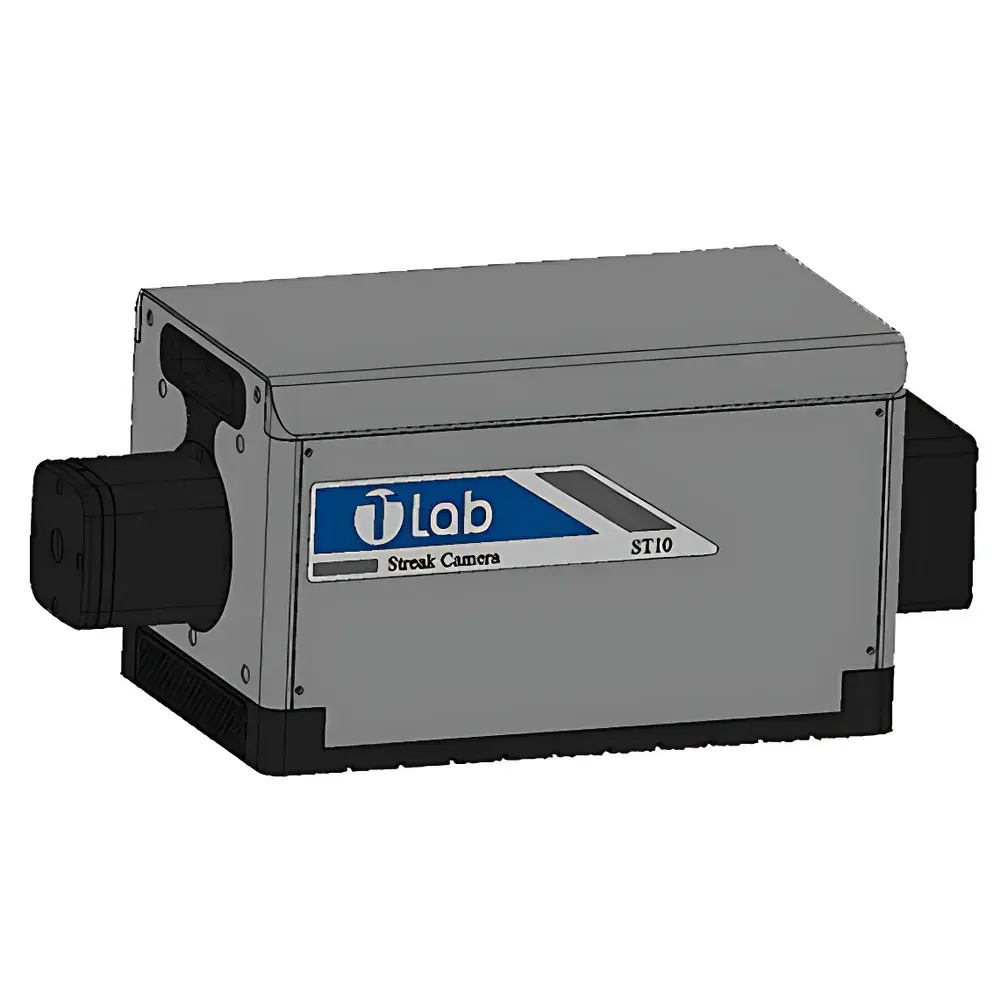
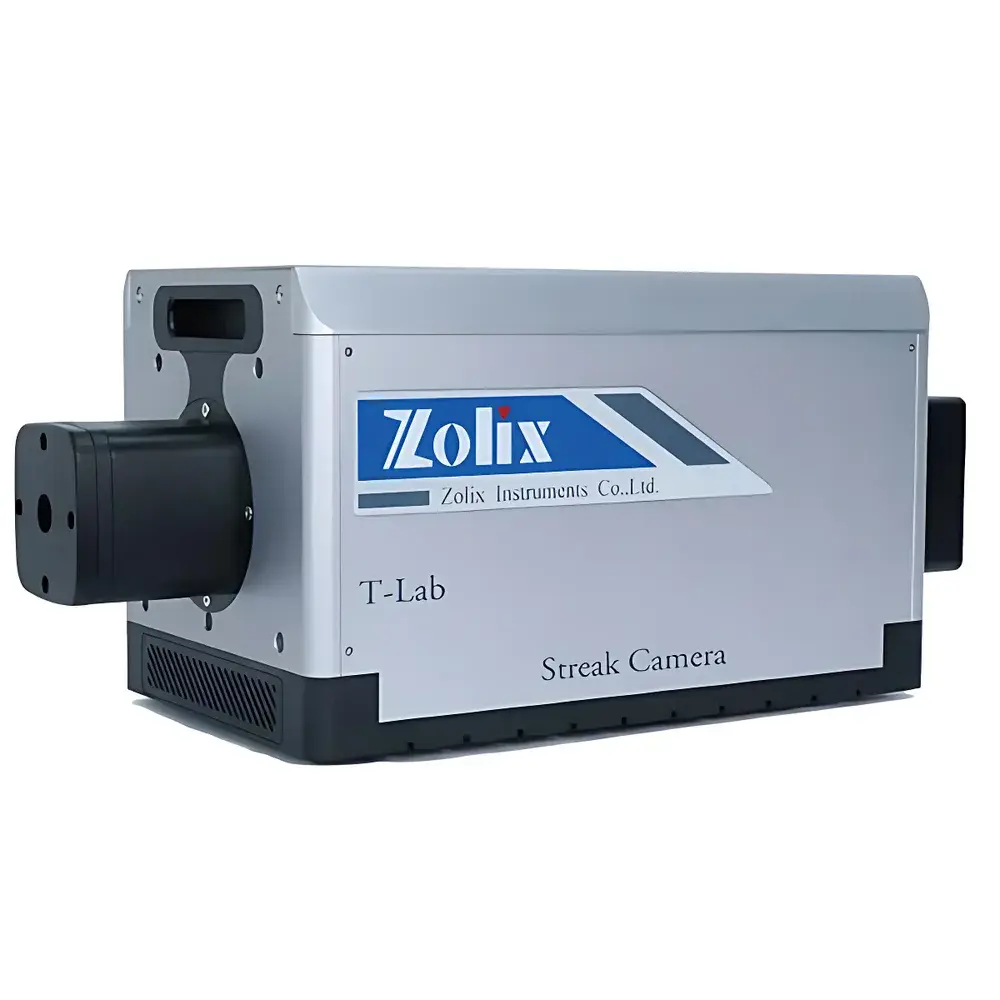
ZOLIX T-lab Series Universal Streak Camera
| Brand | ZOLIX |
|---|---|
| Origin | Beijing, China |
| Manufacturer Type | Original Equipment Manufacturer (OEM) |
| Product Category | Domestic |
| Model | T-lab Series |
| Spectral Response Range | 200–900 nm (UV-VIS-NIR) |
| Time Resolution (Streak Tube) | ≤2 ps |
| Spatial Resolution | >50 lp/mm |
| Scan Modes | Single-shot & High-frequency (up to >200 MHz) |
| Image Intensifier | Dual-MCP optional |
| Readout Sensor | Cooled scientific CMOS, 16-bit output, dynamic range >10,000:1 |
| Software | Integrated control & analysis suite with 3D visualization, time-decay fitting, spectral slicing, and fluorescence lifetime extraction |
Overview
The ZOLIX T-lab Series Universal Streak Camera is a high-performance, research-grade transient optical measurement instrument engineered for simultaneous picosecond-scale temporal resolution and micrometer-level spatial fidelity. Based on the principle of photoelectron deflection in a streak tube—where incident photons strike a photocathode, generating electrons accelerated across a time-varying electric field onto a phosphor screen—the system converts time-of-arrival information into spatial displacement along one axis, while preserving spatial distribution along the orthogonal axis. This enables direct acquisition of intensity-vs.-time-vs.-space (I–t–x) or intensity-vs.-time-vs.-wavelength (I–t–λ) data when coupled with spectrographs. Designed explicitly for broad adoption in university laboratories, national institutes, and industrial R&D centers, the T-lab series bridges the gap between specialized ultrafast diagnostics and routine experimental accessibility—without compromising core metrological integrity.
Key Features
- Ultra-broad spectral response: 200–900 nm coverage enabled by interchangeable photocathodes (S20, BK7, S25), supporting UV, visible, and near-infrared transient detection.
- Sub-2 ps intrinsic streak tube time resolution (down to 400 fs for optimized configurations), with system-level temporal fidelity ≤5 ps when integrated into calibrated spectro-temporal setups.
- Dual operational scan modes: single-shot triggering for non-repetitive events (e.g., laser-induced breakdown, plasma initiation), and high-frequency scanning up to >200 MHz for statistically robust averaging of repetitive ultrafast phenomena.
- Modular image intensification architecture featuring dual microchannel plate (MCP) stacks, delivering gain up to 10⁵ for low-photon-yield applications such as weak fluorescence decay or faint Thomson scattering signals.
- Cooled scientific CMOS readout sensors (2048×2048 or 4096×4096 pixel formats), offering 16-bit digitization, >10,000:1 dynamic range, and thermal stabilization to –15°C via forced-air cooling—ensuring shot-to-shot stability and dark-current suppression.
- Optomechanically optimized coupling interface: standardized flange-mount design with precision XYZ-adjustable baseplate for seamless integration with monochromators, spectrographs, or microscope objectives—enabling rapid focal plane alignment and repeatable optical registration.
Sample Compatibility & Compliance
The T-lab platform accommodates diverse optical input geometries—including free-space beams, fiber-coupled inputs, and direct imaging paths—making it compatible with pulsed lasers (Ti:sapphire, Yb-fiber, OPOs), synchrotron beamlines, and plasma sources. Its modular construction supports compliance with laboratory safety standards (IEC 61000-6-3/4, CE marking) and facilitates traceable calibration against NIST-traceable photodiode standards for temporal and radiometric validation. While not certified under FDA 21 CFR Part 11, the software architecture includes audit-trail logging, user-access controls, and exportable metadata—supporting GLP/GMP-aligned workflows in regulated photophysics and materials characterization labs.
Software & Data Management
The bundled ZOLIX StreakView Pro software provides unified hardware control (streak tube bias, scan voltage, MCP gain, sensor exposure) alongside advanced post-acquisition processing. Capabilities include real-time 3D rendering of I–t–λ datasets, arbitrary cross-sectional slicing (temporal, spectral, or spatial), automated fluorescence lifetime fitting using multi-exponential decay models, and batch-mode spectral deconvolution. All data exports adhere to HDF5 format with embedded metadata (timestamp, instrument configuration, calibration coefficients), ensuring FAIR (Findable, Accessible, Interoperable, Reusable) data principles. USB 3.0 interface guarantees sustained 40 fps frame rates at full resolution without packet loss.
Applications
- Time-resolved photoluminescence (TRPL) spectroscopy of semiconductors, perovskites, and quantum dots.
- Ultrafast chemical kinetics: monitoring reaction intermediates in photoinduced electron transfer or bond cleavage processes.
- Plasma diagnostics: temporal profiling of emission lines in laser-ablation plasmas, arc discharges, or fusion-relevant Z-pinches.
- Transient absorption and time-resolved Raman spectroscopy for vibrational dynamics mapping.
- Characterization of scintillator decay kinetics and afterglow behavior in radiation detection materials.
- Quantum device testing: photon arrival timing jitter analysis in single-photon avalanche diodes (SPADs) and superconducting nanowire detectors (SNSPDs).
- LIDAR and atmospheric sensing: high-speed return-signal temporal profiling for range-gated imaging.
FAQ
What photocathode options are available for extended UV sensitivity?
S20 (200–900 nm) and specialized CsTe-based cathodes (down to 115 nm) can be configured upon request; standard delivery includes S20 and BK7 variants.
Can the system be synchronized with external laser triggers?
Yes—TTL-compatible trigger input accepts rising/falling edge signals with adjustable delay (0–10 µs, 10 ps resolution) and jitter <20 ps RMS.
Is vacuum maintenance required for routine operation?
No—the streak tube is sealed and permanently evacuated during manufacture; no user-serviceable vacuum components are present.
How is calibration traceability established for time-axis accuracy?
Each unit ships with factory-applied time-axis calibration using femtosecond-laser-generated reference pulses; NIST-traceable recalibration services are available annually.
Does the software support third-party spectral analysis libraries?
Yes—Python API (via PyZOLIX SDK) enables integration with SciPy, NumPy, and custom machine learning pipelines for automated feature extraction and classification.




