
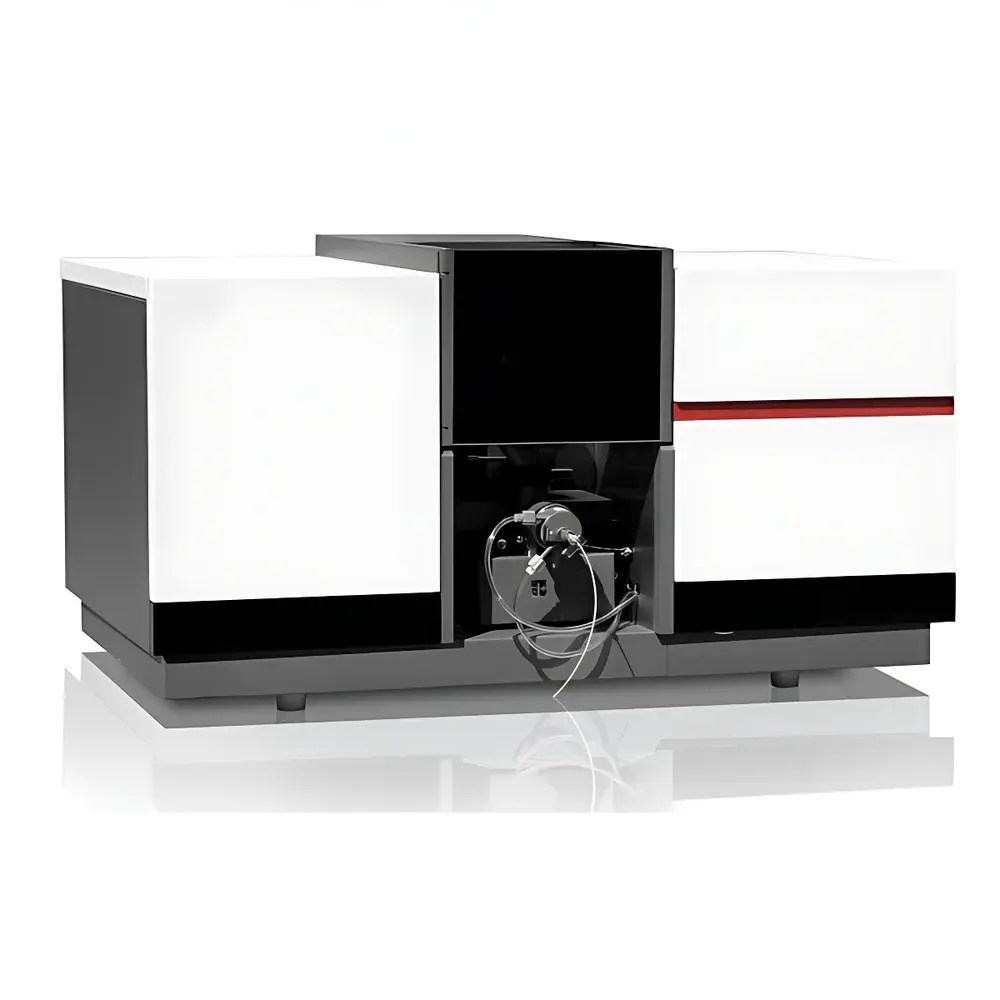
ZOLIX AA-5000 Series Flame and Graphite Furnace Atomic Absorption Spectrometer
| Brand | ZOLIX |
|---|---|
| Origin | Beijing, China |
| Manufacturer Type | Manufacturer |
| Instrument Type | Flame and Graphite Furnace AAS |
| Monochromator | Czerny-Turner grating monochromator with 1800 lines/mm grating |
| Optical System | Single-beam |
| Background Correction | Deuterium lamp + Self-reversal (Self-absorption) background correction |
| Wavelength Range | 190–900 nm |
| Spectral Bandwidth | 0.1/0.2/0.4/1.0/2.0 nm (5-step automatic switching) |
| Cu Detection Limit (Flame) | ≤0.003 µg/mL |
| Cd Characteristic Mass (GFAAS) | 0.3×10⁻¹² g |
| Cd Detection Limit (GFAAS) | 0.2×10⁻¹² g |
| Graphite Furnace Temp. Range | Room temperature to 3000 °C |
| Max. Sample Volume (GFAAS) | 70 µL |
| Background Correction Capacity | >60× at up to 1.0 A absorbance |
Overview
The ZOLIX AA-5000 Series Flame and Graphite Furnace Atomic Absorption Spectrometer is a dual-mode analytical instrument engineered for high-precision elemental quantification across trace and ultra-trace concentration ranges. Based on the fundamental principle of atomic absorption spectroscopy—where ground-state free atoms in a flame or graphite furnace vapor phase absorb characteristic radiation from hollow cathode lamps—the system delivers quantitative analysis of over 70 elements, including refractory, volatile, and hydride-forming species. Its optical architecture employs a single-beam Czerny-Turner monochromator with an 1800 lines/mm holographic grating, optimized for high photon throughput and spectral resolution (<0.1 nm). The instrument integrates flame and electrothermal atomization within a compact, unified chassis—enabling rapid, tool-free switching between modes without optical realignment. Designed for compliance-driven laboratories, the AA-5000 meets core performance criteria outlined in ASTM E1905, ISO 11170, and USP , supporting method validation under GLP and GMP frameworks.
Key Features
- Suspended optical bench design minimizes sensitivity to mechanical vibration and ambient thermal drift, ensuring long-term baseline stability (≤0.002 A/30 min static).
- Dual-background correction: Deuterium lamp (190–350 nm) and self-reversal (broadband, 190–900 nm) modes operate independently or concurrently, correcting up to 1.0 A background absorbance with >60× correction efficiency.
- Integrated dual-atomizer platform: Flame burner head (100 mm titanium or 50 mm stainless steel) and transversely heated graphite furnace coexist in one housing; automated 2-second mode switching eliminates manual reconfiguration.
- Graphite furnace with optical temperature control: Achieves ≥3000 °C peak temperature with ≤1% accuracy (1000–3000 °C range) and ≤0.5% temperature reproducibility; supports 20-step programmable heating with ramp, hold, and step modes.
- 8-lamp automated turret with motorized positioning: Fully software-controlled selection, alignment, and current optimization; enables sequential multi-element analysis without user intervention.
- Titanium雾化系统 (fogging system): Precision-cast pure titanium nebulizer chamber and burner head resist corrosion from HF-containing matrices and extend service life beyond 5,000 analytical cycles.
- Real-time graphite furnace visualization: Integrated color CCD camera enables live monitoring of sample injection, drying, charring, atomization, and residue formation—critical for method development and interference diagnosis.
Sample Compatibility & Compliance
The AA-5000 accommodates aqueous, organic, and digested solid samples (e.g., soil extracts, biological tissues, food homogenates, geological leachates) via flame, graphite furnace, or hydride generation interfaces. It supports full integration with the optional HG-01 ceramic-heated quartz tube hydride generator for As, Se, Hg, Pb, Bi, Sb, Sn, and Te—achieving sub-pg detection limits. For regulated environments, the system complies with data integrity requirements of FDA 21 CFR Part 11 through audit-trail-enabled software, electronic signatures, role-based access control, and immutable raw-data archiving. All calibration, QC, and sample run metadata—including lamp usage time, graphite furnace cycle count, gas pressure logs, and water-cooling flow status—are automatically timestamped and stored. Instrument qualification documentation aligns with ICH Q2(R2) guidelines for analytical procedure validation.
Software & Data Management
The Windows-based ZOLIX AAS Control Suite provides comprehensive instrument automation and data governance. Key capabilities include: automatic wavelength scanning and slit width selection (five bandwidths); intelligent power-frequency recognition for stable operation under variable grid conditions; dynamic baseline correction and multi-point curve fitting (linear, quadratic, cubic, standard addition); QA/QC modules for SD/RSD, correlation coefficient, baseline drift, and upper-limit violation alerts; and automated re-analysis triggers upon QC failure. Data management conforms to ISO/IEC 17025:2017 Annex A.3 requirements: full audit trail (user action, timestamp, parameter change), electronic signature enforcement, encrypted backup, and granular permission tiers (admin, analyst, reviewer). Remote diagnostics and data export (CSV, XML, PDF) are supported via Ethernet interface.
Applications
The AA-5000 serves as a primary elemental analyzer in environmental monitoring (EPA Method 7000B, ISO 11885), clinical toxicology (blood Pb, urinary Cd), metallurgical QC (Ni, Co, Mo in alloys), agrochemical residue testing (As in rice, Se in soil), and pharmaceutical impurity profiling (catalyst metals per ICH Q3D). Its high-temperature graphite furnace enables robust analysis of refractory elements (V, Nb, Ta) and carbon-rich matrices, while the hydrogenation module delivers reliable speciation-ready data for regulatory reporting. The system’s ≤0.95% RSD for Cd (1 µg/L) and ≤1.49% RSD for Mo (40 µg/L) confirm suitability for ISO 17294-2 certified water testing labs.
FAQ
Does the AA-5000 support both flame and graphite furnace analysis without hardware reconfiguration?
Yes. The integrated dual-atomizer design allows software-triggered, fully automated switching between flame and graphite furnace modes in under two seconds—with no optical realignment required.
What background correction methods are available, and what is their maximum correction capacity?
Deuterium lamp correction (190–350 nm) and self-reversal correction (190–900 nm) are both implemented. The system reliably corrects background absorbance up to 1.0 A with >60× correction factor.
Is the software compliant with FDA 21 CFR Part 11 requirements?
Yes. The control software includes electronic signatures, audit trails, role-based permissions, data encryption, and immutable raw-data storage—fully supporting Part 11 validation protocols.
Can the graphite furnace accommodate large-volume injections for low-concentration samples?
Yes. The optimized furnace geometry supports up to 70 µL sample volume, enabling improved detection limits for dilute environmental or biological matrices.
What safety interlocks are built into the flame and graphite furnace systems?
Comprehensive hardware/software interlocks include acetylene leak detection, air pressure monitoring, water seal level sensing, nitrous oxide flow verification, graphite furnace overheat cutoff, and real-time cooling water flow surveillance—all linked to automatic gas shutoff and power interruption.





