
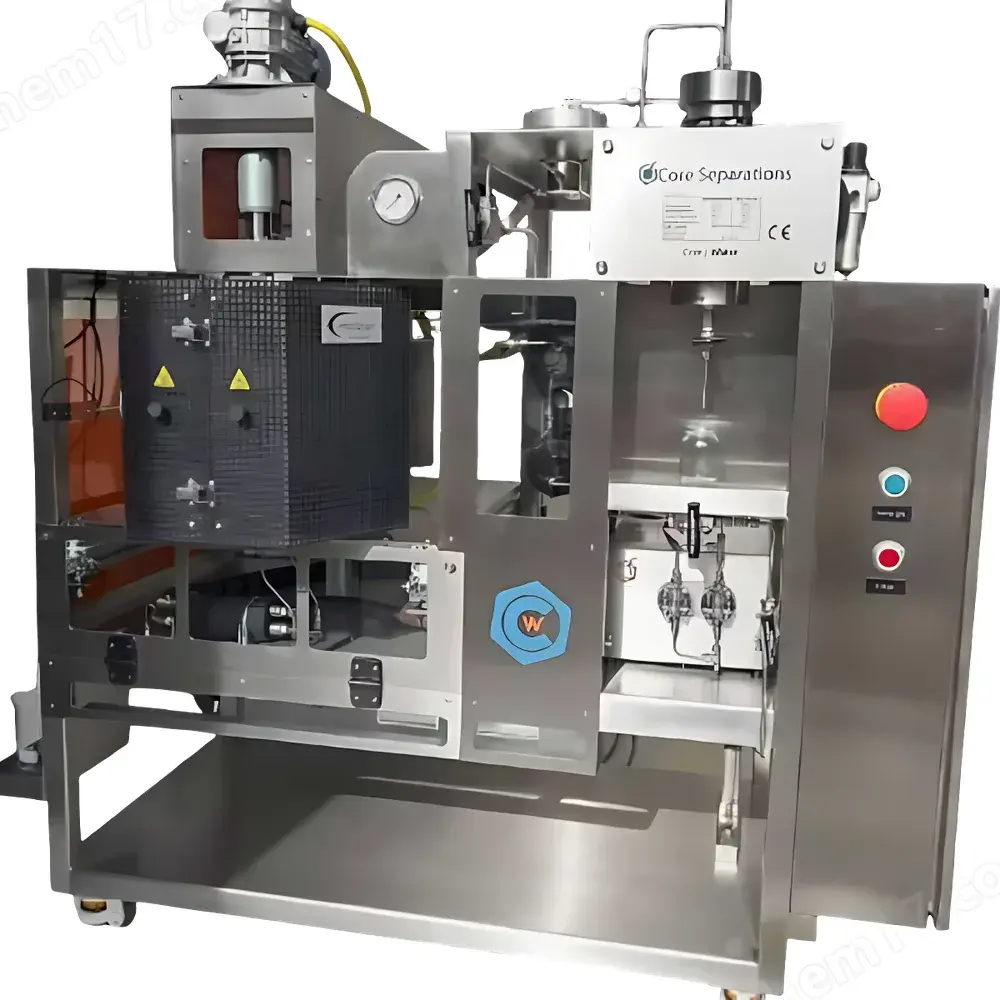
Core Separations Subcritical Water Extraction System
| Brand | Core Separations |
|---|---|
| Origin | USA |
| Manufacturer Type | Authorized Distributor |
| Origin Category | Imported |
| Model | Subcritical Water Extraction System |
| Price Range | USD 210,000 – 280,000 |
| Max Temperature | 400 °C |
| Max Pressure | 550 bar |
| Flow Rate Range | 5–200 g/min |
Overview
The Core Separations Subcritical Water Extraction System is a high-integrity, bench-scale continuous-flow extraction platform engineered for controlled thermolysis, hydrolysis, and selective compound isolation using water in its subcritical state (i.e., liquid-phase water at temperatures between 100 °C and 400 °C and pressures sufficient to maintain liquid density > 0.3 g/cm³). Unlike supercritical CO₂ systems, this instrument leverages the tunable polarity, dielectric constant, and solvation power of subcritical water—properties that shift dramatically with temperature and pressure—to enable selective extraction of polar, semi-polar, and thermally labile analytes from complex matrices such as plant biomass, food waste, pharmaceutical residues, and environmental solids. The system operates on a closed-loop, fully pressurized flow architecture with integrated thermal management, ensuring reproducible residence time control, minimized thermal degradation, and compliance with ISO 17025 traceability requirements for method development laboratories.
Key Features
- Robust reactor vessel constructed from Inconel® 625 alloy—resistant to chloride-induced stress corrosion cracking and oxidation under prolonged exposure to subcritical aqueous environments up to 400 °C and 550 bar.
- Annular furnace heating system surrounding the reactor core, enabling uniform radial heat distribution and eliminating localized hot spots; designed with mechanical interlocks to prevent access during pressurized operation.
- Continuous-flow configuration with adjustable mass flow control (5–200 g/min), supporting both steady-state extraction and dynamic parameter ramping for method optimization.
- Integrated cryogenic trap (−40 °C) downstream of the reactor outlet, condensing vapor-phase water and facilitating quantitative recovery of non-volatile extracts while minimizing solvent carryover.
- Top-mounted magnetic or mechanical agitator (optional) for enhanced solid–liquid mass transfer during slurry-based extractions.
- Intermittent (batch-mode) capability: maintains set pressure without flow, enabling static soaking periods for diffusion-limited extractions—critical for lignocellulosic or mineral-bound target compounds.
- Automated fraction collector with programmable timing and pressure-triggered sampling, supporting unattended operation across multi-hour extraction sequences and GLP-compliant audit trails.
Sample Compatibility & Compliance
The system accommodates solid, semi-solid, and slurry samples—including dried botanicals, fermented feedstocks, spent catalysts, and municipal compost—with particle size recommendations ≤ 500 µm for optimal flow homogeneity. All wetted components meet ASTM B443 Grade 1 specifications for nickel-based alloys. Pressure containment design conforms to ASME Boiler and Pressure Vessel Code Section VIII, Division 3 (high-pressure systems), and instrumentation complies with IEC 61000-6-2/6-4 for electromagnetic compatibility. Data acquisition supports 21 CFR Part 11–compliant electronic signatures when paired with validated software modules.
Software & Data Management
Control and monitoring are executed via a real-time embedded HMI running deterministic RTOS firmware, with optional Ethernet/IP or Modbus TCP connectivity for integration into centralized LIMS or MES platforms. Extraction logs—including temperature, pressure, mass flow, trap temperature, and actuator status—are timestamped with UTC synchronization and stored in CSV/SQLite formats. Raw data files include cryptographic hash verification for integrity assurance. Optional validation packages provide IQ/OQ documentation templates aligned with GMP Annex 15 and USP analytical instrument qualification guidelines.
Applications
- Green extraction of polyphenols, flavonoids, and alkaloids from herbal matrices without organic solvents.
- Depolymerization and fractionation of lignin and hemicellulose in biorefinery R&D.
- Recovery of heavy metals and rare earth elements from contaminated soils and electronic waste leachates.
- Accelerated solvent extraction (ASE)-equivalent workflows compliant with EPA Method 3546 modifications.
- Stability-indicating forced degradation studies of APIs under hydrothermal stress conditions (ICH Q1A–Q1E).
- Development of water-only cleaning protocols for reusable labware in regulated QC environments.
FAQ
What distinguishes subcritical water extraction from supercritical fluid extraction?
Subcritical water retains liquid-phase density and hydrogen-bonding capacity, enabling efficient dissolution of polar organics and inorganic salts—unlike supercritical CO₂, which requires co-solvents for similar functionality.
Can the system be used for acidic or alkaline aqueous media?
Yes—Inconel 625 provides exceptional resistance to pH extremes (pH 1–13) at elevated temperatures; however, long-term exposure to >10 ppm chloride above 300 °C is not recommended without corrosion monitoring.
Is third-party calibration certification available?
Factory calibration certificates traceable to NIST standards are provided for all pressure transducers and RTD sensors; on-site calibration services are offered globally through authorized service partners.
What maintenance intervals are recommended for high-temperature operation?
Valve seals and O-rings should be inspected every 200 operational hours above 350 °C; furnace insulation integrity checks are advised annually per ASME PCC-2 guidelines.
Does the system support method transfer to industrial-scale units?
Yes—dimensionless scaling parameters (e.g., Reynolds number, Froude number, and Damköhler number) are logged and exportable to facilitate geometric and dynamic similarity modeling for pilot- and production-scale replication.



