
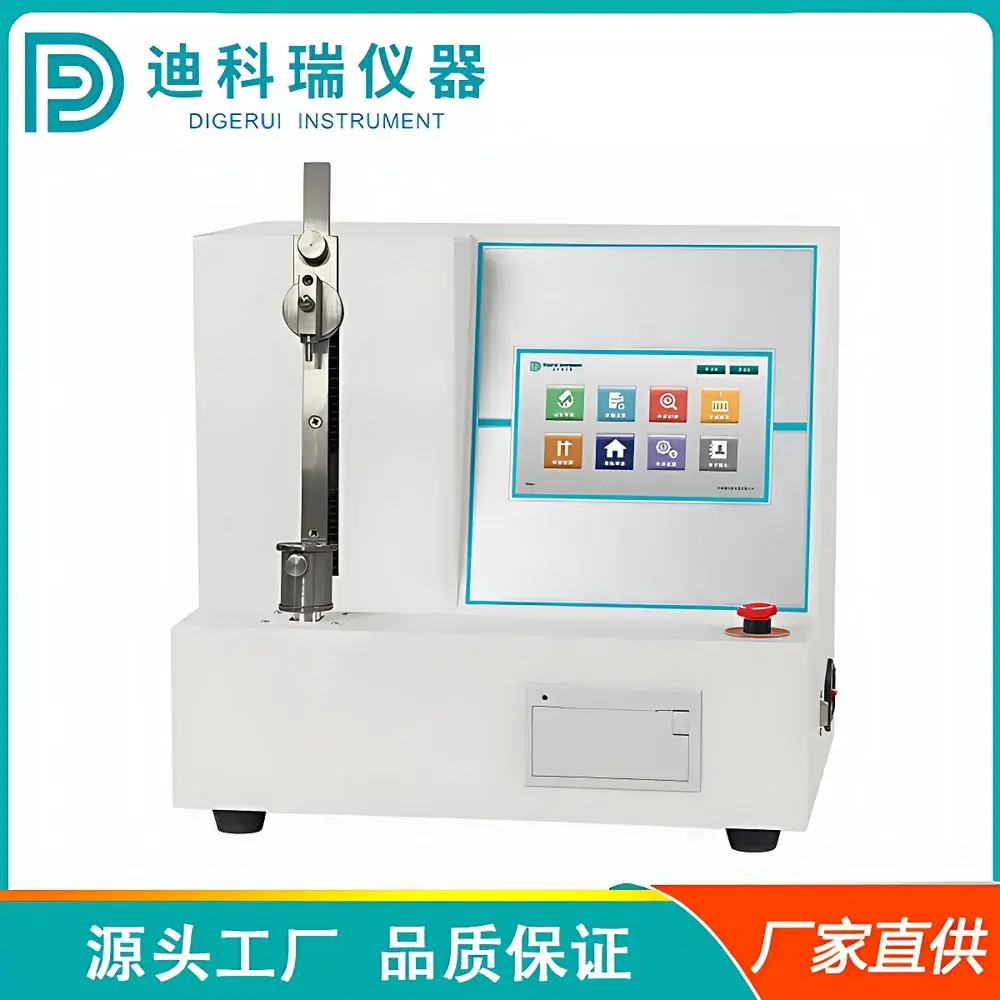
Digerui DKR Needle Tip Penetration Force Tester
| Brand | Digerui |
|---|---|
| Origin | Shandong, China |
| Manufacturer Type | Direct Manufacturer |
| Country of Origin | China |
| Model | DKR |
| Price | USD 140 (approx.) |
| Key Standards | GB 15811-2016, YY/T 0167, ISO 7864, ASTM F2182 |
| Nominal Needle Gauge Range | 0.2–3.4 mm |
| Force Measurement Range | 0–20 N (standard), 0–50 N (optional) |
| Force Accuracy | ±0.5% FS |
| Crosshead Speed Range | 0–500 mm/min |
| Speed Accuracy | Class 0.5 |
| Penetration Substrate | Medical-grade polyurethane membrane per GB 15811 |
| Display | 7-inch industrial capacitive touchscreen |
| Data Output | Built-in thermal printer |
| Software | Multi-level user permission management, remote firmware update capability |
| Compliance | Designed for GLP-aligned lab environments |
Overview
The Digerui DKR Needle Tip Penetration Force Tester is a precision-engineered mechanical testing instrument designed specifically for quantifying the puncture resistance of hypodermic needle tips during controlled penetration into standardized biological simulant materials. It operates on the principle of axial force measurement under defined kinematic conditions: a mounted needle is driven vertically at a regulated speed through a certified polyurethane membrane—representing human skin biomechanical response—and the peak force required to achieve full penetration is recorded as the needle’s penetration force. This value directly correlates with clinical sharpness, patient comfort, and device safety compliance. The system adheres to internationally harmonized test protocols specified in GB 15811-2016 (Chinese national standard for disposable sterile hypodermic needles), YY/T 0167 (Chinese pharmaceutical packaging and device standards), ISO 7864 (sterile hypodermic needles for single use), and ASTM F2182 (standard test method for needle tip penetration force). Its architecture integrates load cell metrology, closed-loop motion control, and traceable calibration pathways to ensure repeatable, inter-laboratory comparable results essential for regulatory submissions and quality assurance workflows.
Key Features
- Industrial-grade 7-inch capacitive touchscreen interface with intuitive menu navigation—designed for glove-compatible operation in cleanroom and QC laboratory settings
- High-fidelity load cell with ±0.5% full-scale accuracy, calibrated to ISO/IEC 17025-accredited reference standards
- Programmable crosshead speed from 0 to 500 mm/min, adjustable in 0.1 mm/min increments, with Class 0.5 velocity fidelity per JJG 475 calibration requirements
- Dual-range force measurement capability: standard 0–20 N configuration optimized for common gauge needles (25G–18G); optional 0–50 N extension supports heavy-duty applications including spinal or bone marrow needles
- Integrated thermal printer for immediate hard-copy documentation of test reports—including date/time stamp, operator ID, sample ID, force curve snapshot, and pass/fail status against selected standard thresholds
- Firmware architecture supports secure over-the-air (OTA) updates via Ethernet or USB, enabling continuous alignment with evolving regulatory guidance without hardware intervention
Sample Compatibility & Compliance
The DKR tester accommodates all standard hypodermic needle configurations within the nominal gauge range of 0.2 mm (30G) to 3.4 mm (10G), including stainless steel, coated, and polymer-coated variants. Test substrates consist exclusively of medical-grade polyurethane membranes manufactured to strict dimensional and durometer tolerances per GB 15811 Annex B specifications—ensuring consistent surface modulus, thickness (2.0 ± 0.1 mm), and tear resistance across batches. The system supports multi-standard test method selection (e.g., GB 15811 Clause 5.3, ISO 7864 Clause 6.3, ASTM F2182 Section 7), each with preloaded parameters for speed, dwell time, and acceptance criteria. All test logs retain metadata required for FDA 21 CFR Part 11 compliance when operated with enabled electronic signature and audit trail modules.
Software & Data Management
The embedded control software features role-based access control (RBAC) with three configurable privilege tiers: Operator (test execution only), Supervisor (method editing and calibration verification), and Administrator (system configuration, user management, and audit log review). Each action—including parameter modification, calibration event, or result deletion—is timestamped and linked to a unique user credential. Raw force-time datasets are exportable in CSV and PDF formats, preserving native sampling resolution (≥100 Hz). Optional PC-hosted data management software enables long-term trending analysis, SPC charting (X̄–R charts), and integration with LIMS platforms via HL7 or RESTful API interfaces. Calibration certificates include uncertainty budgets compliant with GUM (Guide to the Expression of Uncertainty in Measurement) methodology.
Applications
- Final release testing of sterile disposable needles prior to packaging and distribution
- Process validation and in-process monitoring during needle point grinding and electrochemical sharpening operations
- Comparative evaluation of coating technologies (e.g., silicone vs. diamond-like carbon) on penetration performance
- Root cause analysis of needle tip deformation or premature blunting observed in field complaints
- Supporting design verification per ISO 14971 risk management files for Class IIa/IIb medical devices
- Training and competency assessment for QA technicians performing physical testing per ISO/IEC 17025 clause 6.2.5
FAQ
What standards does the DKR tester natively support?
GB 15811-2016, YY/T 0167, ISO 7864, and ASTM F2182 are preconfigured in the firmware; custom methods may be defined for other regional or internal specifications.
Is the polyurethane membrane supplied with the instrument?
Yes—each unit ships with one certified batch of GB-compliant membrane (100-sheet pack); additional consumables are available under part number DKR-MEM-PU20.
Can test data be exported to Excel or LIMS?
Raw CSV files and formatted PDF reports are exportable via USB drive; optional network-enabled version supports automated LIMS push via configurable HTTP POST endpoints.
Does the system meet FDA 21 CFR Part 11 requirements?
When deployed with enabled electronic signatures, audit trails, and secure user authentication, the DKR satisfies predicate rules for Part 11 compliance in regulated environments.
What maintenance is required to sustain measurement accuracy?
Annual recalibration by an ISO/IEC 17025-accredited provider is recommended; daily verification using NIST-traceable check weights and speed calibrators is advised per internal SOPs.



