
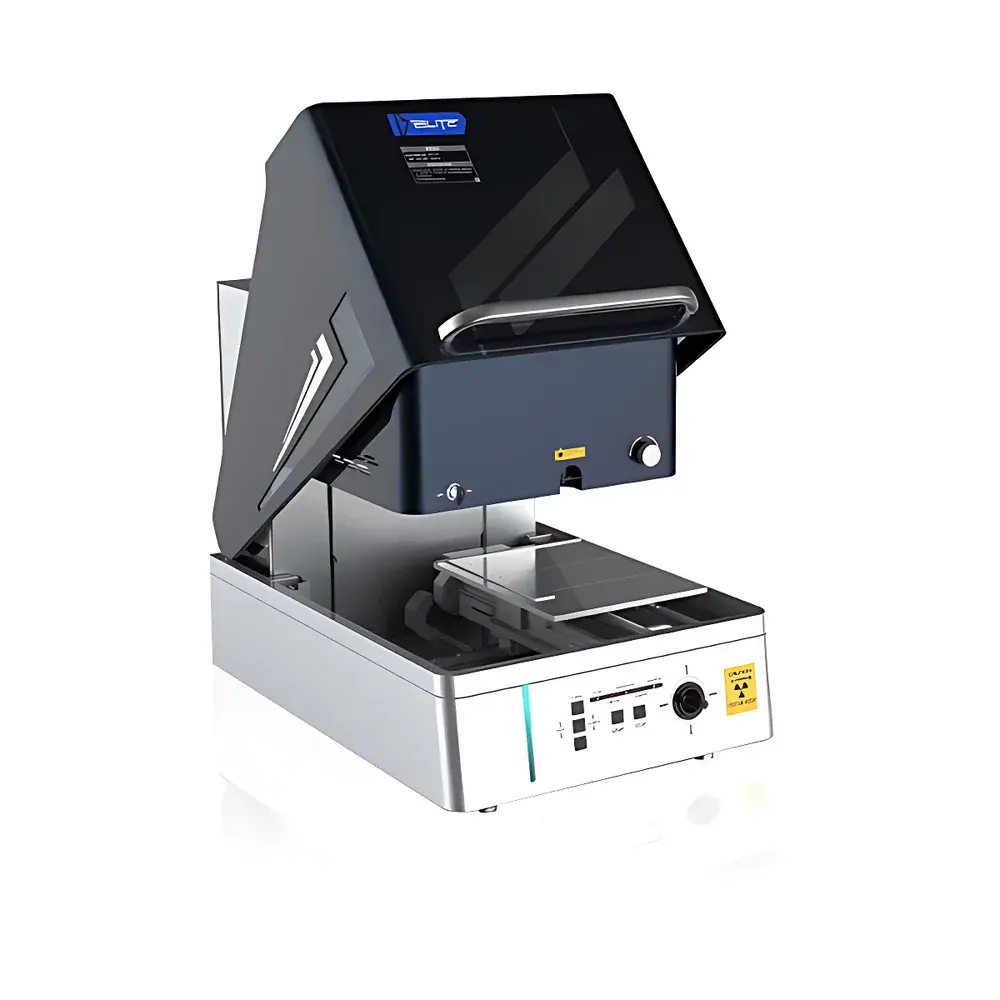
Elite Capillary-Focused XRF Thickness Analyzer Model CF-5μm
| Brand | Elite |
|---|---|
| Origin | Jiangsu, China |
| Manufacturer Type | Authorized Distributor |
| Regional Classification | Domestic (China) |
| Model | Capillary-Focused |
| Price Range | USD 112,000 – 155,000 |
Overview
The Elite Capillary-Focused XRF Thickness Analyzer Model CF-5μm is a high-resolution micro-X-ray fluorescence (μ-XRF) instrument engineered for non-destructive, quantitative thickness measurement of ultra-thin metallic coatings and multi-layer stacks on microelectronic components. Unlike conventional collimated XRF systems relying on pinhole or slit metal apertures, this analyzer employs a polycapillary optic — a bundled array of hollow glass capillaries — to focus the primary X-ray beam to a nominal full width at half maximum (FWHM) spot size of ≤5 µm. This optical architecture enables true micro-area analysis with spatial resolution unattainable via standard collimation. The system operates on fundamental parameter (FP)-based quantification principles, where characteristic X-ray intensities (Kα/Kβ lines) are modeled using matrix correction algorithms that account for absorption, enhancement, and geometry effects. It is optimized for routine metrology in semiconductor packaging, PCB manufacturing, connector plating, leadframe evaluation, and wafer-level interconnect characterization — environments demanding sub-10 nm coating thickness resolution and trace-level elemental sensitivity in localized regions.
Key Features
- Capillary-optic beam focusing delivering ≤5 µm FWHM spot size for true micro-area analysis
- Primary beam intensity enhancement of >1000× compared to equivalent metal-collimated systems, enabling higher photon flux at the sample surface
- Proprietary EFP (Enhanced Fundamental Parameters) algorithm for rapid, matrix-corrected quantification of single- and multi-layer coatings (e.g., Ni/Cu/Sn, Au/Ni/Cu, Pd/Ni/Cu)
- Motorized XYZ stage with sub-micron repeatability and integrated high-magnification optical camera for precise feature localization and AI-assisted auto-targeting
- Modular measurement head design: all critical components — X-ray tube, capillary optic, SDD detector, and collimator — housed in a sealed, field-replaceable unit for plug-and-play integration into production lines
- Optional large-chamber configuration and motorized translation platform supporting samples up to 300 mm × 300 mm
- Automated shutter mechanism with responsive open/close logic synchronized to stage positioning and imaging workflow
Sample Compatibility & Compliance
The CF-5μm accommodates rigid and planar substrates including silicon wafers, ceramic substrates, FR-4 and polyimide-based PCBs, stamped metal leadframes, and molded interconnect devices (MIDs). It supports both flat and gently curved surfaces (radius ≥50 mm). Coating systems routinely analyzed include electroplated and electroless deposits of Au, Ag, Sn, Ni, Cu, Pd, Pt, Rh, Cr, and Zn — typically ranging from 0.5 nm to 50 µm in thickness. The instrument complies with IEC 61000-6-3 (EMC emission standards) and IEC 61000-6-2 (immunity), and meets mechanical safety requirements per ISO 13857. While not certified as a medical device or GLP/GMP-compliant out-of-the-box, its data acquisition and reporting architecture supports audit-ready operation when deployed with validated SOPs and configured for 21 CFR Part 11–compliant software extensions (available upon request).
Software & Data Management
Control and analysis are performed via Elite’s XRFMaster v4.x platform, a Windows-based application featuring intuitive workflow sequencing, real-time spectral visualization, and batch report generation in PDF/CSV/XLSX formats. The software implements full spectral deconvolution using least-squares fitting with library-based peak identification (NIST X-ray line database). All measurement parameters — voltage, current, live time, detector gain, and calibration coefficients — are stored with each spectrum in an embedded metadata structure. Audit trail functionality logs user actions, method changes, and result modifications with timestamps and operator IDs. Raw spectra and processed results are exportable in standardized .rtd (Rigaku-compatible) and .xrf formats for third-party validation or LIMS integration.
Applications
- Thickness mapping of solderable finishes (e.g., ENIG, ENEPIG, immersion Sn/Ag) on fine-pitch BGA pads and QFN land patterns
- Quantitative analysis of barrier layers (Ni, Pd) beneath precious metal caps in wire-bondable surfaces
- In-line verification of electroplated contact plating uniformity across connector pins and terminals
- Multi-layer stack characterization in MEMS packaging and RF shield coatings
- R&D support for plating bath optimization through nanoscale thickness trend analysis across wafer lots
- Failure analysis of delamination or interdiffusion by depth-resolved layer interrogation using variable take-off angle measurements
FAQ
What is the minimum measurable coating thickness with this system?
For high-Z elements (e.g., Au, Ni) on low-Z substrates (e.g., Cu, FR-4), detection limits are typically ≤0.3 nm (1σ) under optimized conditions; practical quantification lower limits range from 0.5 nm to 1 nm depending on matrix and acquisition time.
Can the system analyze non-planar or irregularly shaped samples?
Yes — optional height-sensing Z-axis compensation and tilt-adjustable stages allow stable analysis on mildly contoured surfaces; however, extreme curvature or deep recesses may require custom fixturing.
Is the capillary optic replaceable in the field?
Yes — the entire optical module is pre-aligned and shipped as a sealed, calibrated subassembly; replacement requires no realignment or recalibration beyond standard energy calibration verification.
Does the instrument support regulatory compliance for quality-controlled manufacturing?
When paired with documented IQ/OQ protocols and configured with optional electronic signature and audit trail modules, the system supports deployment in ISO 9001, IATF 16949, and IPC-4552A-compliant environments.
What maintenance intervals are recommended for routine operation?
Capillary optics require no scheduled maintenance; the X-ray tube is rated for ≥15,000 hours; annual preventive maintenance includes detector resolution verification, vacuum integrity check, and stage calibration.
Related Products



