
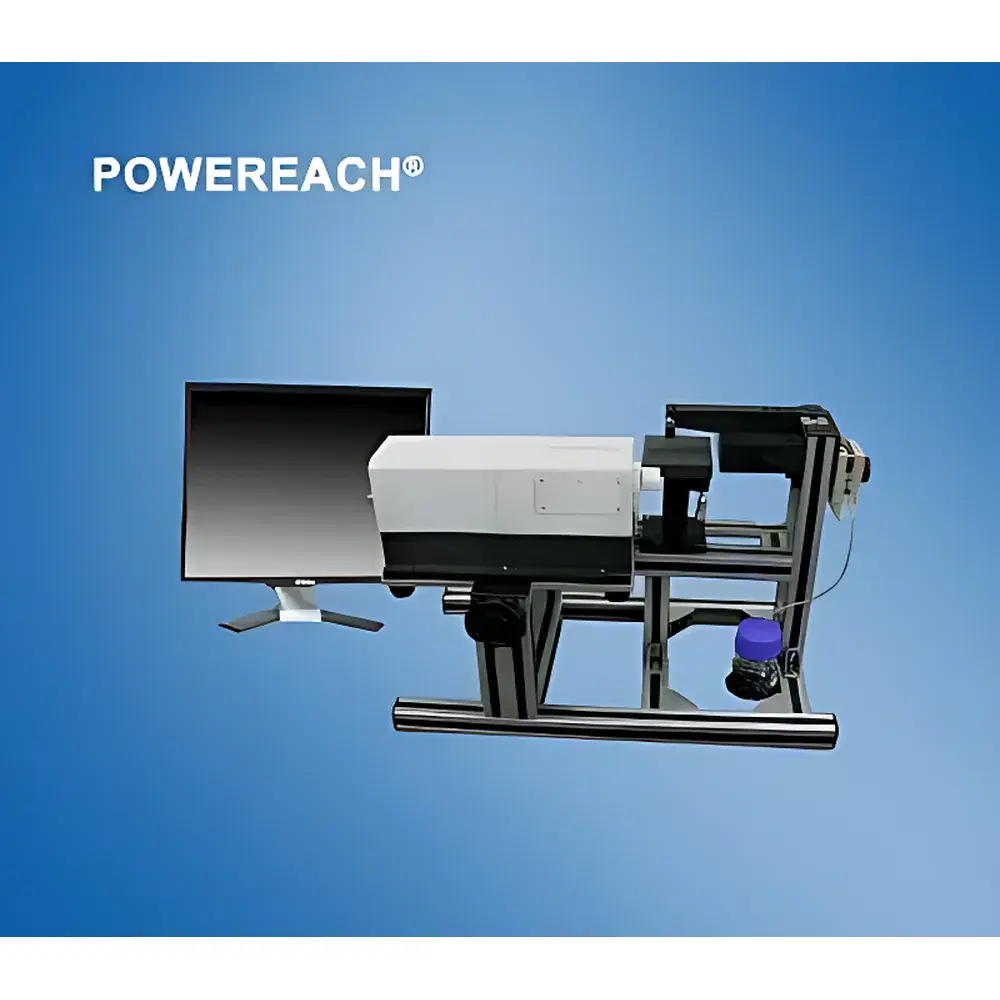
POWEREACH JJ2000B2 Dual-Mode Rotating Drop Interfacial Tensiometer & Contact Angle Goniometer
| Brand | POWEREACH |
|---|---|
| Origin | Shanghai, China |
| Model | JJ2000B2 |
| Measurement Range (Interfacial Tension) | 1×10⁻⁶ mN/m to 100 mN/m |
| Resolution | 0.001 mN/m |
| Accuracy | <2% (100 mN/m to 10⁻² mN/m), <8% (10⁻³ mN/m to 10⁻⁶ mN/m) |
| Rotational Speed Range | 2000–10,000 rpm |
| Speed Stability | ±0.1% |
| Temperature Control Range | Ambient to 95 °C |
| Capillary Inner Diameter | 2 mm / 4 mm |
| Contact Angle Range | 0–180° |
| Contact Angle Resolution | 0.01° |
| Image Magnification | 50–318 px/mm |
| Frame Rate | Up to 30 fps (continuous), programmable interval capture (1–3600 s) |
| Power Consumption | <50 W |
Overview
The POWEREACH JJ2000B2 is a dual-function laboratory instrument engineered for high-precision interfacial characterization in research and quality control environments. It integrates two physically distinct but optically unified measurement modules: a rotating drop interfacial tensiometer and a contact angle goniometer. The rotating drop method operates on the principle of centrifugal force-induced droplet deformation in a density-matched fluid system; under controlled rotation, the equilibrium shape of a pendant droplet suspended in an immiscible continuous phase is analyzed via Laplace equation fitting to determine interfacial tension with exceptional sensitivity down to 1×10⁻⁶ mN/m. Simultaneously, the goniometric module employs high-resolution video capture and automated edge-detection algorithms to quantify static and dynamic contact angles using multiple analytical methods—including tangent, circle, ellipse, and Young–Laplace curve-fitting—enabling rigorous assessment of solid surface wettability, heterogeneity, and energy distribution.
Key Features
- Dual-mode architecture: Single optical path shared between rotating drop and sessile/drop-on-fiber contact angle configurations—minimizing alignment drift and maximizing reproducibility across measurement modes.
- High-stability rotational stage: Brushless DC motor with closed-loop speed control ensures ±0.1% rotational accuracy from 2000 to 10,000 rpm, critical for low-tension measurements where minor speed fluctuations induce significant shape deviation.
- Thermostatically regulated sample chamber: Peltier-assisted temperature control (ambient to 95 °C) enables isothermal interfacial studies under process-relevant conditions, supporting ASTM D971 and ISO 6295 compliance protocols.
- Modular capillary system: Interchangeable quartz capillaries (2 mm and 4 mm inner diameter) allow optimization for viscosity range and interfacial sensitivity—smaller diameters enhance resolution at ultralow tensions (<10⁻⁴ mN/m).
- Manual precision positioning: Three-axis mechanical stage (X/Y/Z) with calibrated micrometers provides sub-millimeter repeatability for sample placement and lens focus; vertical travel (45 mm), horizontal translation (50 mm), and lens fine-focus (10 mm) are all manually actuated for stability and longevity.
- Optical imaging subsystem: Continuous zoom optical train (50–318 px/mm magnification) coupled with progressive-scan CCD camera (30 fps real-time capture) supports both transient phenomena observation and high-fidelity static image acquisition.
Sample Compatibility & Compliance
The JJ2000B2 accommodates a broad spectrum of material systems without requiring surface modification or conductive coating. Solid substrates up to 20 mm thick and 100 × 70 mm in footprint are fully compatible, including polymers, metals, ceramics, textiles, and porous membranes. For liquid–liquid interfacial analysis, the system supports immiscible pairs across wide density and viscosity ranges—provided density matching is achievable within the operational temperature window. All measurements adhere to internationally recognized methodologies: rotating drop tensiometry follows ISO 14491 and ASTM D7490 guidelines; contact angle evaluation conforms to ISO 27448 and ASTM D7334 standards. Data acquisition and processing meet GLP documentation requirements, with timestamped image metadata, operator ID logging, and audit-trail-capable software architecture compatible with FDA 21 CFR Part 11 readiness when deployed with validated IT infrastructure.
Software & Data Management
The proprietary POWEREACH Surface Analysis Suite (v5.x) provides integrated control, real-time visualization, and quantitative post-processing. Core functions include automatic droplet contour extraction, dynamic contact angle tracking (advancing/receding), surface free energy calculation via Owens–Wendt, Fowkes, Wu, and van Oss–Chaudhury–Good models, and interfacial tension derivation from rotating drop profile fitting using numerical solutions of the augmented Young–Laplace equation. Raw images and processed data are stored in vendor-neutral formats (TIFF, CSV, XML) with embedded calibration parameters and environmental metadata. Software supports batch analysis, statistical reporting (mean, SD, CV%), and export to LIMS-compatible schemas. Lifetime free updates ensure continued compatibility with evolving OS platforms and regulatory expectations.
Applications
This instrument serves as a foundational tool in formulation science, materials development, and interfacial process engineering. Typical use cases include: screening surfactant efficacy in enhanced oil recovery (EOR) fluids; evaluating coating adhesion promoters on automotive or aerospace composites; characterizing hydrophobic/hydrophilic treatments on filtration membranes; quantifying protein adsorption kinetics at air–water interfaces; assessing ink–substrate interaction in printed electronics; and validating cleaning agent performance in semiconductor wafer fabrication. Its ultralow interfacial tension capability makes it especially valuable in microemulsion and nanoemulsion R&D, while its contact angle versatility supports biomaterials testing (e.g., blood–polymer interactions) and pharmaceutical tablet coating uniformity analysis.
FAQ
What is the minimum interfacial tension measurable with the JJ2000B2?
The instrument achieves reliable detection down to 1×10⁻⁶ mN/m under optimized conditions—using 2 mm capillaries, stable temperature control, and low-viscosity continuous phases.
Does the system support dynamic contact angle measurement?
Yes—via programmable dispensing and time-resolved image capture, enabling advancing/receding angle determination and hysteresis analysis.
Is the software compliant with 21 CFR Part 11 requirements?
The software architecture includes user authentication, electronic signatures, and audit trail generation; full Part 11 compliance requires site-specific validation and integration with qualified IT systems.
Can the JJ2000B2 be used for fiber or powder wettability analysis?
While primarily designed for flat substrates and liquid–liquid systems, optional accessories (e.g., fiber holders, powder compaction stages) extend applicability to single-fiber contact angle and modified Washburn analysis.
What maintenance is required for long-term rotational accuracy?
Annual calibration of the rotational encoder and periodic verification of capillary concentricity are recommended; no routine lubrication or consumable replacement is needed due to brushless motor design and fused-silica optical components.



