
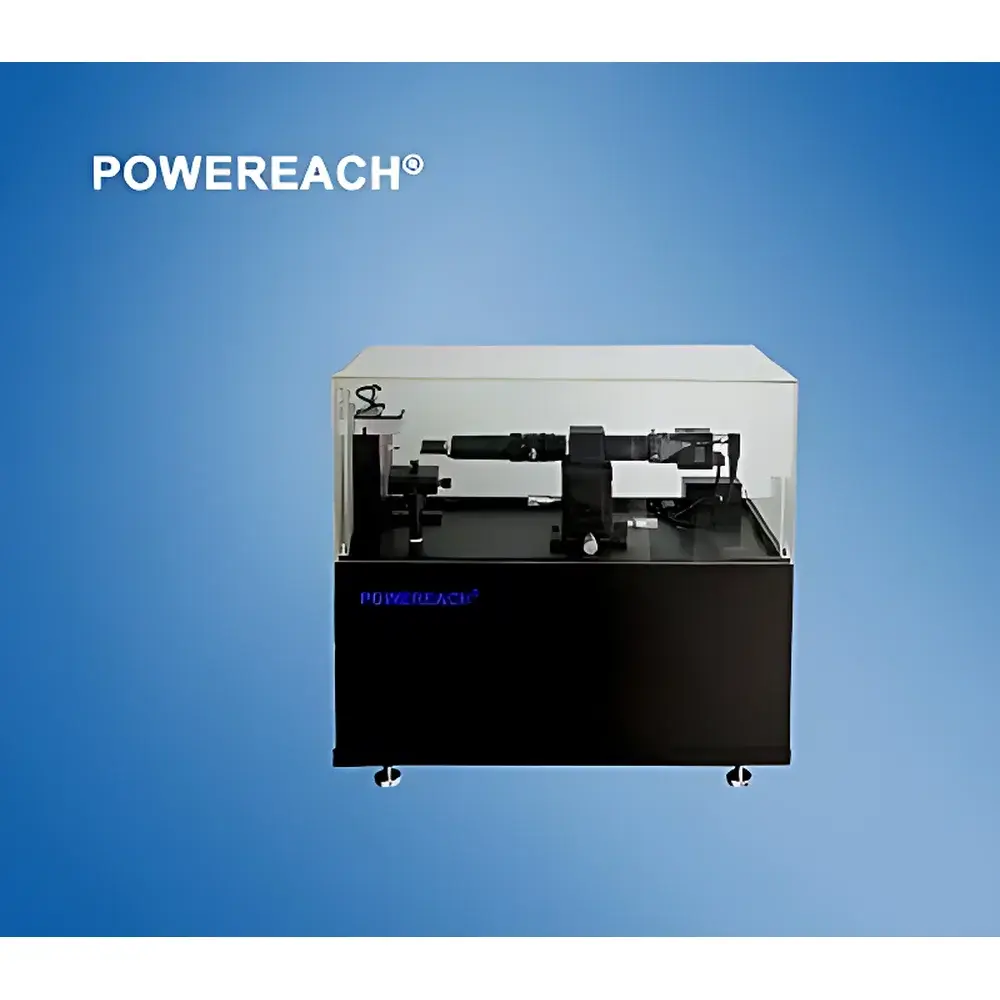
POWEREACH JQ03D Single-Fiber Tensile-Compression-Bending Tester
| Brand | POWEREACH (Shanghai Zhongchen) |
|---|---|
| Origin | Shanghai, China |
| Model Series | JQ03 |
| Compliance | ASTM D3822, ISO 5079, GB/T 14337, GB/T 14338, USP <1061> (Fiber Mechanical Testing Guidance) |
| Force Range | 0.1 mN – 500 mN (selectable full-scale ranges) |
| Displacement Resolution | ≤ 0.1 µm |
| Strain Rate Control | 0.01 – 500 mm/min (programmable) |
| Integrated Imaging | 10×–100× motorized zoom optical module with real-time diameter/length measurement |
| Data Acquisition | 10 kHz sampling rate, synchronized force–displacement–image stream |
| Software | POWEREACH FiberTest v4.2 (GLP-compliant audit trail, 21 CFR Part 11 optional module) |
Overview
The POWEREACH JQ03D Single-Fiber Tensile-Compression-Bending Tester is a precision-engineered mechanical characterization system designed for quantitative evaluation of micro- and sub-micron scale fibrous materials under uniaxial tensile, compressive, and three-point bending loading conditions. Built upon Couette-type load cell architecture and high-resolution linear actuation, the instrument implements standardized quasi-static mechanical testing protocols aligned with ASTM D3822 (Standard Test Method for Tensile Properties of Single Textile Fibers), ISO 5079 (Textiles — Determination of Tensile Properties of Single Fibres), and Chinese national standards GB/T 14337 and GB/T 14338. Its dual-mode mechanical head integrates independent tension-compression and bending modules, enabling concurrent acquisition of stress–strain curves, flexural rigidity, bending recovery ratio, and post-fracture morphology—critical parameters for evaluating functional textiles, biomedical scaffolds (e.g., nerve guidance conduits), natural fibers (cashmere, spider silk), and advanced nanocomposite filaments.
Key Features
- Modular dual-function design: Interchangeable tensile-compression and three-point bending fixtures calibrated to NIST-traceable standards
- High-fidelity force transduction: Dual-range capacitive load cells (0.1–10 mN and 1–500 mN) with thermal drift compensation and ±0.2% FS accuracy
- Micrometer-level displacement control: Closed-loop stepper-driven stage with 0.1 µm positional resolution and programmable strain rates from 0.01 to 500 mm/min
- Synchronized multimodal imaging: Motorized optical zoom system (10×–100×) with real-time fiber diameter measurement (±0.2 µm repeatability), length tracking, and fracture morphology capture
- Environmentally stable operation: Temperature-compensated chamber (optional) supporting tests at 20–25°C ±0.5°C and 45–65% RH per ISO 139
- GLP-ready firmware: Timestamped raw data logging, user-access level management, and configurable electronic signatures
Sample Compatibility & Compliance
The JQ03D accommodates individual fibers ranging from 5 µm to 200 µm in diameter and 1 mm to 50 mm in gauge length—including animal fibers (wool, cashmere), regenerated cellulose (lyocell, viscose), synthetic polymers (polyester, nylon), biopolymers (collagen, chitosan), carbon nanotube assemblies, and electrospun nanofibers. Sample mounting utilizes pneumatically actuated micro-grippers (standard) or custom-machined slot fixtures for high-modulus or brittle fibers. All test protocols conform to ISO/IEC 17025 requirements for accredited laboratories. The system supports validation against reference standards including certified polyester monofilament (NIST SRM 2813 analog) and calibrated tungsten wire. Documentation packages include IQ/OQ templates compliant with FDA 21 CFR Part 11 and EU Annex 11 expectations.
Software & Data Management
POWEREACH FiberTest v4.2 is a Windows-based application developed in accordance with IEC 62304 Class B software safety requirements. It provides automated calculation of mechanical indices: tensile modulus (initial slope of stress–strain curve), breaking tenacity (MPa), elongation at break (%), work of rupture (mJ/g), flexural rigidity (µN·cm²), bending recovery ratio (%), and hysteresis energy loss. Raw force–displacement–time–image datasets are stored in HDF5 format with embedded metadata (operator ID, calibration certificate ID, environmental logs). Audit trails record all parameter modifications, report exports, and user logins. Optional 21 CFR Part 11 module enables electronic signatures, role-based access control, and immutable archive export for regulatory submissions.
Applications
- Quality assurance of specialty natural fibers: Quantifying stiffness degradation in aged silk or moisture-induced plasticization in wool
- Biomedical material development: Evaluating bending compliance of resorbable nerve guides under physiological hydration
- Nanocomposite fiber R&D: Correlating CNT dispersion homogeneity with tensile modulus distribution across 50+ single-filament replicates
- Textile trade standardization: Generating ISO 5079-compliant reports for cross-border certification of high-value cashmere lots
- Fundamental polymer physics: Mapping strain-rate dependence of viscoelastic dissipation in thermoplastic elastomer fibers
- Failure mechanism analysis: High-speed image synchronization (up to 1,000 fps via optional camera upgrade) for crack propagation studies during fracture
FAQ
What fiber diameters and lengths can the JQ03D accommodate?
The system supports fibers from 5 µm to 200 µm in diameter and 1 mm to 50 mm in effective gauge length. Custom fixtures extend compatibility to shorter (50 mm) specimens upon request.
Is the instrument compatible with ISO/IEC 17025-accredited laboratory workflows?
Yes. Full traceability documentation—including factory calibration certificates, uncertainty budgets, and IQ/OQ protocol templates—is provided. Software audit trails and electronic signature support align with GLP/GMP and ISO/IEC 17025 Clause 7.7 requirements.
Can the JQ03D perform cyclic loading or relaxation tests?
Yes. FiberTest v4.2 includes preconfigured protocols for stress relaxation, creep, and multi-cycle tensile loading with programmable hold times and ramp profiles.
What environmental controls are available?
Standard operation complies with ISO 139 (standard atmosphere: 20°C ±2°C, 65% RH ±4%). Optional temperature/humidity chamber (–10°C to +60°C, 10–90% RH) enables climate-dependent mechanical testing.
Does the system meet FDA 21 CFR Part 11 requirements for electronic records?
The optional 21 CFR Part 11 compliance package includes electronic signatures, audit trail encryption, role-based permissions, and immutable data archiving—validated per GAMP5 guidelines.





