
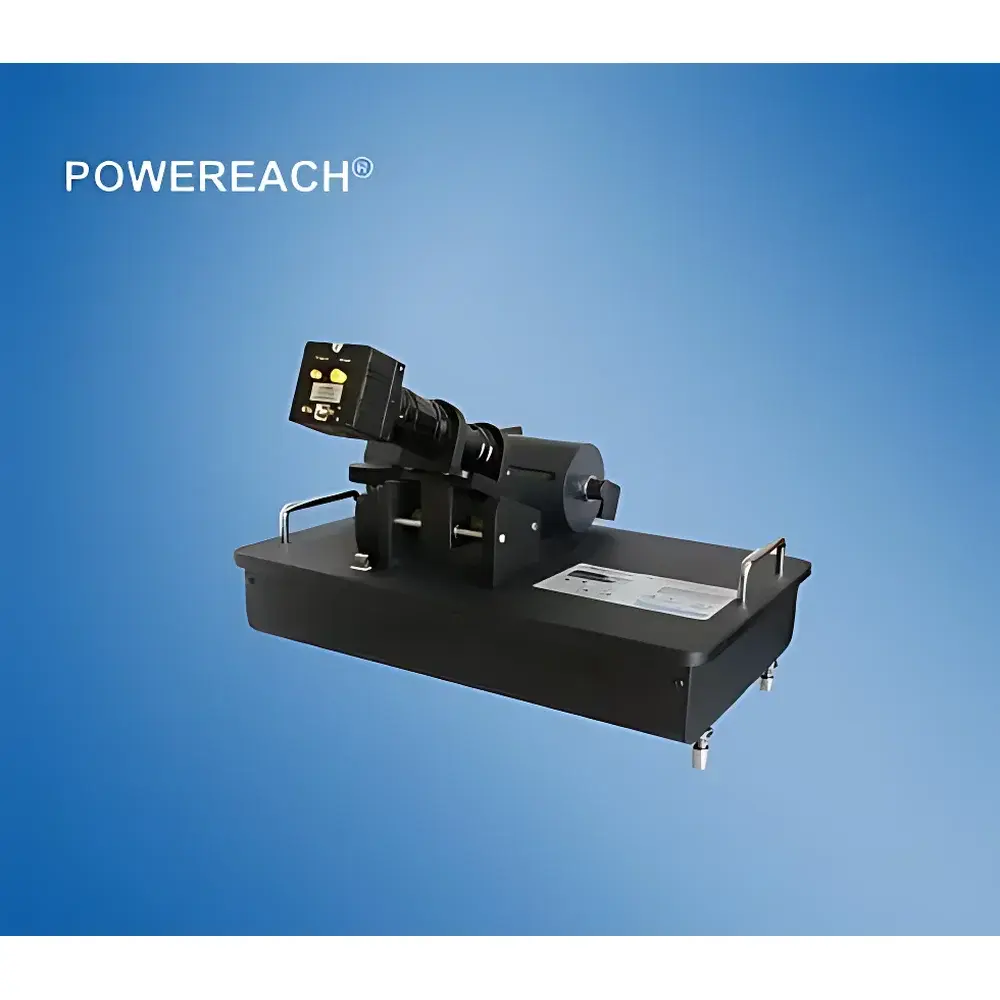
POWEREACH JJ2000C Rotating Drop Interfacial Tensiometer
| Brand | POWEREACH |
|---|---|
| Origin | Shanghai, China |
| Model | JJ2000C |
| Measurement Range | 10⁻⁶–100 mN/m |
| Temperature Control Range | 5–95 °C (PID) |
| Temperature Display Range | 0–99.9 °C |
| Temperature Accuracy | ±0.1 °C |
| Rotational Speed | 1,000–10,000 rpm (±5 rpm) |
| Image Capture | USB-triggered monochrome camera, 60 fps |
| Spatial Resolution | 0.001 mm |
| Sample Tube ID | 2 mm & 4 mm high-purity quartz |
| Interface | USB or RS-232 |
| Data Export | Native Excel (.xlsx), BMP image archive |
| Compliance | ASTM D971, ISO 6295, USP <1042>, GLP-ready audit trail support |
Overview
The POWEREACH JJ2000C Rotating Drop Interfacial Tensiometer is a precision instrument engineered for ultra-low interfacial tension (IFT) measurement in complex fluid systems using the rotating drop method—a well-established hydrodynamic technique grounded in Laplace pressure equilibrium and axisymmetric drop shape analysis (ADSA). In this method, a denser droplet of one liquid phase is suspended within a less-dense continuous phase inside a horizontally rotating quartz capillary tube. Under centrifugal force, the droplet elongates; its shape is captured via high-resolution video imaging and fitted to the Young–Laplace equation to derive interfacial tension with sub-micron spatial resolution. The JJ2000C achieves a dynamic range spanning eight orders of magnitude—from 10⁻⁶ mN/m (critical for enhanced oil recovery surfactant screening) to 100 mN/m (suitable for polymer–solvent or immiscible organic–aqueous systems)—without hardware reconfiguration. Its design integrates thermally matched stainless-steel rotor assemblies, corrosion-resistant PID-controlled heating, and real-time video-based shape analysis—enabling stable, reproducible measurements under controlled temperature and rotational conditions essential for quantitative colloidal and interfacial science.
Key Features
- Modular quartz capillary system with quick-release spring-pin mounting—minimizes breakage risk and simplifies cleaning between samples.
- High-stability rotation assembly featuring imported Pittman servo motor (1,000–10,000 rpm, ±5 rpm accuracy) with 500-line optical encoder feedback for precise speed regulation and low-speed torque consistency.
- LED-synchronized triggered imaging at 60 fps—eliminates motion blur across full speed range and enhances edge contrast for turbid or scattering samples (e.g., microemulsions, crude oil–surfactant mixtures).
- PID-controlled electrothermal system with stainless-steel jacketed heater—ensures uniform axial temperature distribution (5–95 °C) and stability ≤ ±0.1 °C over extended runs.
- Windows-native software with automated workflow: auto-focus assist, real-time droplet contour fitting, time-resolved IFT logging, and concurrent graphical display of curve + raw image + numerical output.
- Full data provenance: timestamped BMP images, metadata-rich measurement folders, exportable Excel datasets, and optional GLP-compliant audit trail (user login, parameter changes, calibration events).
Sample Compatibility & Compliance
The JJ2000C accommodates diverse sample chemistries—including aqueous surfactant solutions, hydrocarbon–water systems, polymer melts, ionic liquids, and opaque emulsions—via interchangeable 2 mm and 4 mm inner-diameter quartz capillaries. Its non-contact optical measurement principle avoids contamination or interfacial perturbation. The system conforms to internationally recognized test standards for interfacial property characterization: ASTM D971 (standard test method for interfacial tension of oil against water by the rotating drop method), ISO 6295 (petroleum products—determination of interfacial tension), and USP (interfacial tension in pharmaceutical formulations). When configured with user-defined electronic signatures and session logging, it supports FDA 21 CFR Part 11 compliance for regulated environments operating under GLP or GMP frameworks.
Software & Data Management
The proprietary acquisition and analysis suite runs natively on Windows OS and provides an intuitive GUI with dual-panel visualization: left panel displays live or archived BMP frames with superimposed fitted contours; right panel shows real-time numeric readouts, trend plots (IFT vs. time/temperature/speed), and editable metadata fields. All measurements are stored in structured directories containing calibrated images, raw coordinate files (.txt), and summary reports (.xlsx). Batch processing allows retrospective re-analysis using updated fitting algorithms without re-acquisition. Database integration enables cross-experiment querying (e.g., “all IFT values at 45 °C for C₁₂E₅ series”), while built-in statistical tools compute standard deviation, confidence intervals, and repeatability per ISO 5725. Export modules support direct import into MATLAB, OriginLab, or LIMS platforms via standardized CSV or XML schemas.
Applications
- Enhanced Oil Recovery (EOR): Quantification of ultra-low IFT (<10⁻³ mN/m) in alkali–surfactant–polymer (ASP) floods and nanoemulsion formulations for reservoir simulation input.
- Surfactant & Colloid Science: Critical micelle concentration (CMC) validation, HLB optimization, and microemulsion phase behavior mapping.
- Pharmaceutical Development: Stability assessment of liposomal dispersions, nanostructured lipid carriers (NLCs), and self-emulsifying drug delivery systems (SEDDS).
- Coatings & Inks: Wetting dynamics at pigment–binder interfaces and rheo-interfacial coupling in shear-thinning formulations.
- Materials Synthesis: Monitoring interfacial activity during sol-gel transitions, Pickering emulsion templating, and nanoparticle surface functionalization kinetics.
FAQ
What is the minimum measurable interfacial tension?
The instrument reliably measures down to 1 × 10⁻⁶ mN/m under optimized conditions (e.g., low-density contrast, high-speed rotation, high-magnification imaging).
Is external temperature control required?
No—the integrated stainless-steel PID heater maintains setpoint stability from 5 °C to 95 °C without auxiliary chillers or baths.
Can the system be validated against certified reference materials?
Yes—calibration verification is supported using NIST-traceable standard oils (e.g., dodecane/water at 25 °C, IFT ≈ 51.1 mN/m) and custom-certified surfactant solutions.
Does the software support automated sequence runs?
Yes—users can define multi-step protocols including variable temperature ramps, stepwise speed changes, and timed image capture intervals.
What computer specifications are required?
A Windows 10/11 PC with ≥4 GB RAM, USB 2.0 port, and ≥1280 × 720 display resolution is sufficient; no dedicated GPU is required.



