
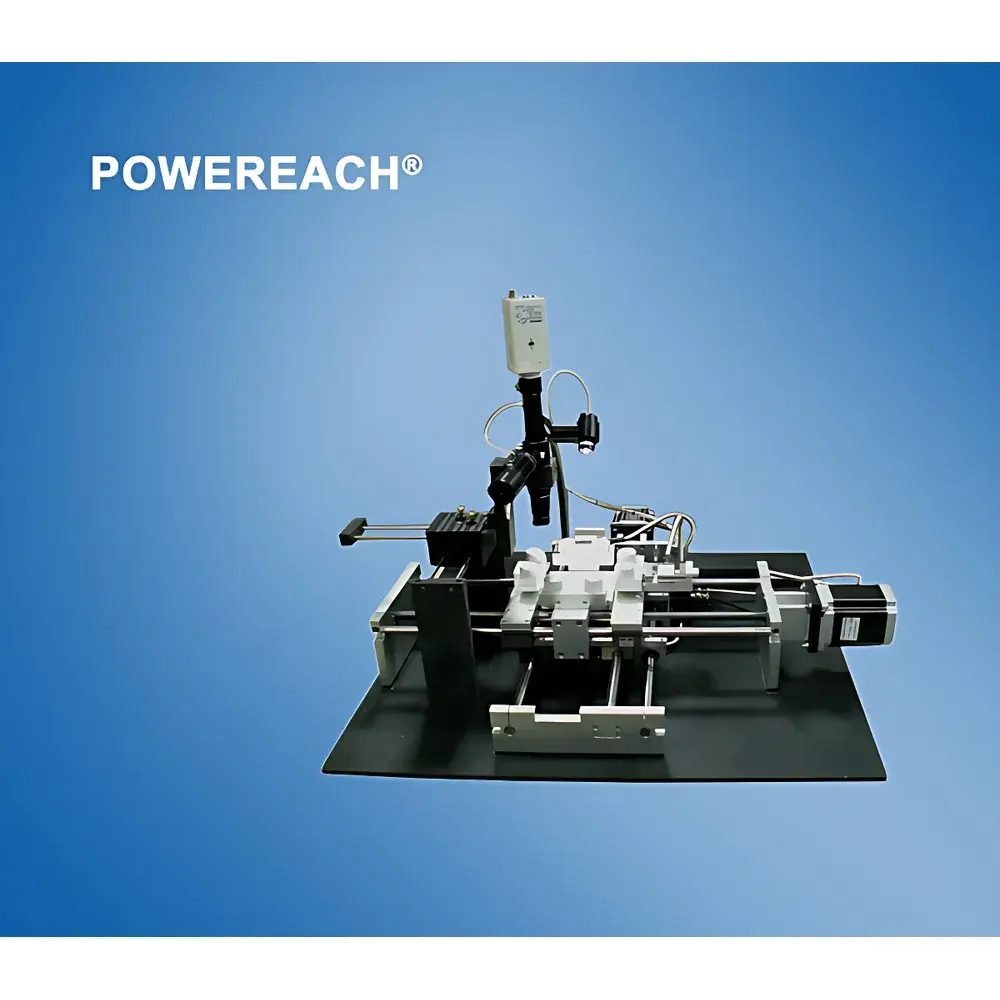
POWEREACH JDS05A Dual-Axis Material Characterization System (50 kg Capacity)
| Brand | POWEREACH (Shanghai Zhongchen) |
|---|---|
| Origin | Shanghai, China |
| Model | JDS05A |
| Instrument Type | Electromechanical Dual-Axis Tensile Testing System |
| Max Test Force per Axis | 500 N |
| Force Resolution | 1/10000 FS |
| Image Magnification | Up to 8 pixels/µm |
| Displacement Resolution | 0.001 mm |
| Travel Range | Not specified |
| Compliance | ASTM D5035, ISO 13934-1, GB/T 3923.1, AATCC 207 |
Overview
The POWEREACH JDS05A Dual-Axis Material Characterization System is an integrated electromechanical platform engineered for synchronized biaxial mechanical testing and high-resolution surface morphology analysis of textile fabrics and planar soft materials. Unlike conventional uniaxial tensile testers, the JDS05A applies controlled, independent tensile loads along two orthogonal axes—X and Y—enabling quantitative evaluation of anisotropic deformation behavior, shear coupling, and in-plane Poisson’s ratio under realistic loading conditions. The system operates on a servo-controlled dual-actuator architecture with closed-loop force feedback, ensuring high reproducibility across repeated cycles. Simultaneously, its optical sub-system supports real-time, non-contact imaging of fabric structural evolution—including yarn migration, interlacing distortion, pore geometry changes, and surface topography shifts—during mechanical loading. This concurrent mechanical–optical acquisition capability makes the JDS05A particularly suited for R&D in technical textiles, smart fabrics, geotextiles, medical meshes, and composite preforms where multi-directional load response and microstructural integrity are critical design parameters.
Key Features
- Dual-axis independent actuation: Two precision linear motors deliver programmable tensile forces up to 500 N per axis, with force resolution of 1 part in 10,000 of full scale (FS).
- Real-time synchronized imaging: Integrated long-working-distance zoom lens (continuous magnification), dual illumination modes (transmitted backlight + movable reflective coaxial source), and pixel-level calibration enable morphological tracking at up to 8 pixels per micrometer.
- Modular mechanical frame: Aluminum alloy rigid base with precision-ground guide rails and anti-backlash ball screws ensures minimal parasitic motion and high positional repeatability.
- Standardized test protocols: Pre-configured test routines compliant with ASTM D5035 (strip method), ISO 13934-1 (maximum force and elongation), and GB/T 3923.1 (Chinese national standard for textile tensile properties).
- Thermally stable enclosure option: Optional climate-controlled chamber (±0.5 °C) available for humidity- and temperature-sensitive specimens such as hygroscopic natural fibers or hydrogels.
Sample Compatibility & Compliance
The JDS05A accommodates flat, flexible specimens up to 200 mm × 200 mm, including woven/knitted fabrics, nonwovens, thin elastomeric films, paper-based substrates, and biomedical meshes. Specimen clamping utilizes pneumatic jaw systems with adjustable pressure (0.1–0.6 MPa) and interchangeable jaw faces (smooth, serrated, or rubber-coated) to prevent slippage or premature failure at grips. All mechanical and optical subsystems conform to CE safety directives (2014/30/EU EMC, 2014/35/EU LVD) and support GLP-compliant operation when paired with audit-trail-enabled software (see Software section). Data outputs meet requirements for regulatory submissions under FDA 21 CFR Part 11 when used with validated configurations and electronic signature workflows.
Software & Data Management
The proprietary POWEREACH TestMaster™ v4.2 software provides unified control of both mechanical and imaging modules via a single GUI. It supports real-time force–displacement curve plotting, time-synchronized video capture (up to 60 fps), and automated image analytics—including fiber alignment angle mapping, weave density quantification, and local strain field calculation via digital image correlation (DIC) algorithms. Raw data are stored in vendor-neutral HDF5 format with embedded metadata (test parameters, calibration history, operator ID, timestamp). Export options include CSV, XML, and PDF reports compliant with ISO/IEC 17025 documentation standards. Audit trail functionality logs all user actions—including parameter edits, test starts/stops, and data exports—with tamper-proof timestamps, satisfying traceability requirements for ISO 9001, ISO 13485, and GMP environments.
Applications
- Development and qualification of stretchable electronics substrates under biaxial strain
- Evaluation of surgical mesh mechanical stability during dynamic tissue loading
- Characterization of warp-knit reinforcement fabrics for automotive composites
- Quantitative assessment of moisture-induced dimensional instability in cotton–polyester blends
- Correlation of surface texture degradation (e.g., pilling onset, fuzz formation) with cumulative cyclic loading
- Validation of finite element models for textile-reinforced elastomers using experimentally derived stress–strain–morphology datasets
FAQ
What is the maximum specimen thickness the JDS05A can accommodate?
The standard pneumatic grips accept specimens up to 3 mm thick; optional high-clearance grips extend this to 8 mm.
Does the system support cyclic or creep testing protocols?
Yes—TestMaster™ includes built-in templates for tension–tension fatigue, relaxation, and constant-load creep tests, with programmable dwell times and load ramping profiles.
Is third-party calibration certification available?
Calibration certificates traceable to NIM (National Institute of Metrology, China) or NIST-equivalent standards are provided upon request, with uncertainty budgets aligned to ISO/IEC 17025 Annex A.
Can the imaging module be upgraded for fluorescence or polarized light observation?
Yes—the optical path supports modular filter wheels and LED excitation sources; custom integration of polarizers or bandpass filters is supported under engineering services agreement.
What computer specifications are required if supplying our own host PC?
A Windows 10/11 64-bit OS (minimum 8 GB RAM, Intel i5-8th gen or equivalent), one USB 3.0 port, one RS-232 serial port (or USB-to-serial adapter with FTDI chipset), and dedicated GPU recommended for real-time DIC processing.



