
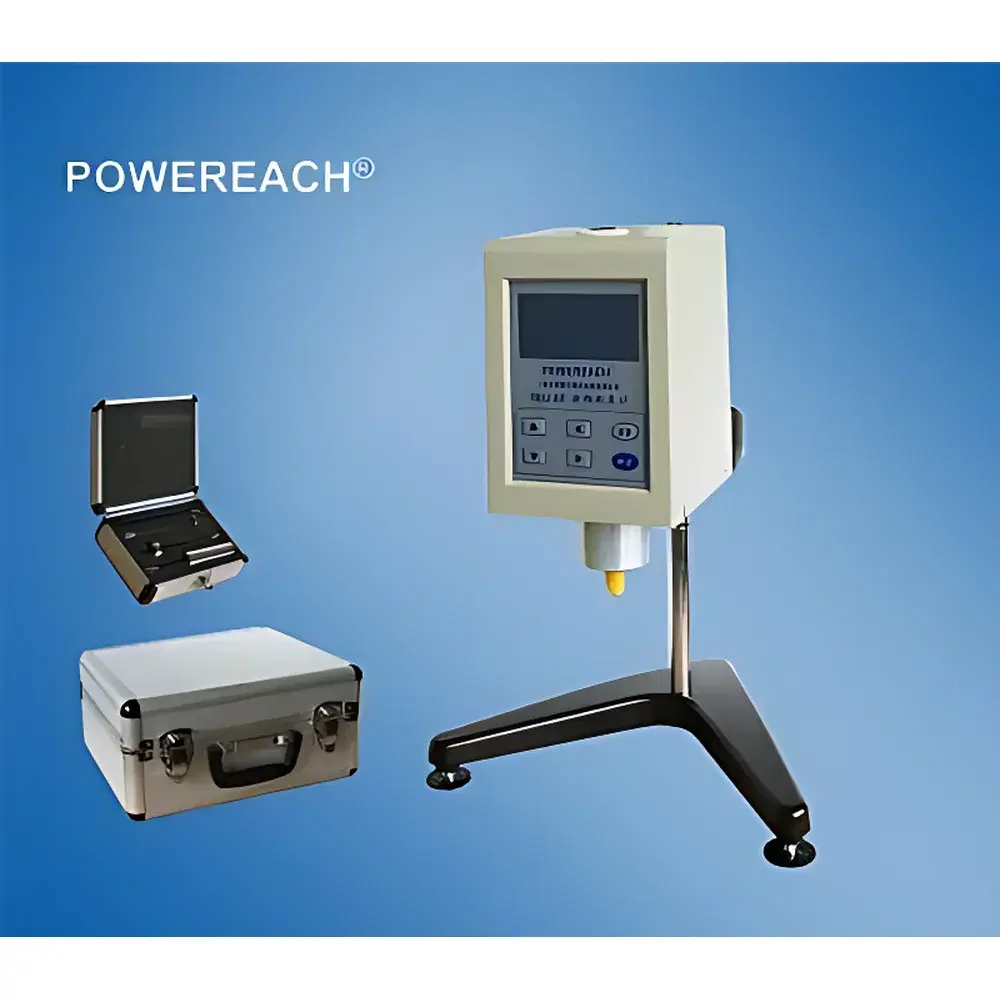
POWEREACH NDJ-5S Digital Display Rotational Viscometer
| Brand | POWEREACH (Shanghai Zhongchen) |
|---|---|
| Origin | Shanghai, China |
| Model | NDJ-5S |
| Instrument Type | Portable Rotational Viscometer |
| Viscosity Range | 1–100,000 mPa·s |
| Rotors | Standard #1–#4 |
| Speed Settings | 6, 12, 30, 60 rpm |
| Accuracy | ±2% for Newtonian liquids |
| Power Supply | AC 220 V ±10%, 50 Hz ±10% |
| Operating Temperature | 5–35 °C |
| Relative Humidity | ≤80% |
| Dimensions | 370 × 325 × 280 mm |
| Net Weight | 6.8 kg |
| Compliance | Designed for GLP-compliant routine QC environments |
Overview
The POWEREACH NDJ-5S Digital Display Rotational Viscometer is a microprocessor-controlled, benchtop-capable rotational viscometer engineered for precision measurement of dynamic viscosity in both Newtonian and non-Newtonian fluids. It operates on the principle of Couette flow: a precisely machined spindle (rotor) rotates at a defined angular velocity within the sample fluid, generating a shear stress proportional to the fluid’s resistance to flow. This torque is detected by a high-stability sensor, digitized, and processed in real time to compute absolute viscosity (mPa·s) or apparent viscosity under specified shear conditions. Unlike capillary or falling-ball methods, rotational viscometry enables controlled shear rate application—critical for characterizing pseudoplastic, dilatant, or thixotropic behavior in industrial formulations. The NDJ-5S delivers repeatable, operator-independent results across its full 1–100,000 mPa·s range, making it suitable for routine quality control, R&D screening, and process validation in regulated and non-regulated laboratories.
Key Features
- Four standardized spindles (#1–#4) paired with four discrete rotational speeds (6, 12, 30, 60 rpm), yielding 16 predefined shear rate–spindle combinations for broad coverage of low- to high-viscosity samples
- Optional #0 spindle available for extended low-viscosity measurement down to 0.1 mPa·s—ideal for solvents, thin coatings, and aqueous surfactant solutions
- Backlit high-contrast LCD display showing real-time viscosity value, selected rotor number, speed setting, % full-scale indication, and stability status (via vertical bar indicator)
- Auto-range logic assists users in selecting optimal rotor/speed combination based on preliminary reading—minimizing manual trial-and-error and reducing measurement uncertainty
- Robust mechanical architecture with precision-machined aluminum housing, integrated leveling base, and adjustable height column for stable immersion depth control
- Compliance-ready design: supports manual recording of instrument ID, operator, date/time, sample ID, rotor/speed used, and raw viscosity output—aligning with basic GLP documentation requirements
Sample Compatibility & Compliance
The NDJ-5S accommodates a wide spectrum of liquid and semi-liquid materials commonly encountered in chemical, pharmaceutical, food, and coating industries—including mineral oils, polymer melts (pre-diluted), emulsions, syrups, gels, latex dispersions, and cleaning formulations. Its open-bath configuration allows direct immersion into standard 600-mL beakers or custom sample containers (minimum depth ≥ 40 mm). While not equipped with Peltier temperature control or automated rheological profiling, the instrument meets ASTM D2196 and ISO 2555 standards for single-point viscosity determination when operated within its specified environmental envelope (5–35 °C ambient, ≤80% RH). Data outputs are compatible with external spreadsheet logging for traceability; though lacking native 21 CFR Part 11 electronic signature capability, its deterministic analog-to-digital signal path ensures measurement integrity required for internal QC audits per ISO/IEC 17025 Clause 7.7.
Software & Data Management
The NDJ-5S operates as a standalone instrument without proprietary PC software or USB connectivity. All data acquisition, computation, and display occur internally via embedded firmware. Measured values are presented numerically on the LCD screen with no internal memory or export functionality. Users must manually record readings alongside contextual metadata (e.g., rotor ID, speed, sample code, ambient temperature) in laboratory notebooks or LIMS-compatible spreadsheets. This architecture prioritizes operational simplicity, electromagnetic noise immunity, and long-term calibration stability—particularly advantageous in production-floor environments where networked instruments may introduce cybersecurity or compatibility risks. For labs requiring digital archiving, optional third-party USB microscope cameras or document scanners can capture screen displays for inclusion in electronic batch records.
Applications
- Quality assurance of lubricating oils and hydraulic fluids per OEM specifications
- Batch release testing of topical pharmaceutical gels and ointments (USP )
- Formulation development of water-based paints and architectural coatings
- Viscosity grading of edible oils, honey, and fruit concentrates in food processing
- Routine monitoring of ink rheology during gravure and flexographic printing operations
- Educational demonstrations of shear-thinning behavior in polymer solutions and colloidal suspensions
FAQ
What viscosity standards are recommended for daily verification?
NIST-traceable silicone oil standards (e.g., Cannon N4, N10, N100) are advised for daily system suitability checks. Calibration should be performed annually by an accredited service provider using certified reference materials.
Can the NDJ-5S measure yield stress?
No. As a constant-shear-rate viscometer, it does not provide controlled shear ramp or oscillatory capability required for yield stress determination. For such analysis, a controlled-stress rheometer is required.
Is temperature control integrated?
No. External water baths or Peltier plates must be used for temperature-dependent measurements. Sample temperature must be verified independently with a calibrated thermometer prior to testing.
How is rotor identification handled?
Rotors are physically marked with engraved numbers (#0, #1, etc.) and must be manually entered into the instrument’s setup menu before measurement. No RFID or auto-detect functionality is present.
Does the instrument support GLP audit trails?
It supports manual GLP compliance through structured operator documentation. No electronic audit trail, user login, or data immutability features are built-in—consistent with Class II standalone analytical devices per FDA guidance.



