
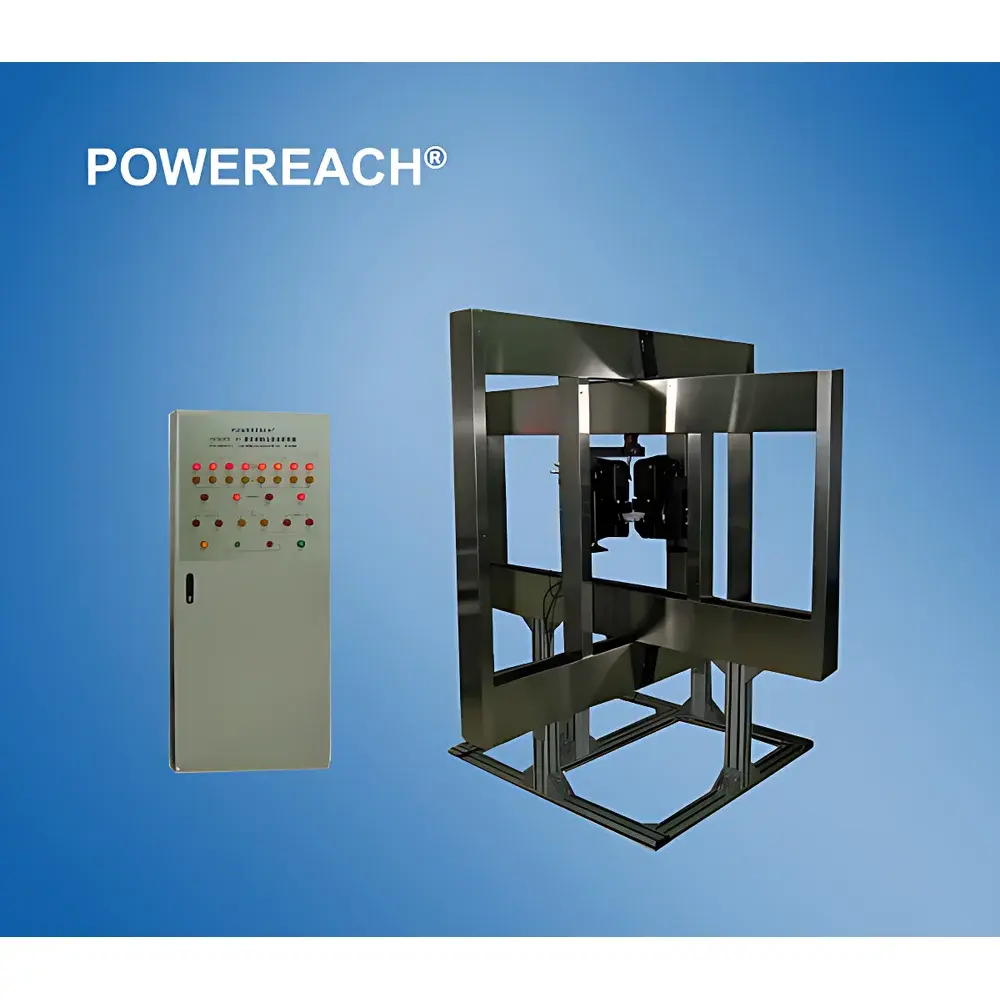
POWEREACH JDS05B Dual-Axis Material Characterization System (500 kg Capacity)
| Brand | POWEREACH (Shanghai Zhongchen) |
|---|---|
| Origin | Shanghai, China |
| Model | JDS05B |
| Instrument Type | Electromechanical Dual-Axis Tensile Testing System |
| Max. Biaxial Load Capacity | 500 kg (≈4.9 kN per axis) |
| Load Resolution | 1/10,000 FS |
| Travel Range | Not specified |
| Displacement Resolution | Not specified |
Overview
The POWEREACH JDS05B Dual-Axis Material Characterization System is an electromechanical testing platform engineered for quantitative, synchronized biaxial mechanical evaluation of planar soft materials—including woven and nonwoven textiles, polymer films, composites, geotextiles, and biomaterial membranes. Unlike uniaxial tensile testers, the JDS05B applies controlled, independent tensile loads along two orthogonal axes (X and Y), enabling measurement of in-plane anisotropy, shear coupling, Poisson’s ratio evolution, and strain field heterogeneity under true biaxial stress states. Its architecture follows the principles of servo-controlled force-displacement feedback, with dual high-precision load cells and linear motion stages calibrated to NIST-traceable standards. The system operates within a defined force envelope up to 500 kg (4.9 kN) per axis—sufficient to characterize high-strength technical fabrics, coated substrates, and reinforced elastomers without slippage or frame deformation. Real-time synchronization between mechanical actuation and optical imaging allows direct correlation of macroscopic load–displacement curves with microstructural evolution, such as yarn migration, crimp reduction, fiber reorientation, and localized failure initiation.
Key Features
- Dual independent servo-driven actuation axes with programmable displacement profiles and closed-loop force control.
- Maximum biaxial load capacity of 500 kg per axis (4.9 kN), with load resolution of 1 part in 10,000 of full scale.
- Integrated digital microscopy subsystem featuring continuous zoom long-working-distance lens (up to 8 px/µm magnification), dual illumination modes (transmitted backlight + motorized reflectance stage), and real-time image overlay on force–strain plots.
- Optional high-speed video acquisition (≥1,000 fps) synchronized to mechanical triggers for dynamic fracture analysis and strain mapping via digital image correlation (DIC) post-processing.
- Modular clamping interface supporting pneumatic, mechanical, and custom-designed grips for single fibers, yarn bundles, knitted structures, and brittle or low-modulus specimens.
- Fully configurable test protocols compliant with ASTM D5035 (strip method), ISO 13934-1 (force–elongation), ISO 13935-1 (burst strength simulation), and GB/T 3923.1 (Chinese textile standard).
Sample Compatibility & Compliance
The JDS05B accommodates specimens ranging from 10 mm × 10 mm miniature coupons to 200 mm × 200 mm full-scale fabric swatches. It supports isotropic and orthotropic planar materials including cotton, polyester, aramid, carbon-fiber-reinforced laminates, hydrogel sheets, electrospun nanofiber mats, and smart textiles with embedded conductive traces. All mechanical measurements adhere to GLP-aligned data integrity practices: raw sensor outputs are timestamped, digitally signed, and stored with audit trails. The system supports FDA 21 CFR Part 11-compliant user authentication, electronic signatures, and version-controlled method files when deployed in regulated QC environments. Calibration certificates conform to ISO/IEC 17025 requirements and include uncertainty budgets traceable to national metrology institutes.
Software & Data Management
The proprietary POWEREACH TestMaster v4.x software provides a unified interface for test definition, hardware orchestration, live visualization, and export-ready reporting. Users define multi-step biaxial loading sequences—including ramp-hold-relax, cyclic tension, and stepwise equibiaxial extension—with adjustable ramp rates (0.1–500 mm/min) and dwell durations. Force, displacement, and image streams are acquired at ≥1 kHz sampling rate and logged in HDF5 format for interoperability with MATLAB, Python (NumPy/Pandas), and commercial FEA pre-processors. Built-in analysis modules compute modulus (initial, secant, tangent), breaking load, elongation at break, work-of-fracture, and energy absorption density. Reports auto-generate PDF summaries with embedded plots, statistical summaries (n ≥ 5), and pass/fail flags against user-defined specification limits.
Applications
- Quantifying biaxial tensile stiffness and rupture behavior of medical sutures and surgical meshes under physiological strain paths.
- Evaluating dimensional stability and warp/weft coupling in technical airbag fabrics subjected to inflation simulations.
- Characterizing strain-dependent permeability shifts in filtration membranes during mechanical preconditioning.
- Validating finite element models of composite layups by correlating simulated stress contours with experimentally observed yarn-level deformation.
- Assessing durability of wearable electronics substrates under repeated stretch–release cycles while monitoring electrical continuity.
- Supporting ISO 13934-2-compliant research into textile reinforcement efficiency in concrete and asphalt overlays.
FAQ
What standards does the JDS05B support for textile biaxial testing?
ASTM D5035, ISO 13934-1, ISO 13935-1, GB/T 3923.1, and custom protocols aligned with ISO 105-E04 (colorfastness under tension) and ISO 13936-2 (seam slippage).
Is the system compatible with third-party DIC software?
Yes—raw high-speed video and synchronized encoder data are exported in open formats (AVI + CSV), enabling integration with VIC-2D, ARAMIS, or open-source Ncorr.
Can the JDS05B perform creep or stress-relaxation tests?
Yes, via programmable hold segments in the test sequence; force decay or strain drift is recorded with thermal drift compensation enabled.
What is the minimum specimen size supported?
10 mm × 10 mm with custom micro-grips; standard fixtures accommodate 50 mm × 50 mm to 150 mm × 150 mm samples.
Does the system include validation documentation for GMP environments?
Yes—IQ/OQ documentation packages, calibration records, and 21 CFR Part 11 configuration files are supplied upon request for regulated laboratories.
Related Products



