
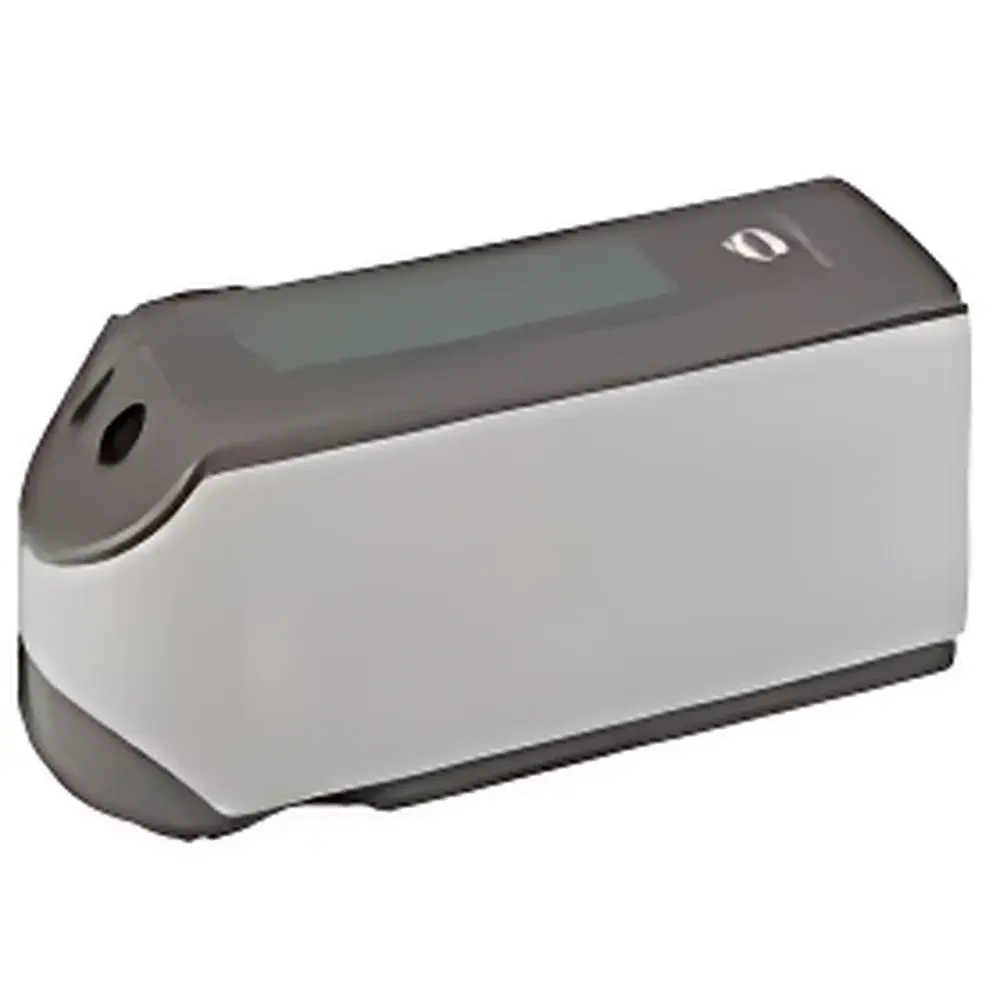
Konica Minolta CM-2300d Portable Sphere Spectrophotometer
| Brand | Konica Minolta |
|---|---|
| Origin | Japan |
| Model | CM-2300d |
| Optical Geometry | d/8° (diffuse illumination / 8° viewing angle) with simultaneous SCI & SCE measurement |
| Wavelength Range | 360–740 nm |
| Interval | 10 nm |
| Spectral Bandwidth | ~10 nm |
| Measurement Area | Ø8 mm / Illumination Area: Ø11 mm |
| Repeatability | ΔE*ab ≤ 0.08 (after white calibration, 30 measurements at 10-sec intervals) |
| Inter-instrument Agreement | ΔE*ab ≤ 0.4 (SCI, BCRA Series II avg.) |
| Data Storage | 1,700 sets (each with paired SCI/SCE spectra) |
| Measurement Time | ~1.5 sec |
| Minimum Interval | 3 sec |
| Power | 4 × AA alkaline batteries or AC adapter |
| Weight | 670 g (without batteries) |
| Compliance | CIE No. 15, ISO 7724-1, ASTM E1164, DIN 5033 Teil 7, JIS Z8722 Condition C |
Overview
The Konica Minolta CM-2300d is a portable sphere spectrophotometer engineered for high-accuracy color measurement in industrial quality control environments. It operates on the d/8° optical geometry—complying with CIE No. 15, ISO 7724-1, and ASTM E1164—enabling rigorous spectral analysis of reflective samples under standardized illuminants and observer conditions. Unlike traditional filter-based colorimeters, the CM-2300d employs a diffraction grating and dual-row 40-element silicon photodiode array to capture full reflectance spectra from 360 nm to 740 nm at 10 nm intervals. Its integrated 52 mm diameter integrating sphere ensures uniform light diffusion and minimizes directional bias, while simultaneous SCI (Specular Component Included) and SCE (Specular Component Excluded) measurement eliminates mechanical mode switching—preserving spatial registration and reducing operator-induced variability. This architecture supports both appearance-critical evaluation (SCE, approximating human visual response) and material-invariant color specification (SCI, essential for formulation and QC traceability).
Key Features
- Simultaneous dual-mode measurement: SCI and SCE spectra acquired in a single 1.5-second exposure without repositioning or optical recalibration.
- High-stability xenon pulse lamp illumination: Provides consistent spectral output across environmental fluctuations and eliminates warm-up drift common in tungsten-halogen sources.
- Integrated 52 mm integrating sphere with optimized baffle design: Ensures uniform diffuse illumination and suppresses stray light, critical for low-gloss or textured surfaces.
- Real-time relative gloss monitoring: Computed from the ratio of specular-reflected energy at 60° (derived from SCE/SCI divergence), displayed alongside chromaticity data.
- Robust portability: Compact form factor (69 × 96 × 193 mm), lightweight construction (670 g without batteries), and built-in illuminated viewfinder enable precise placement on curved, recessed, or irregularly shaped substrates.
- Dual observer support: 2° and 10° standard observer functions implemented per CIE 1931 and CIE 1964 definitions, allowing flexibility for legacy specifications or extended-field applications.
- Multi-illuminant computation: Supports A, C, D50, D65, F2–F12; enables concurrent calculation of color differences under multiple lighting conditions from one spectral acquisition.
Sample Compatibility & Compliance
The CM-2300d is validated for non-destructive reflectance measurement of opaque and translucent planar or gently curved surfaces—including injection-molded plastics, automotive clearcoats, textile weaves, leather finishes, printed packaging, pharmaceutical tablets, cosmetic compacts, and architectural coatings. Its Ø8 mm measurement aperture and Ø11 mm illumination area accommodate fine-grain textures and localized defects while maintaining metrological integrity. All optical and electronic subsystems are certified to meet IEC 61000-4 electromagnetic compatibility standards and operate reliably within 5–40°C ambient temperature and ≤80% RH (non-condensing). Device firmware and measurement algorithms adhere to ISO/IEC 17025 requirements for traceable instrument performance, and raw spectral data export supports GLP/GMP audit trails when paired with SpectraMagic NX software (CM-S100w) configured for 21 CFR Part 11 compliance.
Software & Data Management
The CM-2300d interfaces via RS-232C (D-sub 9-pin) with Konica Minolta’s SpectraMagic NX (CM-S100w) software—a Windows-based platform designed for regulated laboratory workflows. SpectraMagic NX provides full spectral visualization, multi-standard color space conversion (CIELAB, CIELCh, CIE94, CIEDE2000, CMC, WI, YI), tolerance mapping with ellipsoidal or rectangular ΔE boundaries, batch statistical reporting (X̄, R, Cp/Cpk), and customizable pass/fail flagging. Raw .qtx files contain unprocessed reflectance values at 10 nm resolution, enabling third-party spectral modeling or integration into enterprise LIMS/QMS systems. Audit trail functionality logs user actions, parameter changes, calibration events, and data exports with timestamps and operator IDs—meeting FDA 21 CFR Part 11 electronic record requirements when deployed with appropriate system validation protocols.
Applications
- Automotive OEM and Tier-1 suppliers: In-line paint booth verification, trim component matching, and cross-shift color consistency monitoring against master standards.
- Plastics compounders and molders: Batch-to-batch pigment dispersion validation, recycled resin color deviation assessment, and regulatory compliance reporting (e.g., ISO 11475 for automotive interior parts).
- Textile and apparel manufacturers: Dye lot acceptance testing, shade sorting across fiber types (cotton, polyester, nylon), and retailer-specific color gatekeeping (e.g., Walmart Color Standard Program).
- Pharmaceutical and nutraceutical producers: Tablet coating uniformity verification per USP , capsule shell color stability studies, and excipient batch release testing.
- Packaging converters: Spot color fidelity verification on flexographic and gravure prints, substrate metamerism screening, and brand-critical hue maintenance across print runs.
- Consumer electronics: Anodized aluminum housing tone verification, glass panel tint consistency, and polymer housing gloss-color correlation analysis.
FAQ
Does the CM-2300d require annual recalibration to maintain traceability?
No scheduled recalibration is mandated by Konica Minolta; however, daily white calibration using the supplied CM-A145 standard is required before measurement sessions. NIST-traceable recalibration services are available through authorized Konica Minolta service centers every 12–24 months depending on usage intensity and regulatory context.
Can the CM-2300d measure transparent or translucent films?
It is not designed for transmission measurement. For transparent substrates, a transmission accessory (e.g., CM-TA1) and compatible benchtop model (e.g., CM-3600A) are recommended.
Is spectral data export compatible with MATLAB or Python for custom analysis?
Yes—SpectraMagic NX exports ASCII-delimited .txt files containing wavelength and reflectance columns, fully readable by SciPy, Pandas, or MATLAB’s importdata() function.
How does the device handle highly glossy or mirror-like surfaces?
The simultaneous SCI/SCE mode allows direct comparison of surface appearance (SCE) versus material color (SCI); relative gloss values assist in diagnosing orange peel, haze, or coating defects that affect visual acceptability without altering pigment composition.
What is the maximum allowable curvature radius for accurate measurement?
For reliable results, surface curvature should exceed 50 mm radius; tighter radii may cause aperture vignetting or incomplete illumination—verified using the included CM-A146 Ø8 mm mask.



