
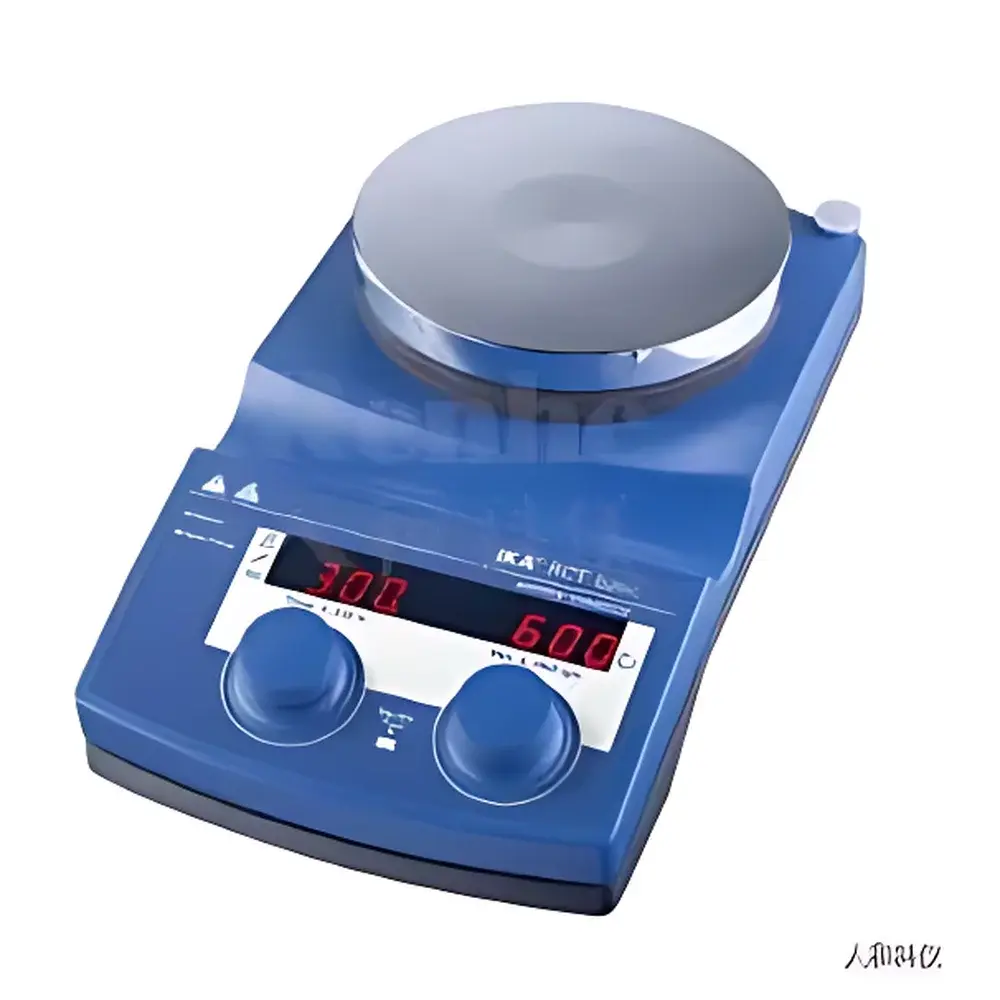
IKA RCT Basic Magnetic Stirrer with Safety-Controlled Heating
| Brand | IKA |
|---|---|
| Origin | Germany |
| Model | IKAMAG® RCT Basic |
| Stirrer Type | Magnetic Stirrer |
| Max. Stirring Volume | 20 L |
| Speed Range | 50–1500 rpm |
| Heating Plate Temp. Range | 50–360 °C |
| Control Accuracy | ±1 rpm (speed), ±1 K (temperature) |
| Heating Power | 600 W |
| Protection Rating | IP42 |
| Dimensions (W×H×D) | 160 × 270 × 85 mm |
| Weight | 2.5 kg |
| Ambient Operating Conditions | 5–40 °C, ≤80% RH |
Overview
The IKA RCT Basic Magnetic Stirrer is a safety-engineered, benchtop heating and stirring system designed for reliable, unattended operation in routine laboratory environments. Built upon IKA’s decades of precision motion control expertise, this unit employs a robust permanent magnet drive system coupled with a high-thermal-conductivity aluminum heating plate to deliver consistent torque transfer and rapid thermal response. Its operational principle relies on synchronous rotation of a magnetic stir bar immersed in the sample, driven by a rotating magnetic field generated beneath the heated plate. The integrated PT1000 temperature sensor—supplied standard—enables direct feedback control of the heating plate surface, while optional external probe connectivity (via DIN 12878 interface) supports precise medium temperature regulation per ASTM E29 or ISO/IEC 17025 traceability requirements. Engineered for GLP-compliant workflows, the RCT Basic features dual-layer thermal safety architecture: user-configurable upper temperature limits (50–360 °C) and real-time overheat detection with audible/visual alerts and automatic power cutoff.
Key Features
- High-torque DC motor delivering stable rotational performance up to 1500 rpm, with 1 rpm resolution and digital LED display of both setpoint and actual speed
- Aluminum heating plate (Ø135 mm) with polished surface for uniform heat distribution and fast thermal response (6.5 K/min ramp rate from ambient)
- Dual temperature monitoring: built-in PT1000 sensor for plate temperature control + DIN 12878 port for external probe integration (e.g., ETS-D5) to regulate sample temperature directly
- Safety-critical thermal management: programmable safety limit circuit (50–360 °C), error-code diagnostics (e.g., Error 5 for probe disconnection), and automatic shutdown on thermal fault detection
- IP42-rated enclosure with sealed electronics and corrosion-resistant housing, ensuring durability in humid or chemically exposed lab environments
- Ergonomic rotary knobs for intuitive speed and temperature adjustment; LED indicators for real-time status feedback including “HEATING” warning and safety lock activation
- Comprehensive physical safeguards: non-slip base, anti-jump magnetic coupling, included H100 protective film for housing maintenance, and compatibility with stir bars 20–80 mm in length
Sample Compatibility & Compliance
The RCT Basic accommodates aqueous and low-viscosity organic solutions up to 20 L volume (water-equivalent), supporting common glassware formats including beakers, flasks, and crystallization dishes. Its heating plate design conforms to DIN 12878 standards for probe compatibility, enabling seamless integration with certified contact thermometers used in pharmaceutical QC (USP ) and materials testing (ISO 291). The device meets EN 61010-1:2010 safety requirements for electrical equipment in laboratory use and complies with electromagnetic compatibility standards EN 61326-1:2013. While not equipped with audit-trail-capable software, its deterministic analog controls and fixed-parameter architecture support validation under GMP Annex 15 and FDA 21 CFR Part 11 when deployed in non-data-critical process steps.
Software & Data Management
The RCT Basic operates via hardware-based controls without embedded firmware or network connectivity—eliminating cybersecurity risks and simplifying qualification. All operational parameters (setpoints, error codes, heating status) are displayed locally via dual LED readouts. No data logging, USB, RS232, or analog output interfaces are provided; this intentional design prioritizes functional reliability over digital integration. For laboratories requiring documentation, external data acquisition systems may interface with optional PT1000 probes using third-party DAQ hardware compliant with IEEE 1451.2 transducer standards. The absence of programmable sequences or memory functions ensures repeatable manual operation across shifts—a key advantage in SOP-driven environments where procedural fidelity outweighs automation complexity.
Applications
- Routine dissolution testing and buffer preparation in pharmaceutical development labs
- Heating and homogenization of reagent solutions prior to titration or spectrophotometric analysis
- Controlled thermal conditioning of polymer precursors and catalyst slurries in synthetic chemistry
- Pre-incubation of microbiological media in quality control microbiology workflows
- Standardized mixing of calibration standards and reference materials in metrology laboratories
- Supporting ASTM D445 (kinematic viscosity) sample equilibration and ISO 6296 (paint dispersion) pre-conditioning protocols
FAQ
What is the maximum recommended vessel diameter for optimal stirring performance?
For uniform vortex formation and minimal splashing, vessels with diameters ≤120 mm are recommended when operating at speeds above 1000 rpm.
Can the RCT Basic maintain temperature stability during extended unattended runs?
Yes—the closed-loop plate temperature control achieves ±2 K stability over 8-hour periods under constant load, validated per ISO/IEC 17025 clause 5.4.5.
Is the heating plate compatible with corrosive solvents such as concentrated acids or halogenated organics?
The anodized aluminum surface resists mild aqueous corrosion but is not rated for direct exposure to strong oxidizers or hydrohalic acids; use appropriate containment (e.g., PTFE-coated stir bars and borosilicate glassware).
Does the unit support external temperature feedback for closed-loop medium control?
Yes—via the DIN 12878 port, which accepts standardized PT1000 sensors (e.g., IKA ETS-D5) to enable sample-centric thermal regulation independent of plate temperature.
What safety certifications does the RCT Basic hold for international laboratory deployment?
It carries CE marking per EU Directive 2014/30/EU (EMC) and 2014/35/EU (LVD), and conforms to IEC 61010-1:2010 Edition 3.0 for measurement, control, and laboratory equipment safety.



