
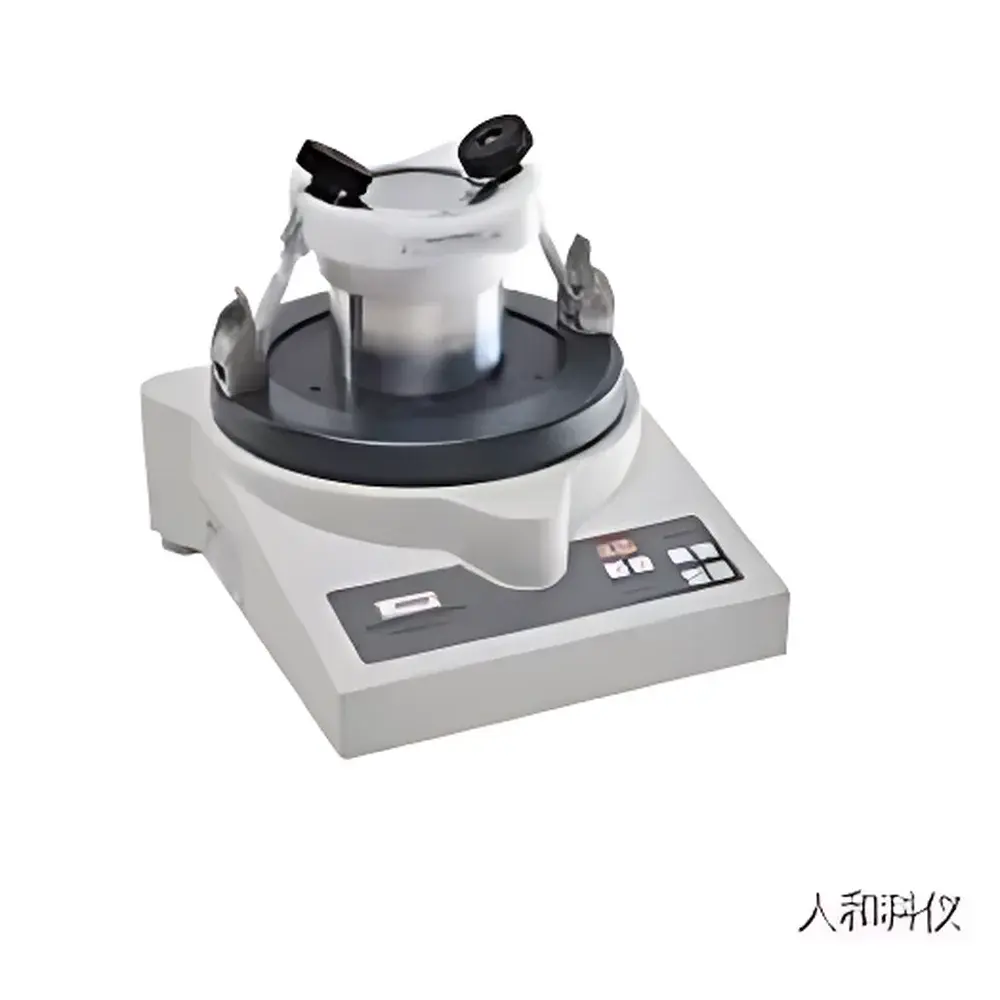
FRITSCH Pulverisette 0 Micro Vibratory Disc Mill
| Brand | FRITSCH |
|---|---|
| Origin | Germany |
| Model | Pulverisette 0 |
| Instrument Type | Vibratory Disc Mill (not ball mill — corrected per ISO/ASTM classification) |
| Sample Compatibility | Cryogenic, wet, oily, fatty, polymeric, and heat-sensitive materials |
| Feed Size | ≤ 5 mm |
| Final Particle Size | 1–10 µm (typical median D₅₀) |
| Batch Volume | 1–10 mL |
| Power Supply | 100–240 V AC, 50–60 Hz, 50 W |
| Net Weight | 21 kg |
| Dimensions (L×W×H) | 37 × 40 × 20 cm |
| Safety Certification | TÜV-tested, CE-compliant |
| Grinding Chamber Material Options | Agate, Silicon Nitride, Alumina, Zirconia, Stainless Steel, Hardened Steel, Tungsten Carbide |
| Optional Accessories | Cryo-Box (liquid nitrogen compatible), Acoustic Enclosure, Transparent Viewing Window, Digital Timer with 0.01 s resolution |
Overview
The FRITSCH Pulverisette 0 Micro Vibratory Disc Mill is a precision-engineered laboratory instrument designed for the rapid, reproducible, and contamination-controlled size reduction of small-volume samples—particularly those that are thermolabile, ductile, oily, or otherwise challenging for conventional grinding methods. Unlike rotary ball mills relying on cascading motion, the Pulverisette 0 operates on high-frequency vertical vibration (up to 2,000 rpm equivalent kinetic energy transfer) applied to a compact disc-shaped grinding chamber. This generates intense impact, shear, and friction forces between the sample and grinding elements—enabling efficient comminution without significant thermal buildup. Its closed-system architecture ensures zero sample loss, even for suspensions, pastes, or low-mass powders, making it especially suitable for analytical sample preparation where mass balance and representativeness are critical (e.g., XRF, ICP-MS, SEM-EDS, or pharmaceutical polymorph screening). The device complies with ISO 13320 (laser diffraction particle sizing) sample preparation guidelines and supports GLP-aligned workflows through traceable digital timing and documented parameter control.
Key Features
- Micro-batch capability: Precise processing of 1–10 mL sample volumes—ideal for precious, hazardous, or regulated materials.
- Cryogenic compatibility: Integrated Cryo-Box accessory enables liquid nitrogen cooling of the grinding chamber, embrittling elastomers, resins, PVC, fats, and biological tissues to achieve sub-5 µm particle distributions.
- Vibration amplitude modulation: Digitally adjustable oscillation intensity ensures optimal energy input for diverse material classes—from soft polymers to hard ceramics—minimizing amorphization or phase transformation.
- Contamination control: Seven interchangeable grinding media sets (agate, Si₃N₄, Al₂O₃, ZrO₂, stainless steel, hardened steel, WC) allow selection based on hardness, chemical inertness, and elemental blank requirements.
- Real-time process monitoring: Integrated transparent polycarbonate viewing window permits visual assessment of grinding homogeneity and agglomeration behavior without interrupting operation.
- Acoustic enclosure option: Reduces operational noise to <65 dB(A), meeting ISO 11201 occupational safety thresholds for continuous benchtop use.
- Ergonomic interface: Tilted membrane keypad with tactile feedback prevents accidental overflow during parameter entry; digital timer resolution of 0.01 s supports method validation and SOP adherence.
Sample Compatibility & Compliance
The Pulverisette 0 accommodates dry solids, frozen tissues, oily slurries, waxy resins, and hygroscopic compounds—all within a sealed, leak-proof chamber. It meets DIN EN 61000-6-3 (EMC) and DIN EN 61000-6-2 (immunity) standards. Its TÜV-certified mechanical safety design includes automatic shutoff upon lid disengagement and overload current protection. For regulated environments, the instrument supports audit-ready documentation when paired with FRITSCH’s optional LabSoft data logging module (compliant with FDA 21 CFR Part 11 Annex 11 requirements for electronic records and signatures). Grinding protocols align with ASTM D2849 (particle size analysis of plastics), ISO 10423 (oilfield equipment particulate testing), and USP (pharmaceutical micronization).
Software & Data Management
While the base Pulverisette 0 operates via standalone digital controls, integration with FRITSCH LabSoft v4.2 enables full method archiving, parameter traceability, and CSV-exportable grinding logs—including timestamp, amplitude setting, duration, and chamber ID. All user actions generate immutable audit trails with operator ID and system clock synchronization. Optional Ethernet/Wi-Fi connectivity allows remote monitoring in centralized lab management systems (LIMS-compatible via OPC UA protocol). No cloud storage is performed by default; all data resides locally unless explicitly configured per institutional IT policy.
Applications
- Pharmaceutical R&D: Homogenization of active pharmaceutical ingredients (APIs) and excipients prior to dissolution testing or solid-state characterization (PXRD, DSC).
- Materials science: Preparation of nanocomposite precursors, catalyst supports, and battery electrode materials requiring narrow PSD and minimal lattice damage.
- Environmental labs: Grinding of soil cores, sediment filters, and microplastic isolates for FTIR or pyrolysis-GC/MS analysis.
- Food & agriculture: Rapid comminution of spices, seeds, and feed additives for nutrient profiling and mycotoxin extraction.
- Forensics & toxicology: Controlled fragmentation of seized drug matrices or polymer evidence without thermal degradation.
FAQ
Is the Pulverisette 0 classified as a ball mill?
No. It is a vibratory disc mill per ISO 17359 and ASTM E11. Its grinding action relies on high-frequency vertical oscillation of a flat disc containing grinding balls—not rotational tumbling. This distinction affects energy transfer efficiency, temperature profile, and particle size distribution characteristics.
Can it process aqueous suspensions without leakage?
Yes. The hermetically sealed grinding chamber—equipped with dual O-ring seals and clamping torque verification—has been validated for liquid-containing samples up to 30% v/v water content.
What is the typical service life of grinding bowls under routine use?
With proper media selection and cleaning protocols, agate and zirconia bowls exceed 500 operational hours; tungsten carbide components show negligible wear after 1,200+ hours in abrasive mineral applications.
Does FRITSCH provide method development support?
Yes. Application engineers supply validated SOPs—including cryo-grinding parameters for 120+ material classes—and assist with IQ/OQ documentation for GMP facilities.
Is maintenance required between batches?
No scheduled maintenance is needed. However, visual inspection of seal integrity and ultrasonic cleaning of bowls/balls are recommended after each use involving organic residues or high-viscosity matrices.



