
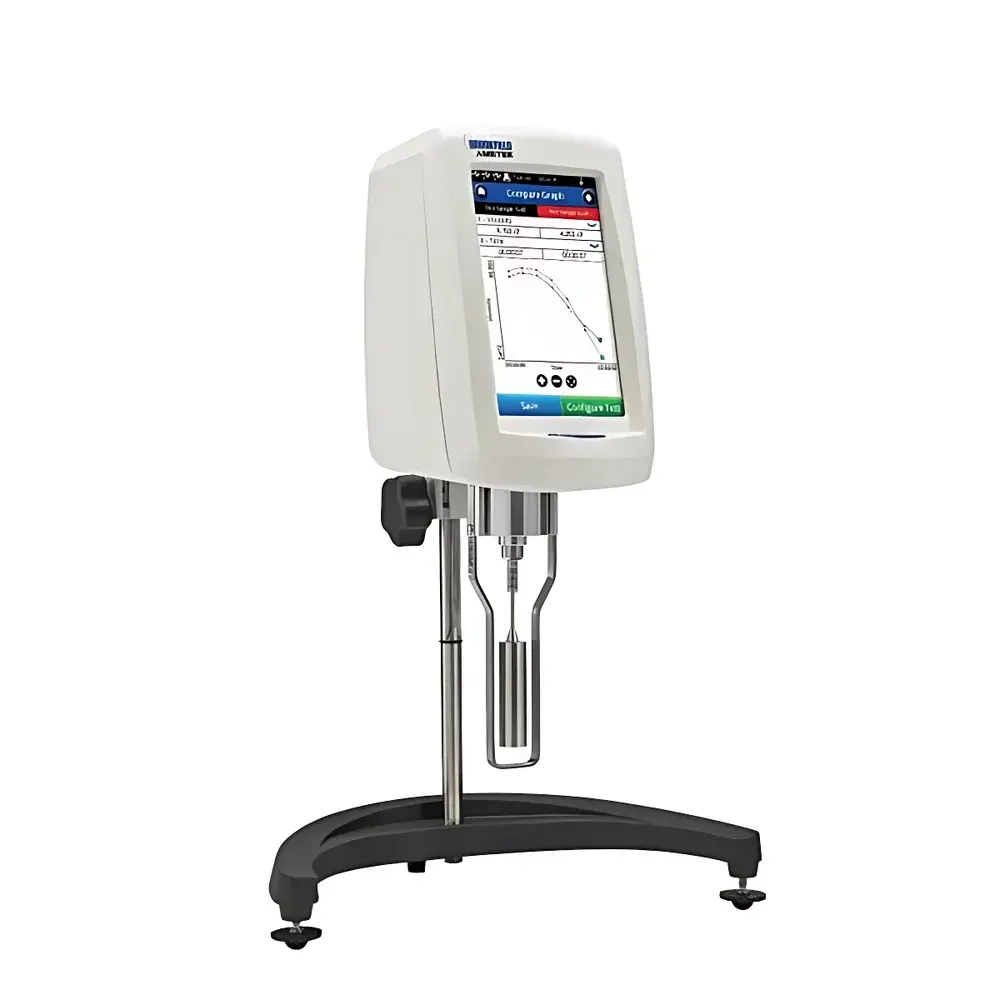
Brookfield DVNext Advanced Rotational Rheometer
| Brand | Brookfield |
|---|---|
| Origin | USA |
| Model | DVNext |
| Instrument Type | Rotational Viscometer/Rheometer |
| Mounting | Benchtop (Fixed) |
| Operating Environment | Ambient Temperature |
| Viscosity Range | 1–320 million cP (mPa·s) |
| Temperature Control | External (via AP/SD Series Circulators or High-Temp Systems) |
| Temperature Accuracy | ±1 °C |
| Temperature Resolution | 1 °C |
| Speed Range | 0.01–250 RPM (2,600 programmable increments) |
| Compliance | FDA 21 CFR Part 11 (Regulatory-Ready Firmware & Audit Trail) |
Overview
The Brookfield DVNext Advanced Rotational Rheometer is an engineered solution for precision viscosity and yield stress characterization of liquids, pastes, gels, and semi-solids across R&D, QC, and regulated manufacturing environments. Based on Couette flow rheometry—where torque response to controlled rotational shear is measured between concentric geometries—the DVNext delivers high reproducibility in both single-point viscosity determination and multi-step rheological profiling. Unlike legacy viscometers, the DVNext integrates real-time graphical feedback, embedded analytical modeling, and regulatory-grade data integrity controls without requiring external software. Its modular architecture supports cone-and-plate, cylindrical, and vane geometries, enabling measurement of complex fluid behavior including thixotropy, shear-thinning, yield point, and time-dependent recovery—critical for formulation development in pharmaceuticals, coatings, food, and personal care.
Key Features
- 7-inch full-color capacitive touchscreen with intuitive icon-driven navigation and multilingual UI (English, German, French, Spanish, Chinese, Japanese)
- Dual-mode operation: fully functional standalone mode + PC-controlled mode via USB 2.0 interface
- Integrated digital leveling system with real-time tilt compensation ensures consistent geometry alignment and eliminates manual bubble-level dependency
- Magnetic coupling spindle mount enables one-handed rotor attachment/detachment with repeatable gap positioning—critical for cone-and-plate and small-sample measurements
- Onboard data storage (150 MB) retains test methods, raw torque/time data, and processed results—including timestamped PDF reports with electronic signatures
- Preloaded rheological models: Casson, Bingham Plastic, Power Law (Ostwald-de Waele), Thixotropic Index (TI), and Yield Stress estimation algorithms
- Compliance-ready firmware supporting 21 CFR Part 11 requirements: role-based user access control, audit trail logging (immutable record of all method edits, data exports, and signature events), electronic signatures, and PDF report locking
- Direct LIMS and network integration via Ethernet port for automated result transfer to enterprise systems
- Real-time display of concurrent parameters: viscosity (cP or mPa·s), temperature (°C/°F), shear rate/stress (calculated), % torque, RPM/spindle ID, test step progress, and model-fitting residuals
Sample Compatibility & Compliance
The DVNext accommodates a broad range of sample types—from low-viscosity solvents (down to 1 cP using the UL adapter) to highly structured pastes (up to 320 million cP with HB-1 spindle). Cone-and-plate configurations support <1 mL volumes and enable precise shear rate control for yield stress quantification per ASTM D2196 and ISO 3219. Optional accessories include PT-100 temperature probes (±1% FS accuracy), small-volume adapters, DIN-compliant spindles, spiral adapters for non-Newtonian suspensions, and high-temperature test chambers (up to 200 °C). The instrument meets GLP/GMP documentation standards and is validated for use in environments governed by USP , ISO 17025, and ICH Q5C. All firmware and calibration routines are traceable to NIST-certified reference standards.
Software & Data Management
RheoCalcT software (optional) extends the DVNext’s capabilities with advanced curve fitting, batch analysis, statistical process control (SPC) charting, and customizable report templates compliant with internal SOPs. However, the instrument operates autonomously: users define multi-step protocols—including ramped shear rates, timed holds, oscillatory sweeps, and recovery intervals—directly on the touchscreen. Every exported dataset includes embedded metadata: operator ID, instrument serial number, calibration date, environmental conditions, and full audit trail references. PDF reports are digitally signed and write-protected, satisfying FDA expectations for electronic records under 21 CFR Part 11 Subpart B. Data export formats include CSV (for Excel/LabView), XML (for LIMS ingestion), and encrypted PDF (for archival).
Applications
- Pharmaceutical: Suspension stability assessment, ointment yield stress verification, injectable viscosity profiling per USP
- Coatings & Inks: Flow curve analysis for spray application, leveling evaluation, thixotropic recovery post-shear
- Foods: Texture consistency of sauces, dairy products, and plant-based alternatives; pumpability modeling for processing lines
- Chemicals: Polymer solution rheology, surfactant micelle breakdown, catalyst slurry homogeneity
- Adhesives & Sealants: Open-time prediction, sag resistance validation, cure-state monitoring via time-sweep
- Quality Control: Pass/fail testing against configurable QC limits with audible/visual alarms and auto-flagging of out-of-spec results
FAQ
Does the DVNext require a PC to perform basic viscosity measurements?
No. All core functions—including method setup, real-time measurement, mathematical modeling, and PDF reporting—are fully operational in standalone mode.
Can the DVNext be used for yield stress determination?
Yes. Using cone-and-plate geometry and built-in Casson or Bingham models, it calculates yield stress from steady-shear flow curves per ASTM D4442 and ISO 3219.
Is temperature control integrated into the instrument?
The DVNext does not include an internal heating/cooling system but features standardized analog and digital interfaces to synchronize with Brookfield AP/SD series recirculating baths or high-temperature test systems.
What level of 21 CFR Part 11 compliance is supported?
The Regulatory Edition firmware provides full Part 11 compliance: electronic signatures with biometric or token-based authentication, immutable audit trails, role-based permissions, and encrypted, locked PDF outputs—all verified during IQ/OQ/PQ validation.
How is calibration verified and maintained?
Calibration is performed using NIST-traceable viscosity standards (RV/HA/HB-1 series). The instrument logs all calibration events, including date, technician ID, standard lot number, and deviation values—accessible via audit trail export.



