
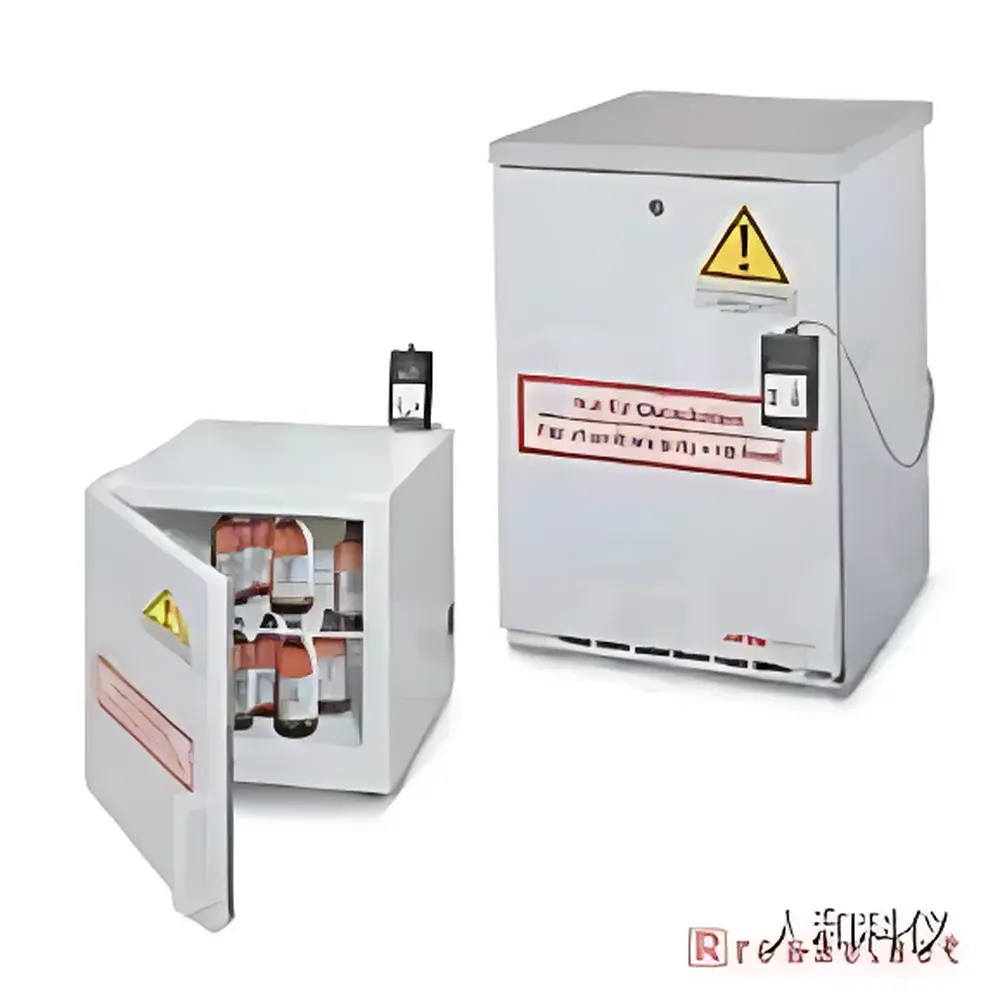
JULABO KRC180 Explosion-Proof Laboratory Refrigerator
| Brand | JULABO |
|---|---|
| Origin | Germany |
| Model | KRC180 |
| Type | Upright |
| Capacity | 180 L |
| Operating Temperature Range | –2 °C to +12 °C |
| Temperature Stability | ±1.0 °C |
| Display | 7-segment green LED, 0.1 °C resolution |
| Sensor | PTC |
| Overtemperature Protection | 105 °C |
| External Dimensions (W×D×H) | 60 × 64 × 86 cm |
| Internal Dimensions (W×D×H) | 52 × 40 × 70 cm |
| Net Weight | 35 kg |
| Ambient Operating Temperature | 0–35 °C |
| Power Supply | 230 V / 50 Hz |
| Safety Classification | DIN 12876-1 compliant |
Overview
The JULABO KRC180 Explosion-Proof Laboratory Refrigerator is an intrinsically safe, upright refrigeration unit engineered for the secure storage of flammable, volatile, and pyrophoric chemicals—including solvents such as acetone, ethanol, ether, and benzene—within regulated laboratory, pharmaceutical, and industrial R&D environments. Designed and manufactured in Germany to meet stringent European safety standards, the KRC180 operates on a hermetically sealed refrigeration circuit with all electrical components—including compressors, controllers, and sensors—located externally or fully encapsulated to eliminate ignition sources inside the storage chamber. Its core thermal management system employs a high-efficiency, low-vibration compressor paired with forced-air circulation and precision PTC temperature sensing, enabling stable operation across the certified working range of –2 °C to +12 °C with ±1.0 °C stability and 0.1 °C digital resolution. Unlike conventional laboratory refrigerators, the KRC180 conforms to DIN 12876-1 Class 3 requirements for explosion-protected equipment used in hazardous areas where flammable vapors may be present during normal operation.
Key Features
- Explosion-proof architecture: No internal wiring, switches, or electronic components within the storage chamber; all electrical circuits are housed externally or embedded in non-sparking, static-dissipative enclosures.
- Dual-sensor safety system: Independent operational and safety temperature sensors continuously monitor chamber conditions; automatic shutdown and dual-mode (visual + audible) alarm activate upon deviation or fault detection.
- Compressor overload protection: Integrated thermal cut-off and current-limiting circuitry prevent overheating and mechanical failure under sustained load or ambient temperature fluctuations.
- Static-control construction: Interior surfaces and shelving fabricated from anti-static, non-sparking materials (e.g., coated stainless steel and conductive polymers) to mitigate electrostatic discharge (ESD) risks.
- Passive safety buffer layer: Insulated cavity walls incorporate flame-retardant, impact-absorbing composite material to contain pressure buildup and delay thermal propagation during emergency scenarios.
- Diagnostic test mode: Dedicated “Safety Simulation” button enables routine verification of alarm response, sensor integrity, and fail-safe shutdown functionality without compromising stored materials.
Sample Compatibility & Compliance
The KRC180 is validated for storage of Class I, Group D (NEC/CEC) and Zone 2 (ATEX/IECEx) hazardous substances, including organic solvents, peroxide-forming reagents, and unstable intermediates. It complies with DIN 12876-1 (Laboratory refrigerators and freezers — Part 1: Safety requirements and testing), and its design supports adherence to broader regulatory frameworks including EU Directive 2014/34/EU (ATEX), ISO/IEC 80079-36, and OSHA 29 CFR 1910.106. The absence of internal spark sources, combined with grounding continuity verified per IEC 61000-4-2, ensures compatibility with GLP and GMP workflows requiring documented hazard mitigation. Units are supplied with full EC Declaration of Conformity and traceable calibration records for temperature sensors.
Software & Data Management
While the KRC180 operates as a standalone analog-digital hybrid system (featuring analog control backup and LED display), it supports external data logging via optional 4–20 mA or 0–10 V analog output interfaces compatible with centralized building management systems (BMS) or LIMS platforms. All alarm events—including door-open duration, temperature excursions >±2.0 °C, and power interruption—are timestamped and retained in non-volatile memory for audit-ready retrieval. Though not natively 21 CFR Part 11 compliant, the unit’s deterministic alarm logic, hardware-enforced safety interlocks, and manual logbook-ready event history facilitate integration into FDA-regulated environments when paired with validated third-party monitoring software.
Applications
- Storage of flammable solvents and reagents in synthetic chemistry labs and QC laboratories.
- Secure holding of peroxide precursors (e.g., diethyl ether, tetrahydrofuran) under temperature-controlled inhibition conditions.
- Short-term stabilization of thermally sensitive catalysts and initiators prior to reaction setup.
- Compliance-driven cold storage in pharmaceutical development labs handling volatile active pharmaceutical ingredients (APIs).
- Backup refrigeration for analytical sample prep stations where solvent evaporation must be minimized during autosampler vial staging.
FAQ
Does the KRC180 require special electrical installation or grounding verification?
Yes. Installation must follow local hazardous area classification guidelines. A dedicated, grounded 230 V / 50 Hz circuit with residual-current device (RCD) protection is mandatory. Ground continuity must be verified (<1 Ω) before commissioning.
Can standard laboratory glassware and plastic containers be used inside the chamber?
Yes—provided containers are chemically compatible and sealed appropriately. The interior accommodates standard 1-L solvent bottles, 500-mL volumetric flasks, and stacked polypropylene trays without obstruction.
Is remote monitoring or network connectivity available?
No native Ethernet or Wi-Fi interface is included. However, analog outputs (4–20 mA) allow connection to SCADA, BMS, or third-party data loggers for centralized oversight.
What maintenance intervals are recommended for long-term reliability?
Compressor oil and refrigerant integrity should be verified annually by an authorized JULABO service technician. Door gasket integrity and sensor calibration checks are recommended every six months.
How does the KRC180 differ from standard “lab-safe” refrigerators?
Standard lab-safe units only remove spark sources (e.g., no internal lights); the KRC180 meets full explosion-proof certification (DIN 12876-1 Class 3), featuring externalized electronics, static-dissipative construction, passive thermal buffering, and redundant safety cutoffs—making it suitable for continuous operation in classified hazardous zones.



