
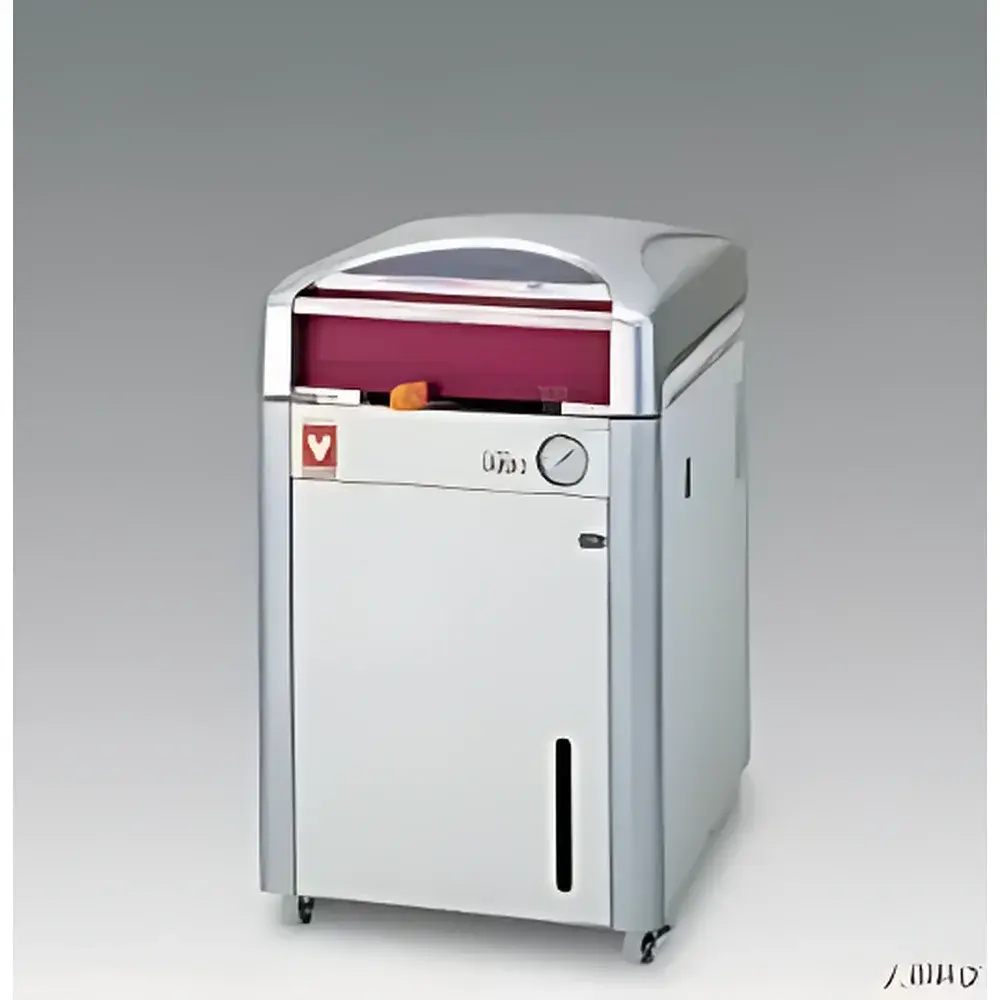
YAMATO SQ810C Vertical Steam Sterilizer
| Brand | YAMATO |
|---|---|
| Origin | Japan |
| Model | SQ810C |
| Instrument Type | Vertical |
| Max Temperature | 135 °C |
| Max Pressure | 0.255 MPa |
| Chamber Dimensions | Ø370 × 744 mm |
| External Dimensions | 520 × 660 × 1125 mm |
| Chamber Volume | 80 L |
| Heating Power | 4000 W |
| Operating Ambient Temperature | 5–35 °C |
| Standard Cooling Fan | Yes |
| Safety Locks | Triple Interlocked Lid Mechanism |
| Voltage Options | AC 100–120 V (20.5–24.5 A) / AC 200–240 V (10.5–12.5 A) |
| Temperature Control | Microprocessor-based PID with Digital Keypad Interface |
| Programmable Stages | Preheating (45–80 °C), Holding (45–60 °C), Dissolution (65–100 °C), Sterilization (105–135 °C) |
Overview
The YAMATO SQ810C is a vertically oriented, microprocessor-controlled steam sterilizer engineered for high-reliability thermal decontamination in academic, clinical, and industrial laboratory environments. It operates on the fundamental principle of saturated steam under pressure—leveraging the thermodynamic properties of water vapor at elevated temperatures (up to 135 °C) and pressures (up to 0.255 MPa) to achieve microbial lethality across bacterial spores, viruses, fungi, and prions. Designed specifically for laboratories requiring reproducible, auditable, and repeatable sterilization cycles—including media preparation, instrument reprocessing, and bioprocess support—the SQ810C integrates precise PID temperature regulation, triple-mechanical lid interlocks, and programmable multi-stage thermal profiles. Its low-profile footprint and front-mounted digital interface enhance ergonomic accessibility, particularly for users of varying stature, while maintaining full compliance with internationally recognized sterilization validation frameworks.
Key Features
- Triple-interlocked lid safety system prevents accidental opening during pressurized operation, meeting ISO 13485 and EN 285 design requirements for Class B sterilizers.
- Microprocessor-based PID temperature control ensures ±0.5 °C stability across all operational ranges (45–135 °C), with real-time digital display and keypad input for intuitive parameter entry.
- Integrated axial cooling fan reduces post-cycle cooldown time by up to 40%, improving throughput without compromising thermal uniformity or material compatibility.
- Programmable multi-stage cycle architecture supports preheating (45–80 °C), holding (45–60 °C), dissolution (65–100 °C), and sterilization (105–135 °C) phases—enabling customized protocols for liquid media, agar plates, glassware, and heat-labile instruments.
- Stainless steel chamber (Ø370 × 744 mm) with 80 L usable volume accommodates standard autoclave baskets, stackable trays, and large-volume flasks; chamber geometry optimized for uniform steam penetration and condensate drainage.
- Dual-voltage compatibility (AC 100–120 V / 200–240 V) facilitates global deployment without hardware modification, supporting seamless integration into diverse electrical infrastructures across North America, Europe, and Asia-Pacific regions.
Sample Compatibility & Compliance
The SQ810C is validated for processing a broad spectrum of load types—including aqueous solutions, nutrient broths, agar-based media, stainless-steel surgical tools, pipette tips, and porous textile packs—without compromising sterility assurance levels (SAL) of 10−6. Its chamber geometry and steam distribution design conform to ISO 17665-1:2017 (Moist Heat Sterilization) and ASTM F1088-22 (Standard Specification for Steam Sterilizers). The unit supports installation qualification (IQ), operational qualification (OQ), and performance qualification (PQ) documentation packages aligned with FDA 21 CFR Part 11, EU Annex 15, and WHO TRS 977 guidelines. Optional data logging modules enable GLP/GMP-compliant audit trails, including timestamped cycle parameters, temperature/pressure profiles, and operator identification.
Software & Data Management
While the SQ810C operates via an embedded microcontroller with no external PC dependency, its firmware architecture supports optional RS-232 or USB serial interfaces for connection to third-party laboratory information management systems (LIMS) or centralized sterilization monitoring platforms. Cycle logs—including start/end times, peak temperature/pressure values, dwell durations, and fault codes—are stored internally with non-volatile memory retention for ≥10,000 cycles. All parameter changes are logged with date/time stamps and user ID fields where integrated authentication is enabled, satisfying traceability requirements under ISO 13485 clause 7.5.10 and FDA 21 CFR Part 11 electronic record provisions.
Applications
- Preparation and sterilization of microbiological growth media (e.g., LB broth, TSA agar, Sabouraud dextrose agar) with controlled dissolution and hold phases to prevent caramelization or precipitation.
- Terminal sterilization of reusable labware—including glass bottles, Petri dishes, and stainless-steel forceps—under validated gravity-displacement or vacuum-assisted cycles.
- Heat-induced protein denaturation studies requiring precise 135 °C exposure for defined durations, such as enzyme inactivation assays or structural biology sample prep.
- Support of Good Manufacturing Practice (GMP) environments in pharmaceutical QC labs, where batch-record integrity, cycle repeatability, and equipment calibration traceability are mandated.
- Routine decontamination of biohazardous waste in BSL-2 containment facilities, compliant with CDC/NIH Biosafety in Microbiological and Biomedical Laboratories (BMBL) recommendations.
FAQ
What is the maximum allowable operating pressure for the SQ810C?
The maximum working pressure is 0.255 MPa (2.55 bar), certified per ASME BPVC Section VIII Division 1 and JIS B 8225 standards.
Does the SQ810C support automatic water replenishment?
Yes—model SQ810C includes an auto-overfill system that maintains optimal water level during extended cycles, eliminating manual top-up requirements.
Can the unit be validated for use in regulated pharmaceutical manufacturing?
Yes—its design, documentation package, and programmable cycle logic support IQ/OQ/PQ execution per ISO 13485, EU GMP Annex 15, and FDA Process Validation Guidance.
Is the chamber constructed from medical-grade stainless steel?
The inner chamber is fabricated from SUS304 stainless steel with electropolished finish (Ra ≤ 0.8 µm), ensuring corrosion resistance and cleanability per ISO 15883-1.
How is temperature uniformity verified across the chamber volume?
YAMATO provides factory-generated temperature mapping reports (per ISO 17665-2) demonstrating ≤±1.0 °C deviation at nine critical locations during standard 121 °C/15 min cycles.
Related Products



