
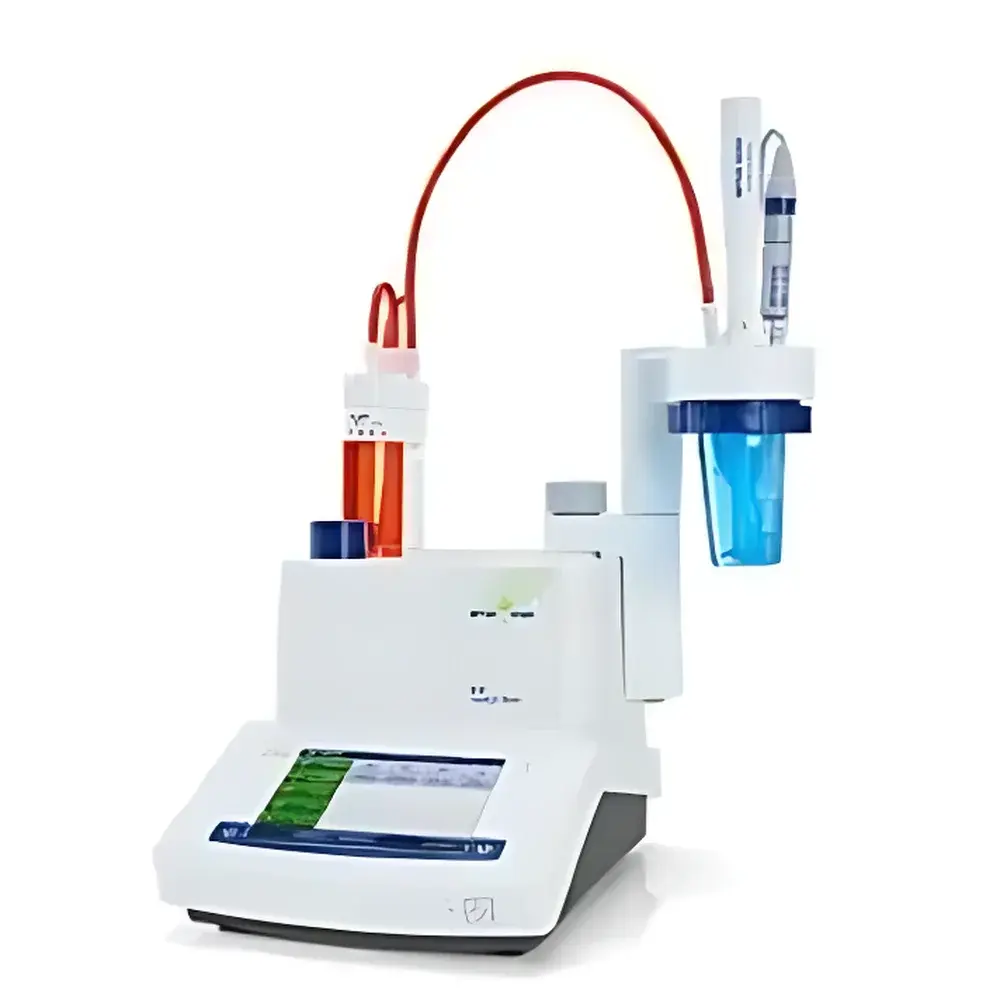
METTLER TOLEDO G10S Smart Compact Potentiometric Titrator
| Brand | METTLER TOLEDO |
|---|---|
| Origin | Switzerland |
| Model | G10S |
| Instrument Type | General-purpose Automatic Potentiometric Titrator |
| Measurement Range | ±2000 mV / –26.0 to 40.0 pH |
| Meter Accuracy | 0.01% of reading |
| Meter Resolution | 0.1 mV / 0.001 pH |
| Titration Precision | 0.2 mV / 0.003 pH |
| Integrated Sensor Interface | Yes (Plug-and-Play) |
| Endpoint Detection | Yes |
| GLP-Compliant Reporting | Yes |
| Predefined Methods | >20 METTLER TOLEDO Validated Methods |
| Sample Capacity (with Rondolino) | Up to 120 samples per batch |
| Stirrer Type | Propeller-type magnetic stirrer |
| Data Export Formats | CSV, PDF, XML |
| User Languages | English, Chinese, German, French, Spanish, Italian, Russian, Polish, Korean, Portuguese |
| RFID-enabled Smart Burette Recognition | Yes |
| One-Click™ Workflow Interface | Yes |
| USB Peripheral Support | Printer (USB-P25 or generic USB), Flash Drive |
Overview
The METTLER TOLEDO G10S Smart Compact Potentiometric Titrator is an engineered solution for routine potentiometric titration in quality control, academic teaching laboratories, and industrial process support environments. Based on classical potentiometric endpoint detection—measuring potential difference between a reference and indicator electrode as titrant is incrementally delivered—the G10S delivers reproducible, traceable results across acid-base, redox, precipitation (e.g., chloride, bromide), complexometric, and photometric titration modes. Its compact footprint and intuitive architecture reduce operational overhead without compromising metrological integrity. Designed and manufactured in Switzerland, the instrument complies with core principles of ISO/IEC 17025, ASTM E202, and USP , supporting method validation and regulatory readiness in GLP- and GMP-aligned workflows.
Key Features
- One-Click™ workflow interface with full-color capacitive touchscreen, enabling rapid method launch and real-time status visualization across 10 localized languages.
- RFID-enabled smart burette recognition: Each METTLER TOLEDO Smart Burette embeds a passive RFID chip storing reagent identity, concentration, expiry date, lot number, and calibration history—automatically loaded upon installation to prevent misuse of expired or mismatched titrants.
- Integrated plug-and-play sensor interface supporting pH, redox, ion-selective, and photometric electrodes without external signal conditioning hardware.
- Propeller-type magnetic stirrer with adjustable speed and torque compensation ensures homogeneous mixing across sample volumes from 10 to 250 mL, minimizing endpoint drift during slow-reaction titrations.
- Onboard method editor with modular logic blocks (e.g., conditional steps, equivalence point algorithms, derivative-based detection) allows customization of preloaded methods or development of user-defined protocols compliant with internal SOPs.
- Hardware-level GLP compliance: Full audit trail (user ID, timestamp, parameter changes, result modifications), electronic signatures, and tamper-evident report generation (PDF/A-1b, CSV, XML) with embedded metadata including instrument ID, firmware version, and sensor serial numbers.
Sample Compatibility & Compliance
The G10S accommodates aqueous and mildly organic matrices typical of pharmaceutical excipient testing, water hardness analysis, food acidity profiling, and electroplating bath monitoring. It supports standard 10–100 mL sample cups and integrates seamlessly with the optional Rondolino automatic sample changer (up to 120 positions). All measurement electronics conform to IEC 61000-4 electromagnetic compatibility standards. The system satisfies key data integrity requirements of FDA 21 CFR Part 11 when deployed with validated network configurations and role-based access control. Certificate of Conformance (CoC), Factory Calibration Report, and IQ/OQ documentation packages are available upon request.
Software & Data Management
Data handling follows ALCOA+ principles (Attributable, Legible, Contemporaneous, Original, Accurate, Complete, Consistent, Enduring, Available). Results export directly via USB to encrypted flash drives or certified USB-P25 thermal printers with non-removable print logs. All reports include cryptographic hash verification and digital signature fields. The instrument’s embedded file system retains raw electrode potential vs. volume curves, first/second derivative plots, and intermediate calculation steps—enabling retrospective reprocessing without re-running samples. No proprietary software installation is required for basic operation; advanced reporting or fleet management may utilize METTLER TOLEDO LabX Lite (optional web-based module).
Applications
- Pharmaceutical: Assay of active ingredients (e.g., amine hydrochlorides), residual chloride in APIs, acid number in excipients.
- Food & Beverage: Total acidity (TA) in wines and juices, salt content (argentometric), peroxide value in oils.
- Environmental: Alkalinity and hardness in wastewater, cyanide in effluents (pyridine-barbituric acid method).
- Chemicals: Saponification value of surfactants, free fatty acids in biodiesel, formaldehyde content via sulfite titration.
- Education: Teaching fundamental titration theory, electrode behavior, Nernst equation validation, and uncertainty propagation in volumetric analysis.
FAQ
Does the G10S support non-aqueous titrations?
Yes—when paired with appropriate non-aqueous electrodes (e.g., Ag/AgCl in acetonitrile) and solvents compatible with its fluidic path materials (e.g., ethanol, isopropanol, acetone), provided viscosity and conductivity remain within operational limits.
Can I import custom titration methods from older METTLER TOLEDO instruments?
Method files from T50/T70/T90 platforms can be converted using the free METTLER TOLEDO Method Migration Tool; syntax adjustments may be required for advanced logic elements.
Is firmware update performed locally or via cloud?
Firmware updates are distributed as signed .bin files via METTLER TOLEDO’s secure customer portal and installed offline via USB drive—no internet connection required during operation.
What is the maximum allowable sample temperature range during titration?
The instrument operates safely between 5 °C and 40 °C ambient; sample temperature must remain stable within ±2 °C during titration to maintain electrode response fidelity.
How is data backup handled in standalone mode?
All methods, results, and audit logs are stored redundantly on internal flash memory and automatically mirrored to any connected USB mass storage device at session end.





