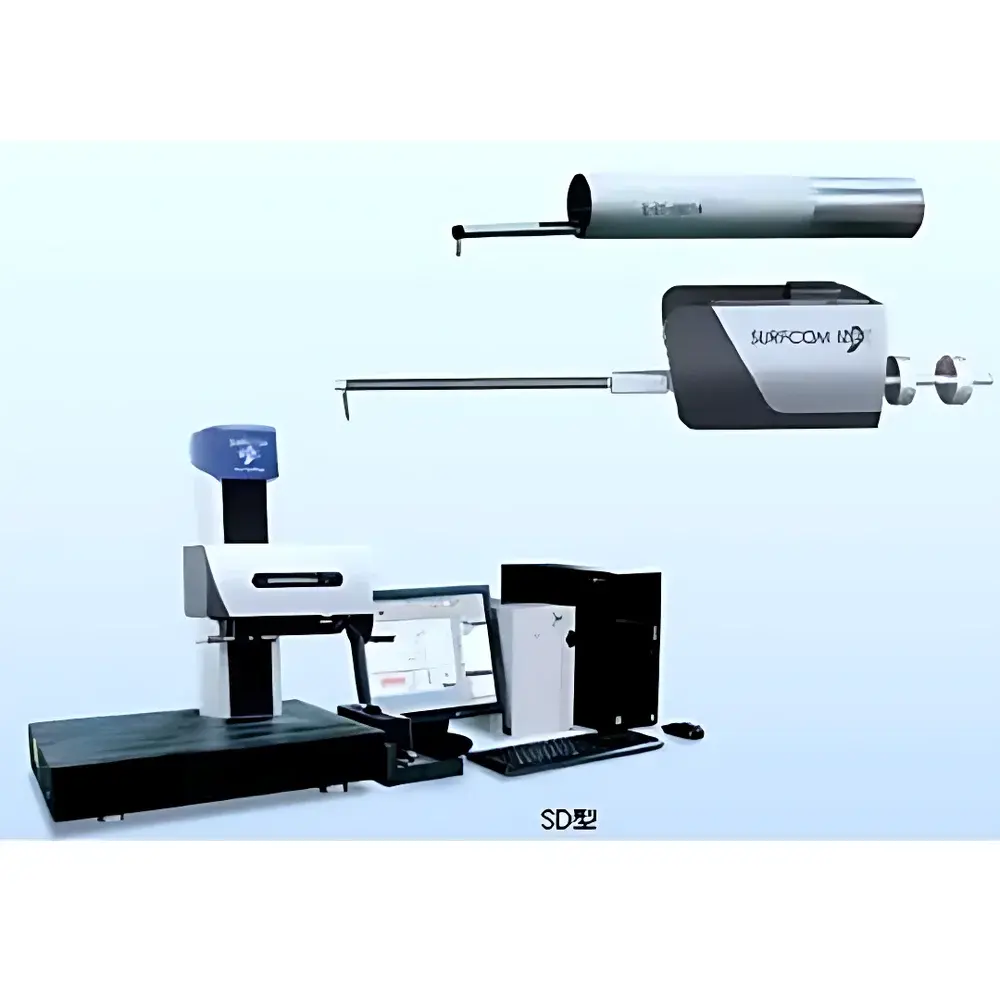
Accretech SURFCOM NEX 031SD Contact Profilometer & Surface Roughness Tester
| Brand | Accretech |
|---|---|
| Origin | Japan |
| Model | SURFCOM NEX 031SD |
| Measurement Principle | Stylus-based profilometry |
| Sensor Type | Dual-purpose (contour + roughness) |
| Standard Stylus Force | 0.75 mN |
| Roughness Vertical Range | ±500 µm |
| Drive Mechanism | Linear motor |
| Temperature Compensation | Yes (20 ± 5 °C operational range) |
| Sensor Mounting | V-groove + three-point ball-pin定位 |
| Quick-change Arm | Yes, with collision detection and auto-stop |
| Measurement Orientation | Upward, downward, lateral (via bracket or stylus reorientation) |
| Compliance Ready | Designed for ISO 4287, ISO 4288, ISO 25178-2, JIS B 0601, ASME B46.1, and GLP/GMP-aligned data integrity workflows |
Overview
The Accretech SURFCOM NEX 031SD is a high-precision, dual-function contact profilometer engineered for simultaneous contour and surface roughness metrology in R&D laboratories, precision manufacturing QA/QC environments, and calibration facilities. Based on proven stylus-based profilometry principles, it measures surface topography by physically tracing a diamond-tipped probe across the sample under controlled force—enabling quantitative analysis of form deviations (e.g., radius, angle, step height, thickness, diameter) and micro-geometric texture parameters (e.g., Ra, Rz, Rq, Rsk, Rku, Sk, Spk, Svk). Its modular architecture integrates two functionally distinct but mechanically interoperable sensor systems—contour and roughness—within a single, thermally stabilized platform. Unlike legacy screw-driven systems, the NEX 031SD employs a direct-drive linear motor for the traversing unit, eliminating backlash, reducing mechanical hysteresis, and delivering sub-nanometer positional repeatability over its full 100 mm horizontal travel range. The system operates within an expanded environmental envelope (20 ± 5 °C), supported by real-time temperature compensation in the drive unit—significantly lowering facility HVAC dependency while maintaining traceable accuracy per ISO 16610-21 and ISO 25178-600.
Key Features
- Integrated dual-sensor capability: Interchangeable contour and roughness sensors mounted via precision V-groove alignment and three-point ball-pin registration—ensuring <0.5 µm repeatability without recalibration after swap.
- Collision-protected measurement: Real-time impact load monitoring triggers immediate drive stop and on-screen alert, preventing stylus damage and preserving measurement integrity.
- Multi-directional measurement flexibility: Standard upward/downward contour acquisition; optional lateral measurement using dedicated mounting brackets; reversible stylus orientation for inverted or overhead surface evaluation.
- Ultra-low-force roughness sensing: 0.75 mN nominal tracking force minimizes plastic deformation on soft metals, polymers, thin films, and coated substrates—fully compliant with ISO 25178-2 requirements for non-destructive assessment.
- Extended vertical range: ±500 µm roughness range—25% greater than prior-generation Accretech systems—supports high-aspect-ratio features such as deep grooves, etched trenches, and additive-manufactured surface layers.
- Linear motor-driven carriage: Delivers smooth, vibration-free motion with <0.02 µm RMS velocity ripple, enabling high-resolution scanning at speeds up to 5 mm/s without sacrificing signal fidelity.
Sample Compatibility & Compliance
The SURFCOM NEX 031SD accommodates samples up to 300 × 300 × 150 mm (W × D × H) on its granite base, with optional vacuum chucks, kinematic fixtures, and custom stage adapters available for semiconductor wafers, medical implants, optical lenses, and micro-machined components. All measurements adhere to internationally recognized standards including ISO 4287 (roughness parameters), ISO 4288 (lay and sampling length), ISO 25178-2 (areal surface texture), JIS B 0601 (Japanese industrial standard for surface roughness), and ASME B46.1 (U.S. surface characterization guidelines). Data output formats (CSV, X3P, ISO 5436-2 compliant XML) support audit-ready traceability. When configured with time-stamped, user-authenticated operation logs and encrypted raw profile archives, the system meets foundational requirements for FDA 21 CFR Part 11 compliance in regulated pharmaceutical and biotech settings.
Software & Data Management
The bundled SURFCOM Navigator software provides a unified interface for setup, acquisition, analysis, and reporting. It supports automated multi-point measurement routines, cross-sectional overlay comparisons, GD&T-compliant geometric fitting (circle, line, sphere, cylinder), and statistical process control (SPC) charting. Raw profile data is stored in native binary format with embedded metadata (operator ID, timestamp, environmental conditions, calibration certificate ID). Export options include ISO-standardized X3P files for third-party interoperability and CSV for integration into LIMS or MES platforms. Audit trail functionality records all parameter changes, measurement starts/stops, and report generations—enabling full GLP/GMP traceability when deployed in regulated quality systems.
Applications
- Precision machining: Verification of turned, ground, or EDM-finished surfaces—including edge break geometry, chamfer consistency, and burr height quantification.
- Medical device manufacturing: Surface texture validation of orthopedic implants, stent struts, and dental abutments per ISO 14644 and ASTM F2715.
- Semiconductor packaging: Step-height measurement of wafer-level under-bump metallization (UBM) and solder bump coplanarity assessment.
- Optics and photonics: Radius-of-curvature verification of lens surfaces, scratch/ripple analysis on AR-coated substrates, and mold cavity fidelity inspection.
- Additive manufacturing: As-built surface characterization of Ti-6Al-4V and Inconel 718 parts, supporting AM qualification per ASTM F3122 and ISO/ASTM 52900.
FAQ
Does the SURFCOM NEX 031SD require recalibration after switching between contour and roughness sensors?
No. The V-groove and three-point ball-pin mounting system ensures mechanical repeatability better than ±0.3 µm, eliminating the need for sensor-specific recalibration.
Can the system measure surfaces oriented vertically or upside-down?
Yes—via optional mounting brackets for lateral measurement and reversible stylus holder for upward-facing acquisition.
What is the minimum measurable radius with the standard contour sensor?
The system resolves radii down to 10 µm with standard 2 µm tip radius stylus; sub-µm resolution achievable with optional 0.5 µm tip stylus.
Is temperature compensation active during both contour and roughness measurement modes?
Yes—compensation is embedded in the drive unit firmware and applies continuously across all measurement types and scan lengths.
How is raw profile data secured for regulatory review?
Navigator software supports password-protected user roles, digital signatures on reports, and immutable audit logs synchronized with system clock—fully aligned with ALCOA+ data integrity principles.