
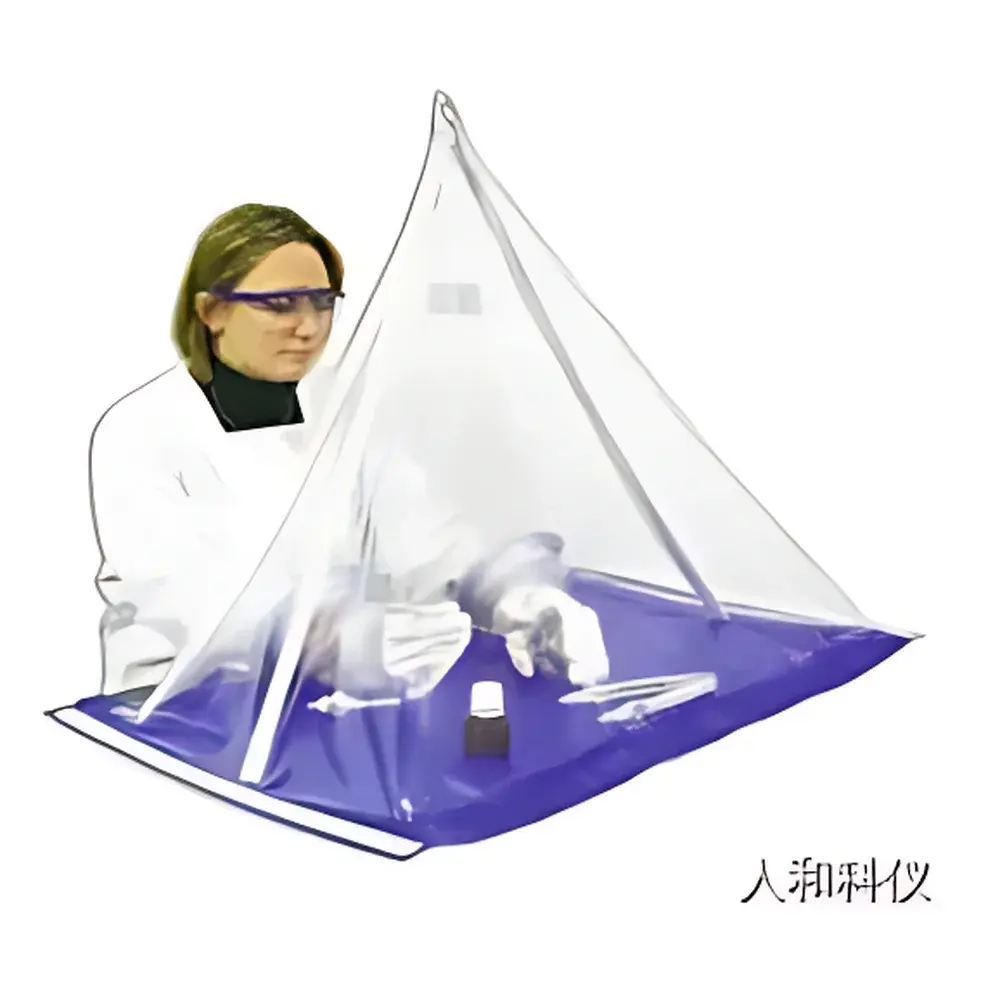
Erlab Captair Pyramid Portable Airtight Isolation Enclosure
| Brand | Erlab |
|---|---|
| Origin | France |
| Model | Captair Pyramid Portable Airtight Isolation Enclosure |
| Dimensions (L×W×H) | 860 mm × 560 mm × 725 mm |
| Application Type | Production-Scale Glove Box |
| Certification | Pre-shipment airtightness test at 2.5 mmHg gauge pressure |
| Construction | Reinforced polymer composite housing with integrated glove ports and HEPA/ULPA filtration interface |
Overview
The Erlab Captair Pyramid Portable Airtight Isolation Enclosure is an engineered containment solution designed for safe handling of low-to-moderate hazard materials in research, quality control, and small-batch production environments. Based on Erlab’s proven Captair platform and refined through decades of French laboratory systems engineering, this enclosure operates on the principle of negative-pressure containment—maintaining a stable inward airflow gradient to prevent uncontrolled release of airborne particulates or vapors. Unlike conventional laminar flow hoods or open-front fume cabinets, the Pyramid model integrates full perimeter sealing, dual-glove access ports, and modular filtration integration points, enabling reliable isolation performance without requiring permanent room modifications or dedicated ducted exhaust infrastructure. Its compact footprint and self-contained design make it suitable for ISO Class 5–7 cleanroom-adjacent workflows, pharmaceutical secondary packaging validation, and controlled substance handling under GLP-compliant conditions.
Key Features
- Pyramid-shaped structural geometry optimized for internal airflow uniformity and visual ergonomics—reducing turbulence and dead zones while enhancing operator visibility and reach depth.
- Factory-certified airtightness verification: Each unit undergoes mandatory pre-shipment pressurization testing at 2.5 mmHg (≈333 Pa) gauge pressure; units passing the 15-minute decay threshold receive a serialized compliance label affixed to the top panel and a traceable test report.
- Modular glove port system compatible with standard 120 mm and 150 mm diameter butyl or Viton® gloves; ports feature O-ring-sealed flanges with torque-spec fasteners for repeatable reinstallation.
- Integrated mounting interface for optional HEPA (EN 1822 H14) or ULPA (ISO 29463 U15) filter modules, supporting recirculation or 100% exhaust configurations per EN 14175-3 and ANSI Z9.5 guidelines.
- Reinforced polymer composite housing—non-corrosive, static-dissipative, and resistant to common solvents including ethanol, isopropanol, and diluted acids—enabling reuse across cleaning/disinfection cycles without structural degradation.
- Tool-free assembly: Frameless interlocking panels with alignment dowels and captive hardware allow full mechanical setup in under 20 minutes by two personnel; no adhesives or permanent fasteners required.
Sample Compatibility & Compliance
The Captair Pyramid is validated for use with solid powders, lyophilized intermediates, cytotoxic APIs, and moisture-sensitive compounds where exposure to ambient humidity or oxygen must be limited to ≤500 ppm during manipulation. It meets the mechanical integrity requirements outlined in ISO 10648-2 (Class 1 containment) for low-risk aerosol generation scenarios. While not classified as a full GMP-grade isolator (per EU Annex 1), its documented airtightness protocol supports audit readiness for FDA 21 CFR Part 11–aligned electronic records when paired with optional data-logging environmental sensors. The enclosure complies with CE marking directives for machinery safety (2006/42/EC) and electromagnetic compatibility (2014/30/EU).
Software & Data Management
This is a standalone mechanical containment system with no embedded firmware or digital interface. However, it includes standardized analog sensor ports (¼” NPT) for third-party integration with differential pressure transducers, particulate counters (e.g., TSI 3330), or humidity/temperature loggers. All test documentation—including serial-numbered airtightness certificates—is archived in Erlab’s EU-based quality management system (QMS) and available upon request for regulatory submission packages. Traceability aligns with ISO 9001:2015 clause 8.5.2 (Identification and traceability) and supports internal SOPs requiring equipment qualification records (IQ/OQ).
Applications
- Pre-sterile weighing and dispensing of potent compounds in QC laboratories operating under USP or guidance.
- Handling of nanomaterials during formulation development where nanoparticle agglomeration must be minimized via inert gas purging (N₂ or Ar).
- Disassembly and inspection of sealed medical device components under controlled particulate conditions.
- Decontamination staging for reusable PPE or labware prior to autoclave loading—when combined with integrated UV-C irradiation modules (sold separately).
- On-site validation of disinfectant efficacy using ASTM E2197 or EN 13697 protocols, leveraging its reproducible air exchange rate and defined internal volume (0.35 m³).
FAQ
Is this unit certified for use with hazardous drugs under USP ?
It is not independently certified as a “containment primary engineering control” per USP , but its documented airtightness and negative-pressure capability support its use as a supplementary containment layer when operated within a compliant facility ventilation environment.
Can the enclosure be connected to a building exhaust system?
Yes—optional duct adapters (DN100 or DN150) are available for hard-piped exhaust integration; static pressure loss remains below 120 Pa at 120 m³/h flow rate.
What maintenance is required to retain airtightness over time?
Glove integrity should be verified weekly via visual inspection and pressure hold test; O-rings require replacement every 12 months or after 500 glove changes, per Erlab’s Maintenance Schedule MS-CAP-PYR-2023.
Does the unit include filtration?
No—filtration modules are optional accessories selected based on application-specific aerosol characteristics and local exhaust regulations.
Is calibration documentation provided?
A factory airtightness certificate with unique serial number, test date, technician ID, and pressure decay curve is supplied with each unit; third-party calibration of integrated sensors is the user’s responsibility.



