
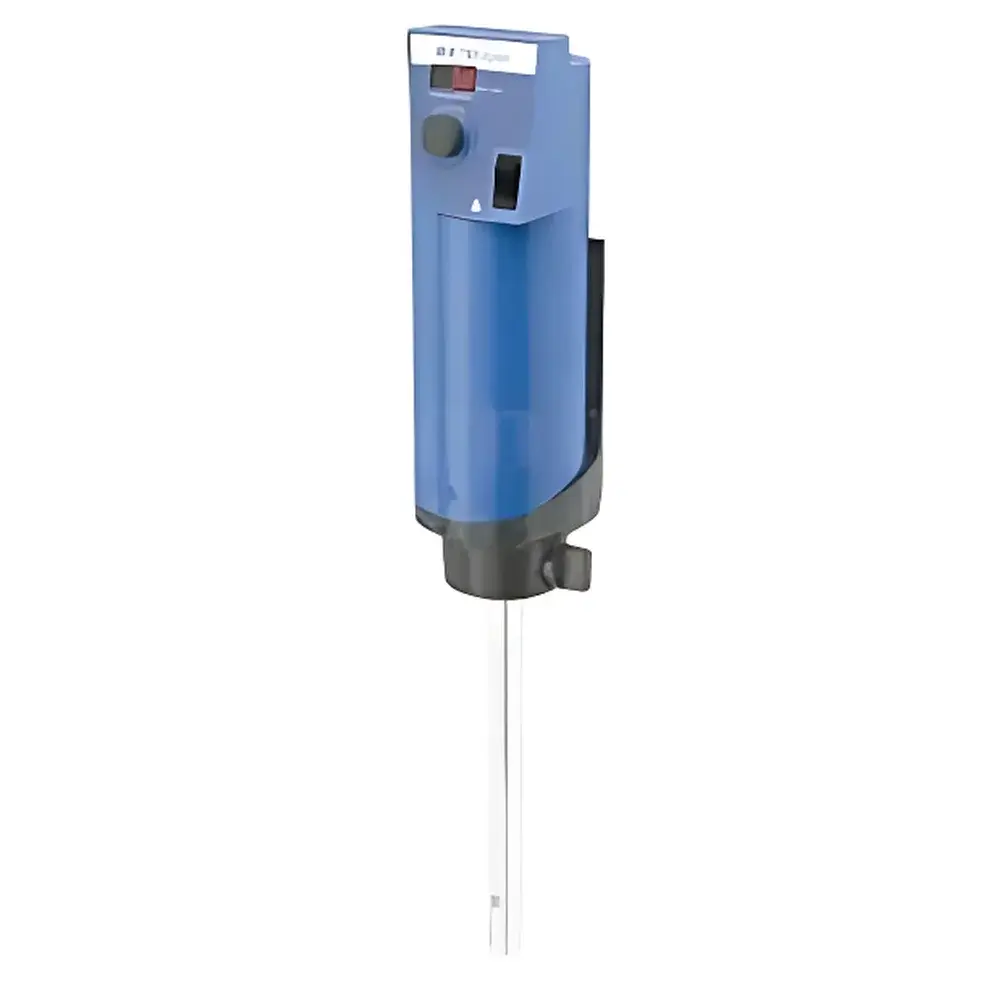
IKA T 50 digital ULTRA-TURRAX® High-Performance Disperser
| Brand | IKA |
|---|---|
| Origin | Germany |
| Model | T 50 digital ULTRA-TURRAX® |
| Instrument Type | Probe-type Rotor-Stator Homogenizer |
| Dimensions (W×D×H) | 115 × 355 × 139 mm |
| Processing Volume Range | 0.25 – 30 L (H₂O) |
| Speed Range | 600 – 10,000 rpm |
| Speed Accuracy | ±1 % |
| Max. Viscosity | 5,000 mPa·s |
| Input Power | 1,100 W |
| Output Power | 700 W |
| Noise Level (without dispersing head) | 72 dB(A) |
| Protection Class | IP20 |
| Operating Temperature | 5 – 40 °C |
| Relative Humidity | ≤80 % |
| Voltage | 220–240 V, 50/60 Hz |
| Weight | 5.76 kg |
| Extension Arm Diameter | 16 mm |
| Extension Arm Length | 220 mm |
| Duty Cycle | Continuous Operation (100 %) |
Overview
The IKA T 50 digital ULTRA-TURRAX® is a high-performance, probe-type rotor-stator homogenizer engineered for precise and reproducible dispersion, emulsification, homogenization, and cell disruption in laboratory-scale applications. Based on the fundamental principle of high-shear mechanical energy transfer—where rotational kinetic energy from a rapidly spinning rotor is converted into intense hydrodynamic forces within a fixed stator—the system generates controlled turbulent flow, cavitation, and extensional stresses essential for particle size reduction and phase integration. Designed for rigorous daily use in QC, R&D, and formulation development labs, the T 50 digital integrates a robust 700 W motor with advanced electronic speed regulation to maintain constant rotational velocity across varying load conditions—including changes in sample viscosity up to 5,000 mPa·s. Its compact footprint (115 × 355 × 139 mm), IP20-rated enclosure, and continuous-duty capability make it suitable for installation in standard fume hoods or benchtop environments compliant with DIN EN 60529 safety standards.
Key Features
- Digitally controlled speed regulation (600–10,000 rpm) with LED display and ±1 % speed accuracy for method traceability and inter-lab reproducibility
- Electronic overload protection and error-code diagnostics for proactive maintenance and operational integrity
- Smooth ramp-up start function minimizing splashing and ensuring operator safety during high-speed initiation
- Stainless-steel dispersing tools (ULTRA-TURRAX® probes) designed for rapid cleaning, autoclavability, and chemical resistance to common solvents and aqueous media
- Modular probe compatibility—including S-shaped, conical, and narrow-diameter geometries—to optimize shear profile for low-volume (0.25 L) or high-volume (up to 30 L H₂O-equivalent) processing
- Integrated extension arm (16 mm Ø, 220 mm length) enabling access to tall or narrow vessels while maintaining mechanical stability
- Noise-optimized gear-motor architecture (72 dB(A) without probe attached) supporting compliance with occupational health guidelines for sustained lab operation
Sample Compatibility & Compliance
The T 50 digital accommodates a broad range of sample types—from low-viscosity aqueous suspensions to moderately viscous polymer solutions and biological lysates—without requiring recalibration. Its rotor-stator geometry ensures consistent energy input regardless of viscosity shifts, supporting GLP-aligned workflows where parameter stability is critical. The instrument meets DIN EN 60529 (IP20) for electrical safety and conforms to IEC 61000-6-3 (EMC emission limits). While not intrinsically rated for explosive atmospheres, its design supports integration into ISO/IEC 17025-accredited laboratories performing method validation per ASTM D3418 (viscosity), ISO 13320 (laser diffraction particle sizing pre-homogenization), or USP (emulsion droplet distribution). All stainless-steel wetted parts comply with FDA-relevant material requirements for non-contact pharmaceutical auxiliary equipment.
Software & Data Management
As a standalone benchtop unit, the T 50 digital does not include embedded software or network connectivity. However, its real-time LED speed readout, error logging (via alphanumeric fault codes), and analog-compatible output signals (optional via external interface modules) facilitate integration into validated data acquisition systems. Laboratories operating under 21 CFR Part 11 requirements may document operational parameters manually or via time-stamped video recording synchronized with vessel labeling and batch logs. For audit readiness, IKA provides full traceability documentation—including CE Declaration of Conformity, RoHS compliance statements, and factory calibration certificates—upon request.
Applications
- Preparation of stable nanoemulsions and microemulsions for topical or oral delivery systems
- Homogenization of tissue homogenates prior to protein extraction or nucleic acid isolation
- Dispersion of carbon nanotubes, graphene oxide, or ceramic nanoparticles into polymeric matrices
- Routine quality control of pigment pastes, ink formulations, and cosmetic bases
- Cell lysis optimization studies under defined shear stress profiles for bioprocess development
- Standardized sample preparation for subsequent analysis by DLS, SEM, or HPLC
FAQ
What is the minimum and maximum recommended processing volume?
The T 50 digital is validated for volumes between 0.25 L and 30 L (water-equivalent), with optimal performance achieved when the probe immersion depth exceeds three times the rotor diameter.
Can the instrument operate continuously without duty-cycle interruption?
Yes—it is rated for 100 % continuous duty under ambient conditions of 5–40 °C and ≤80 % relative humidity.
Are ULTRA-TURRAX® dispersing tools autoclavable?
All standard stainless-steel probes are fully autoclavable at 121 °C / 1 bar for 20 minutes; verify specific tool geometry against IKA’s sterilization guidelines prior to use.
Does the T 50 digital support external data logging or RS-232 communication?
No native digital interface is included, but third-party analog-to-digital converters or optional IKA Labworldsoft-compatible modules can enable basic speed signal capture.
How is speed accuracy maintained across viscosity changes?
Through closed-loop electronic speed control that dynamically adjusts torque output to sustain setpoint rpm—verified per ISO 5725-2 for repeatability under variable load conditions.



