
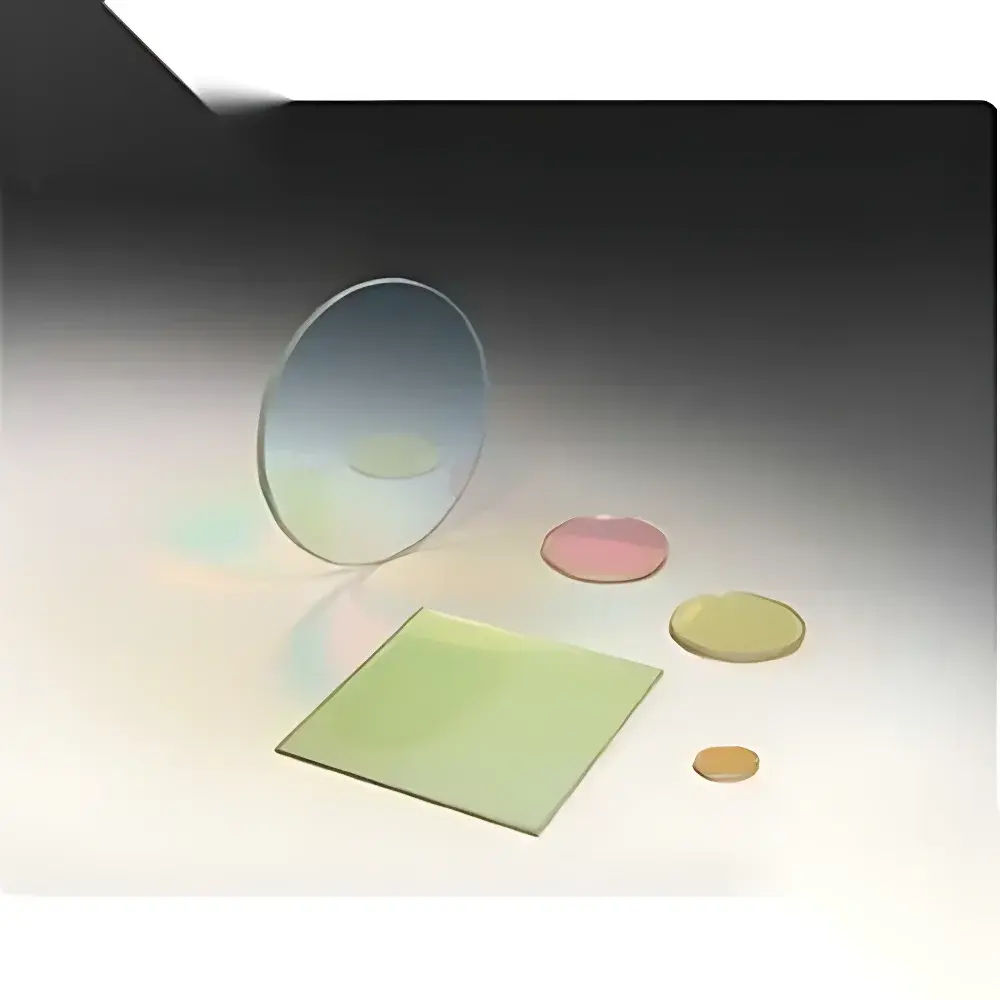
Andover Long-Wave Pass (LWP) Optical Interference Filter
| Brand | Andover Corporation |
|---|---|
| Origin | USA |
| Manufacturer Type | Original Equipment Manufacturer (OEM) |
| Import Status | Imported |
| Pricing | Available upon Request |
| Substrate | BK7 or Borofloat® (optional) |
| Thickness | ≤4.0 mm |
| Clear Aperture | ≥85% of outer dimension |
| Surface Quality | 80–50 per MIL-C-48497A |
| Flatness | 3–5 waves @ 25 mm (TWFS) |
| Operating Temperature | −50 °C to +200 °C |
| Humidity & Abrasion Resistance | Compliant with MIL-C-675C |
| Cut-on Slope (LWP) | ≤6% (≤11% for 300 nm filter) |
| Cut-on Tolerance | ±10 nm (400–1100 nm), ±5 nm (300–375 nm) |
| Avg. Transmission (LWP) | ≥85% from 50% cut-on point to 2000 nm |
| Blocking (LWP) | ≥99% from 0.9× cut-on to UV |
| Effective Refractive Index (n*) | ~1.7 |
| Wavelength Range | 300–1000 nm (50 nm increments standard) |
| Edge Steepness | Significantly steeper than colored-glass filters |
Overview
The Andover Long-Wave Pass (LWP) Optical Interference Filter is a precision thin-film dielectric filter engineered for high spectral selectivity in demanding optical measurement and fluorescence instrumentation applications. Unlike absorptive color-glass filters, Andover LWP filters operate on the principle of constructive and destructive interference within a modified quarter-wave stack architecture. This interference-based design delivers exceptionally sharp transition slopes—typically ≤6% (measured as % wavelength interval between 10% and 90% transmission points)—and enables precise spectral separation without thermal load or photobleaching risks associated with absorption. The filter’s edge position (defined at the 50% transmission point) remains stable across environmental variations, while its slight blue-shift with increasing angle of incidence provides a deterministic means of fine-tuning cutoff wavelength in collimated or convergent beam configurations—critical for alignment-critical setups such as confocal microscopy, Raman spectroscopy, and multi-channel fluorescence detection.
Key Features
- High-performance dielectric coating deposited via ion-assisted e-beam evaporation on optically polished BK7 or optional Borofloat® substrate—ensuring mechanical durability, cleanability, and long-term stability under routine laboratory handling.
- Steep spectral transition slope (≤6% for most models; ≤11% for 300 nm variant), significantly exceeding the performance of traditional colored-glass long-wave pass filters.
- Consistent 50% cut-on tolerance: ±10 nm across 400–1100 nm range; ±5 nm for ultraviolet-edge variants (300–375 nm), enabling traceable calibration in spectrophotometric and photometric workflows.
- High average transmission (>85%) from the 50% cut-on point through the near-infrared (up to 2000 nm), minimizing signal loss in low-light detection systems.
- Robust blocking performance: ≥99% rejection from 0.9× the 50% cut-on wavelength into the UV region—essential for eliminating excitation bleed-through in fluorescence emission pathways.
- Standard wavelength selection from 300 nm to 1000 nm in 50 nm increments; custom edge positions and substrate materials (e.g., fused silica for deep-UV or high-power laser compatibility) available upon request.
Sample Compatibility & Compliance
Andover LWP filters are compatible with standard optical mounts (e.g., SM1-threaded lens tubes, cage systems, and filter wheels) and integrate seamlessly into OEM analytical platforms including fluorometers, hyperspectral imagers, and process monitoring spectrometers. All filters comply with MIL-C-48497A surface quality specifications (80–50 scratch-dig), MIL-C-675C humidity and abrasion resistance standards, and ISO 10110 optical component tolerancing conventions. While not certified to specific FDA or IEC regulatory frameworks as standalone medical devices, their material traceability, batch-controlled coating processes, and documented spectral performance support integration into GLP- and GMP-compliant instrumentation where optical component qualification is required per internal SOPs or ASTM E275 (Standard Practices for Describing and Measuring Performance of Ultraviolet, Visible, and Near-Infrared Spectrophotometers).
Software & Data Management
As passive optical components, Andover LWP filters do not incorporate embedded electronics or firmware. However, their spectral transmission data—including full-wavelength transmission curves (300–2000 nm), angle-dependent shift profiles, and polarization sensitivity—are provided in standardized ASCII and CSV formats compatible with common optical simulation tools (e.g., Zemax OpticStudio, FRED, ASAP) and instrument control software (e.g., LabVIEW, Python-based PyVISA or SpectraPy libraries). Each filter is supplied with a serialized test report referencing NIST-traceable calibration sources used during spectral verification. For customers implementing automated calibration workflows, spectral metadata can be ingested directly into LIMS or instrument asset management databases via API-accessible spectral database interfaces offered by Andover’s authorized distribution partners.
Applications
- Fluorescence microscopy: As emission filters to isolate narrow-band signals from broadband excitation sources while suppressing Raman scatter and autofluorescence.
- Spectrophotometric sorting: In multi-wavelength absorbance or reflectance analyzers requiring precise band segmentation across visible and NIR ranges.
- Laser line cleanup: Removing residual pump diode emission or amplified spontaneous emission (ASE) adjacent to primary lasing wavelengths.
- Environmental sensing: Enabling selective detection of gas-phase absorption features (e.g., CO₂ at 4.26 µm, requiring appropriate IR-transmissive substrate variants) when integrated into FTIR or NDIR optical paths.
- Industrial process control: Deployed in inline optical sensors for real-time monitoring of polymer curing, paint drying, or pharmaceutical film thickness via spectral edge tracking.
FAQ
What is the typical damage threshold for Andover LWP filters under CW laser illumination?
Andover does not specify laser-induced damage thresholds (LIDT) for standard catalog filters, as LIDT depends strongly on wavelength, pulse duration, beam diameter, and coating design. For continuous-wave applications above 500 mW/cm², users should consult technical support for application-specific testing or specify high-LIDT coating options.
Can these filters be used at non-normal incidence angles?
Yes—however, the 50% cut-on wavelength shifts toward shorter wavelengths as angle of incidence increases. A calibrated angular shift curve is provided with each filter lot; this behavior is repeatable and exploitable for fine spectral tuning.
Is Borofloat® substrate substitution available for all standard part numbers?
Borofloat® is available as a no-cost upgrade for most visible-NIR LWP filters (400–1000 nm); availability for UV-edge (<375 nm) or IR-enhanced variants requires engineering review due to substrate transmission constraints.
Do Andover LWP filters exhibit polarization-dependent transmission?
Yes—transmission curves differ slightly between s- and p-polarized light, especially beyond 15° incidence. Polarization effects are quantified in the spectral test report and must be accounted for in polarimetric or ellipsometric systems.
How is spectral calibration performed during manufacturing?
Each filter undergoes full-spectrum transmission measurement using a double-monochromator UV-VIS-NIR spectrophotometer referenced to NIST-traceable standards, with temperature-controlled sample staging (±0.5 °C) to minimize thermal drift artifacts.




