
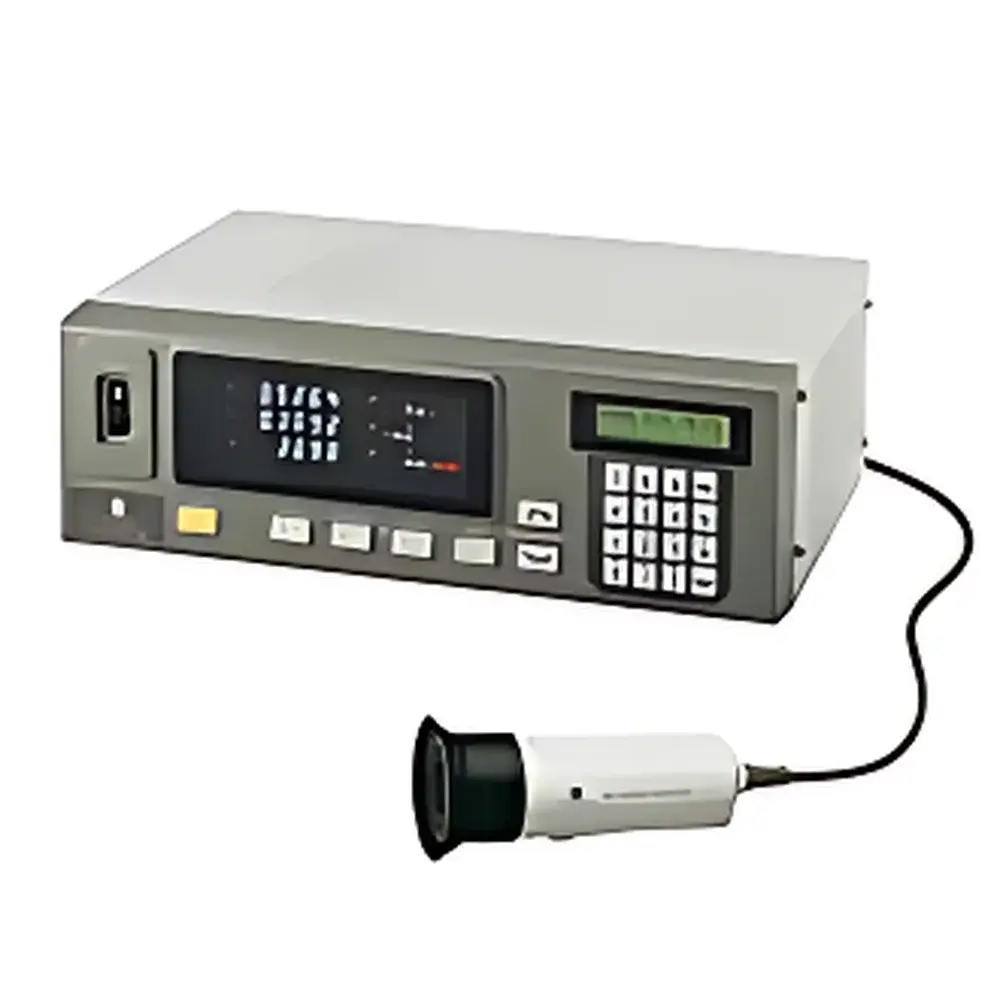
Konica Minolta CA-100Plus CRT Color Analyzer
| Brand | Konica Minolta |
|---|---|
| Origin | Japan |
| Model | CA-100Plus |
| Measurement Aperture | Φ21 mm |
| Luminance Range (Standard Detector) | 0.05–1000 cd/m² |
| Luminance Range (High-Luminance Detector) | 0.05–2000 cd/m² |
| Chromaticity Accuracy (White, ≥0.50 cd/m²) | ±0.003 |
| Luminance Accuracy | ±2% ±1 digit |
| Repeatability (Luminance) | 0.2% + 1 digit (2σ) |
| Measurement Speed | Up to 20 readings/sec (xyLv) |
| Interface | USB 1.1 or RS-232C (up to 38400 bps) |
| Storage Channels | 100 |
| Operating Temperature | 10–28°C, RH ≤70% (non-condensing) |
| Power Supply | 100–240 VAC, 50–60 Hz, 50 VA |
Overview
The Konica Minolta CA-100Plus CRT Color Analyzer is a precision optical measurement instrument engineered for high-fidelity photometric and colorimetric characterization of cathode-ray tube (CRT) displays and other analog video sources. Designed as a direct successor to the CA-100 series, it maintains full backward compatibility while enhancing measurement speed, luminance dynamic range, and system integration flexibility. The analyzer operates on the principle of tristimulus colorimetry—using calibrated silicon photodiodes with spectral response matched to the CIE 1931 standard observer—to deliver xyLv (chromaticity coordinates and luminance), TΔuvLv (correlated color temperature and Δuv deviation), RGB, XYZ, and u’v’Lv values. Its dual-detector configuration—standard and high-luminance variants—enables traceable measurements across a 4-decade luminance span (0.05 to 2000 cd/m²), supporting both low-brightness calibration (e.g., black level optimization) and high-intensity verification (e.g., peak white validation) under controlled environmental conditions (23 °C ±2 °C, 40% RH ±10%). The device complies with fundamental metrological requirements for display manufacturing QA, R&D lab validation, and service-level maintenance workflows.
Key Features
- Backward-compatible operation modes: “CA-100 Interchange Mode” ensures numerical equivalence with legacy CA-100 measurement data and RS-232C communication protocols; “CA-200 Mode” enables full programmability via the included CA-SDK software development kit.
- Matrix correction functionality: Users may define custom 3×3 correction matrices by measuring known R, G, B primaries and white point of a target display, then store up to 100 channel-specific calibration profiles for application-specific output compensation.
- High-speed real-time acquisition: Delivers up to 20 xyLv measurements per second at luminance levels ≥1.00 cd/m²—accelerating white balance adjustment, gamma verification, and factory auto-calibration cycles.
- Dual detector support: Standard detector optimized for general CRT metrology (0.05–1000 cd/m²); high-luminance detector extends upper range to 2000 cd/m² without sacrificing accuracy or repeatability.
- Multi-point measurement capability: With optional CA-B04 4-channel expansion board, up to five spatially distributed sensors can be synchronized and controlled from a single host unit for uniformity mapping and panel-level homogeneity assessment.
- Integrated polarization rejection: Built-in analyzer optics suppress specular reflection artifacts during angled or glossy-surface measurements, improving robustness in production-floor environments.
Sample Compatibility & Compliance
The CA-100Plus is validated for use with interlaced and progressive-scan CRT monitors operating at vertical sync frequencies between 40 Hz and 200 Hz—including NTSC, PAL, and universal sync formats. It supports analog video signal synchronization via external trigger inputs (EXT), internal timing (INT), or standardized broadcast standards (NTSC/PAL/UNIV). While not intended for LED/LCD/OLED self-emissive displays requiring flicker or temporal modulation analysis, its spectral responsivity and geometric acceptance angle (Φ21 mm aperture) align with ISO 13406-2, IEC 61747-5, and relevant portions of SMPTE RP 166 for CRT-based visual quality assurance. All accuracy specifications are referenced to Konica Minolta’s traceable CRT reference standard under GLP-aligned environmental control—ensuring audit readiness for internal quality systems and supplier qualification programs.
Software & Data Management
The CA-100Plus ships with the CA-SDK (Color Analyzer Software Development Kit), a Windows-based API enabling custom application development for automated test sequences, pass/fail logic implementation, and integration into larger manufacturing execution systems (MES). Communication occurs over USB 1.1 or RS-232C (max. 38400 bps), supporting bidirectional command-response protocol with full register-level access to stored calibration channels, measurement buffers, and real-time analog outputs (Δx, Δy, ΔLv, R/G, etc.). Raw data export supports CSV and proprietary binary formats, facilitating post-processing in MATLAB, Python (NumPy/Pandas), or statistical process control (SPC) platforms. Though not natively compliant with FDA 21 CFR Part 11, the SDK permits implementation of electronic signature, audit trail, and user access control layers when deployed within validated laboratory information management systems (LIMS).
Applications
- CRT monitor white/black level calibration in display manufacturing lines
- Color fidelity verification during CRT phosphor aging studies
- Production-line QA for broadcast-grade studio monitors (e.g., waveform alignment, chroma gain matching)
- R&D evaluation of analog video signal path integrity (e.g., DAC output linearity, deflection circuit crosstalk)
- Service technician diagnostics for luminance drift, color convergence errors, and degaussing effectiveness
- Legacy system integration where RS-232C control and CA-100 data continuity are contractual requirements
FAQ
Is the CA-100Plus suitable for measuring modern LCD or OLED displays?
No—it is specifically optimized for CRT phosphor emission characteristics and analog video timing. For flat-panel displays, Konica Minolta recommends the CA-410 or CS-2000 series.
Can measurement data be exported directly to Excel or SPC software?
Yes—CSV export is supported via CA-SDK applications or third-party scripts using the documented ASCII command set.
What is the uncertainty contribution of ambient light during measurement?
The instrument requires dark-room conditions per JIS Z 8722 and ISO/CIE guidelines; ambient illuminance must remain below 1 lux at the measurement plane to avoid photodiode saturation and spectral contamination.
Does the CA-100Plus support automatic gamma curve fitting?
No—it provides raw xyLv and luminance values; gamma calculation requires external software processing of sequential grayscale patch measurements.
How is traceability maintained for calibration certificates?
Each unit ships with a factory calibration report referencing NMIJ (National Metrology Institute of Japan)–traceable standards; users may perform in-house verification using Konica Minolta’s CR-100 reference CRT or equivalent certified sources.



