
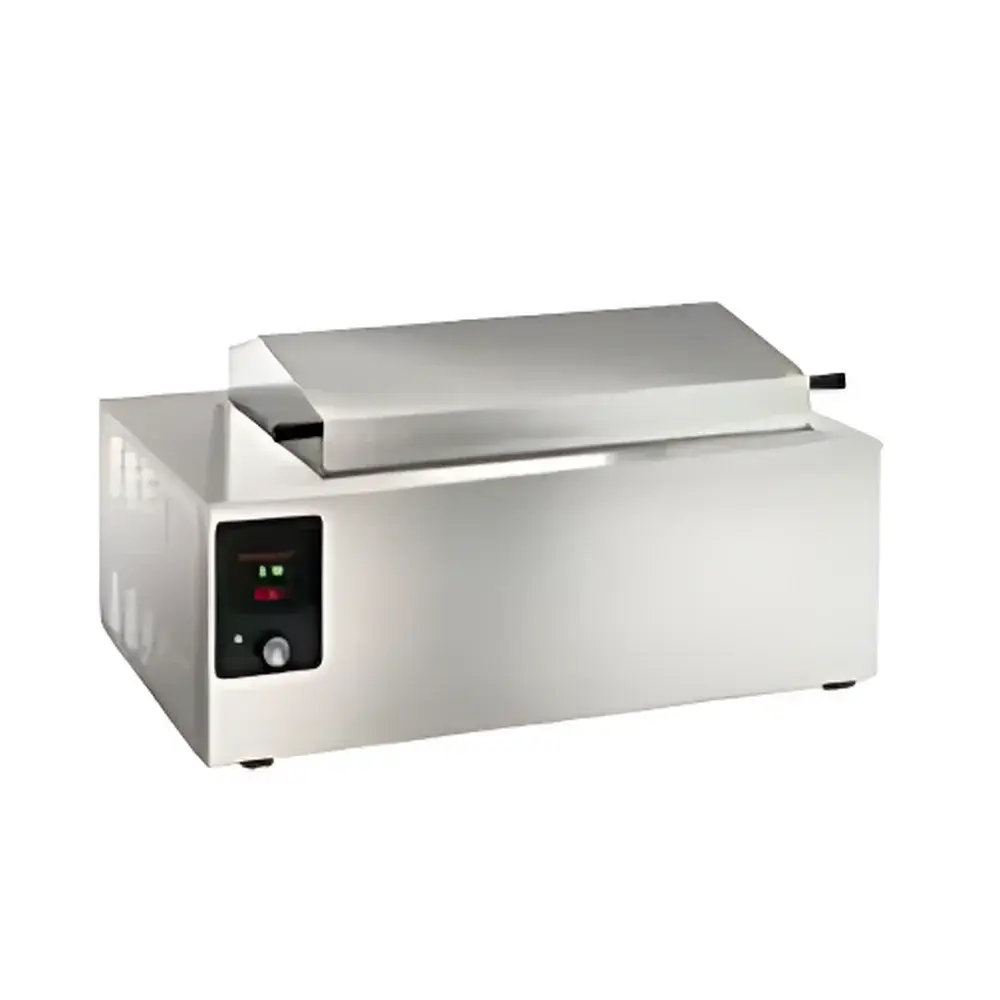
MEMMERT WNB45 Water Bath Circulator
| Brand | MEMMERT |
|---|---|
| Origin | Germany |
| Model | WNB45 |
| Instrument Type | Immersion Circulating Water Bath |
| Circulation | Internal Recirculation |
| Temperature Control | Heating-Only |
| Bath Volume | 45 L |
| Temperature Range | 10 °C to 95 °C (min. setpoint ≥5 °C above ambient) |
| Boil Mode | 100 °C |
| Temperature Stability | ±0.1 °C (typical at 37 °C, load-dependent) |
| Temperature Resolution & Setpoint Accuracy | 0.1 °C |
| Timer Range | B-Type: 1 min – 99 h 59 min |
| E-Type | 1 min – 999 h |
| Overtemperature Protection | Triple-stage (E-Type) / Dual-stage (B-Type) |
| Construction | Stainless Steel 1.4301 (AISI 304) Inner Bath & Outer Casing |
| Certifications | CE, EN 61000-6-3, EN 61000-6-2, IEC 61010-1 |
Overview
The MEMMERT WNB45 is a high-precision, internally recirculating water bath engineered for stable thermal conditioning of samples, reaction vessels, and analytical instrumentation in regulated laboratory environments. Operating on the principle of forced convection via an integrated stainless-steel circulation pump, the WNB45 maintains uniform temperature distribution across its 45 L stainless steel bath chamber (internal dimensions: 590 × 350 × 220 mm). Designed for continuous operation under GLP and GMP-aligned workflows, it delivers traceable, reproducible thermal control from 10 °C up to 95 °C—with an additional dedicated boil mode at 100 °C—while complying with IEC 61010-1 safety standards for laboratory electrical equipment. Its thermally insulated double-walled housing minimizes ambient heat loss and external surface temperature rise, supporting energy-efficient operation in shared lab spaces.
Key Features
- Pt100 four-wire resistance temperature detector (RTD) as standard; E-type models include dual independent Pt100 sensors for redundancy and cross-validation of bath temperature.
- PID-based digital temperature controller with auto-tuning capability, enabling rapid stabilization and minimal overshoot during setpoint transitions.
- Multi-stage overtemperature protection architecture: (1) electronic fail-safe cutoff at +10 °C above setpoint; (2) user-configurable secondary electronic limit (TWW/TWB); (3) mechanical thermal cutout (TB) activated at +30 °C above maximum rated bath temperature—ensuring compliance with EN 61010-1 Clause 11.3.
- LED display with real-time temperature readout, timer status, and visual alarm indicators for fault conditions including sensor failure, dry-run detection (when optional liquid level controller is installed), and overtemperature events.
- Programmable time-controlled operation: supports start delay, hold duration, and conditional hold (temperature-dependent runtime) modes—particularly valuable for unattended overnight protocols in QC/QA and stability testing.
- Stainless steel 1.4301 (AISI 304) construction throughout—bath, pump housing, and outer casing—resistant to corrosion from aqueous buffers, saline solutions, and mild organic solvents.
Sample Compatibility & Compliance
The WNB45 accommodates a broad range of sample formats through modular accessories: conical flask holders (100–500 mL), tube racks (14.5–32 mm diameter, up to 110 positions), and flat or V-shaped lids compatible with orbital shakers (L4 kit). Optional liquid level control prevents dry-heating incidents during evaporation-intensive applications such as solvent concentration or enzymatic assays. All configurations maintain ISO/IEC 17025 traceability when used with calibrated Pt100 probes and documented calibration intervals. The device meets CE marking requirements per Directive 2014/30/EU (EMC) and 2014/35/EU (LVD), and conforms to ASTM E2781–22 for verification of temperature uniformity in liquid baths.
Software & Data Management
While the WNB45 operates autonomously via its front-panel interface, it supports external data logging via analog output (0–10 V DC proportional to measured temperature) and digital RS232 interface (optional adapter). When integrated into networked lab infrastructure, temperature and timer logs can be captured by third-party SCADA or LIMS platforms compliant with FDA 21 CFR Part 11—provided audit trails, electronic signatures, and data integrity controls are implemented at the system level. Firmware updates are performed locally using MEMMERT’s standardized service protocol; no cloud connectivity or proprietary software installation is required.
Applications
- Enzyme kinetics and protein denaturation studies requiring precise thermal ramping and hold profiles.
- USP and compounding workflows where temperature-sensitive formulations (e.g., liposomal suspensions, ointments) must be maintained within narrow thermal bands during preparation.
- Distillation and reflux setups in synthetic chemistry labs, especially when paired with condenser cooling systems.
- Cell culture pre-warming of media, reagents, and CO₂-independent buffers prior to aseptic handling.
- Calibration of thermometers, RTDs, and thermocouples per ISO 17025-accredited procedures using the bath’s certified uniformity zone (±0.2 °C across central 70% volume at 37 °C).
- Accelerated stability testing (ICH Q1A) under controlled temperature stress conditions.
FAQ
What is the difference between the B-type and E-type controllers?
The B-type offers basic PID control with dual overtemperature protection and a 99 h 59 min timer. The E-type adds a second Pt100 sensor, user-adjustable secondary thermal limit, extended 999 h timer, and advanced program logic including temperature-dependent hold functions.
Can the WNB45 be used with oil instead of water?
No—the WNB45 is specifically designed and validated for aqueous media only. For oil-based applications, MEMMERT recommends the OB45 oil bath variant, which features enhanced thermal insulation and modified pump sealing.
Is the circulation pump adjustable in speed?
No—the internal recirculation pump operates at a fixed optimal flow rate (approx. 12 L/min) to ensure laminar, non-turbulent flow and maximal thermal homogeneity without inducing vibration in sensitive samples.
Does the unit support external temperature probe input for sample monitoring?
Not natively—the WNB45 regulates based solely on bath temperature. However, users may integrate an external probe via the analog output channel for parallel monitoring, though this does not affect control logic.
What maintenance is required to sustain long-term accuracy?
Annual verification of Pt100 sensor calibration against a NIST-traceable reference standard is recommended. Regular cleaning of the bath interior with 10% citric acid solution prevents scale buildup; pump impeller inspection is advised every 24 months in hard-water environments.



