
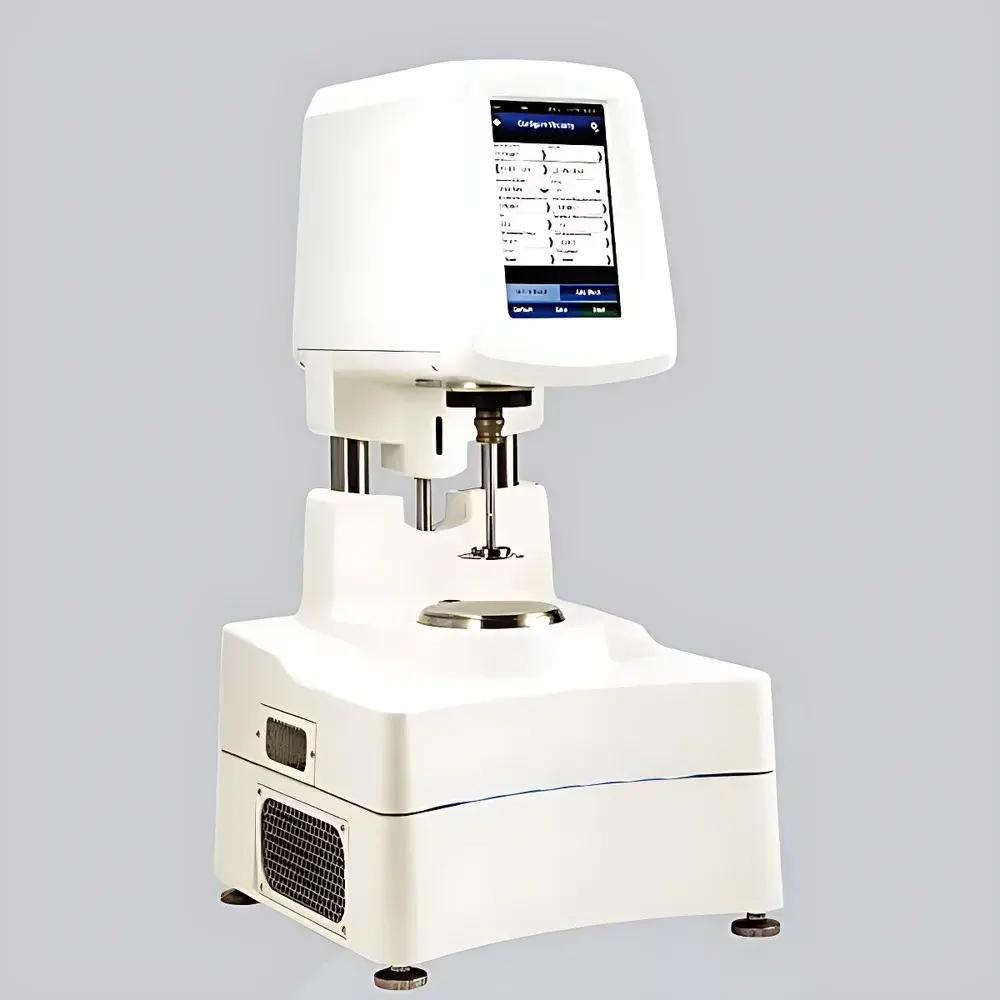
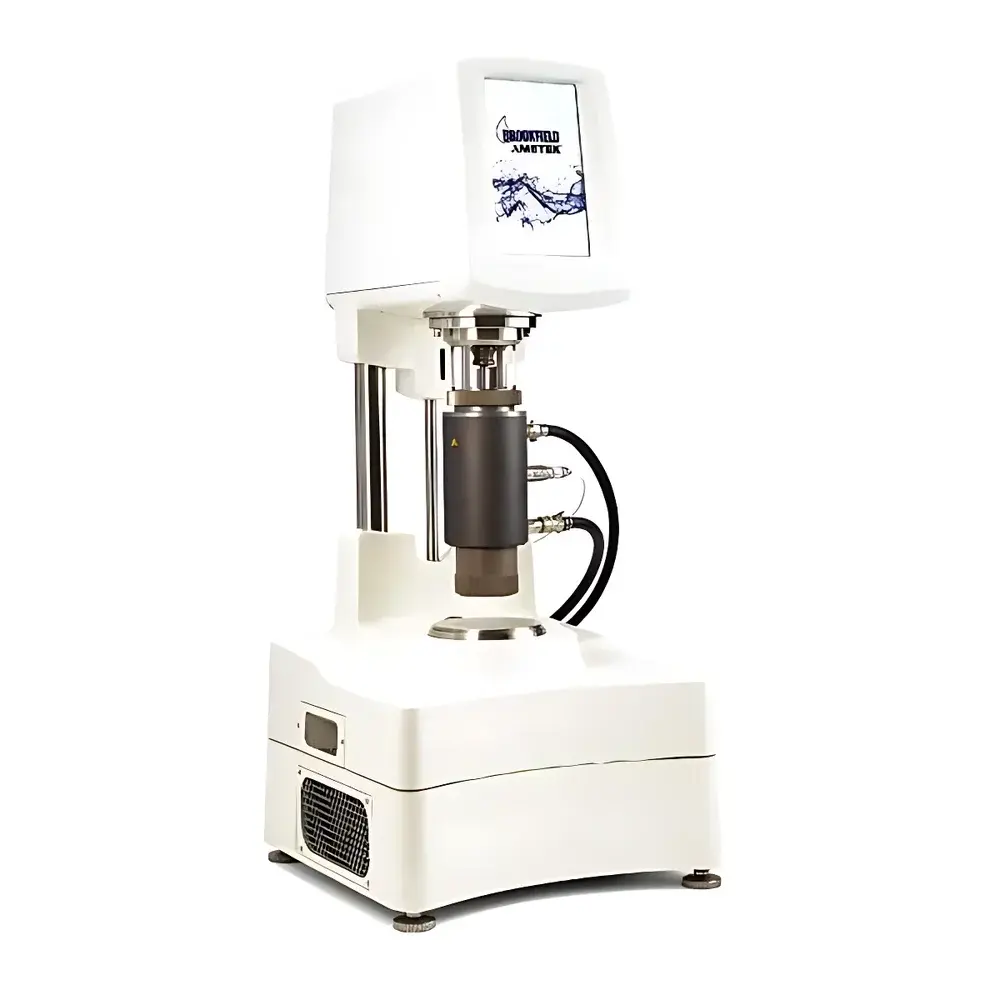
Brookfield RSO Oscillatory Rheometer
| Brand | Brookfield |
|---|---|
| Origin | USA |
| Model | RSO |
| Motor Bearing | Air Bearing |
| Minimum Rotational Speed | 0.001 rpm |
| Maximum Rotational Speed | 1500 rpm |
| Torque Range | 5 µNm – 100 mNm |
| Torque Resolution | 0.02 µNm |
| Angular Frequency Range | 0.001 Hz – 20 Hz (0.006 rad/s – 126 rad/s) |
| Strain Resolution | 1.25 µrad |
| Sample State | Liquid |
| Measurement Geometries | Cone-Plate & Concentric Cylinder |
| Temperature Control | Peltier (0–180 °C) or Water Bath (with optional jacketed cup) |
| Dimensions | 360 × 600 × 340 mm |
| Weight | 31 kg |
Overview
The Brookfield RSO Oscillatory Rheometer is a high-precision, modular rotational rheometer engineered for comprehensive viscoelastic characterization of liquid and soft-solid materials under controlled shear and oscillatory deformation. Based on the Couette flow principle and calibrated torque transduction via air-bearing-supported motor architecture, the RSO delivers exceptional sensitivity in both steady-shear and dynamic oscillatory modes. Its dual-geometry compatibility—supporting interchangeable cone-plate and concentric cylinder systems—enables rigorous compliance with international test standards including ASTM D4402, ISO 3219, and ISO 6721-1 for dynamic mechanical analysis. Designed for laboratories requiring traceable, reproducible rheological data across QC, formulation development, and fundamental research workflows, the RSO operates with minimal sample volume (as low as 0.1 mL for cone-plate), reducing material cost and waste while maintaining metrological integrity.
Key Features
- Air-bearing motor system ensuring near-frictionless rotation, critical for ultra-low torque measurements down to 5 µNm and resolution of 0.02 µNm
- Wide angular frequency range (0.001–20 Hz; 0.006–126 rad/s) enabling full spectrum characterization—from gel point detection to linear viscoelastic region (LVER) mapping
- Real-time graphical display via integrated 7-inch capacitive touchscreen, supporting standalone operation without external PC
- Auto-identification of measurement geometries via embedded RFID or barcode scanning, eliminating manual parameter entry errors
- Motorized gap control for cone-plate configurations, achieving ±1 µm repeatability in gap setting for high inter-test consistency
- Modular thermal control: Peltier-based semiconductor module (0–180 °C) for rapid ramping and stabilization, or integration with external water baths for extended temperature ranges
- Quick-connect rotor interface reducing setup time by >70% compared to threaded mounting systems
Sample Compatibility & Compliance
The RSO accommodates Newtonian and non-Newtonian liquids—including polymer melts, emulsions, suspensions, gels, and biological fluids—across a broad viscosity range (1 mPa·s to >10⁶ mPa·s, dependent on geometry and conditions). Its cone-plate configuration supports precise yield stress determination via controlled-stress ramp tests per ASTM D2196, while oscillatory sweeps comply with ISO 6721-10 for storage/loss modulus (G′/G″) profiling. All firmware and software modules adhere to GLP/GMP documentation requirements, with audit-trail functionality available in Rheo3000 software (21 CFR Part 11 compliant when configured with electronic signatures and secure user roles).
Software & Data Management
Rheo3000 software (optional but recommended for regulated environments) provides full instrument control, method scripting, real-time curve overlay, and comparative analysis of multiple datasets. It supports automated reporting templates aligned with internal SOPs or external regulatory submissions. Raw data export is available in ASCII, CSV, and universal rheology file formats (.rheo) compatible with third-party analysis tools (e.g., MATLAB, Python SciPy, OriginLab). The software includes built-in validation protocols for geometry calibration, temperature verification, and torque linearity checks—traceable to NIST-certified reference oils.
Applications
- Quality control of coatings, inks, and adhesives through yield stress and thixotropic loop quantification
- Rheokinetic profiling of thermosetting resins during cure monitoring (isothermal and non-isothermal)
- Structure-property relationships in food gels, dairy products, and plant-based alternatives
- Viscoelastic fingerprinting of pharmaceutical suspensions and injectables per USP
- Dynamic mechanical analysis of polymer melts prior to extrusion or injection molding
- Colloidal stability assessment via time-sweep and amplitude sweep testing
FAQ
What measurement geometries are supported natively on the RSO?
Cone-plate (with automatic gap adjustment) and concentric cylinder systems are fully interchangeable on a single base unit without hardware modification.
Is temperature control integrated or optional?
A Peltier-based semiconductor temperature module is available as an integrated option (0–180 °C); alternatively, the concentric cylinder system may be coupled with an external thermostatted water bath using the FTKY3 jacketed cup assembly.
Does the RSO meet FDA 21 CFR Part 11 requirements?
Yes—when operated with Rheo3000 software configured with role-based access control, electronic signatures, and immutable audit trails, it satisfies Part 11 criteria for electronic records and signatures in regulated pharmaceutical and biotech settings.
How is geometry calibration performed?
Calibration is executed via software-guided procedures using certified reference oils (e.g., Brookfield Standard Viscosity Oils), with results stored in geometry-specific metadata files for traceability.
Can the RSO perform time-dependent thixotropy testing?
Yes—it supports multi-step protocols including step-shear recovery, hysteresis loops, and time sweeps at fixed shear rates or oscillatory strains, all programmable within the onboard interface or Rheo3000.



