
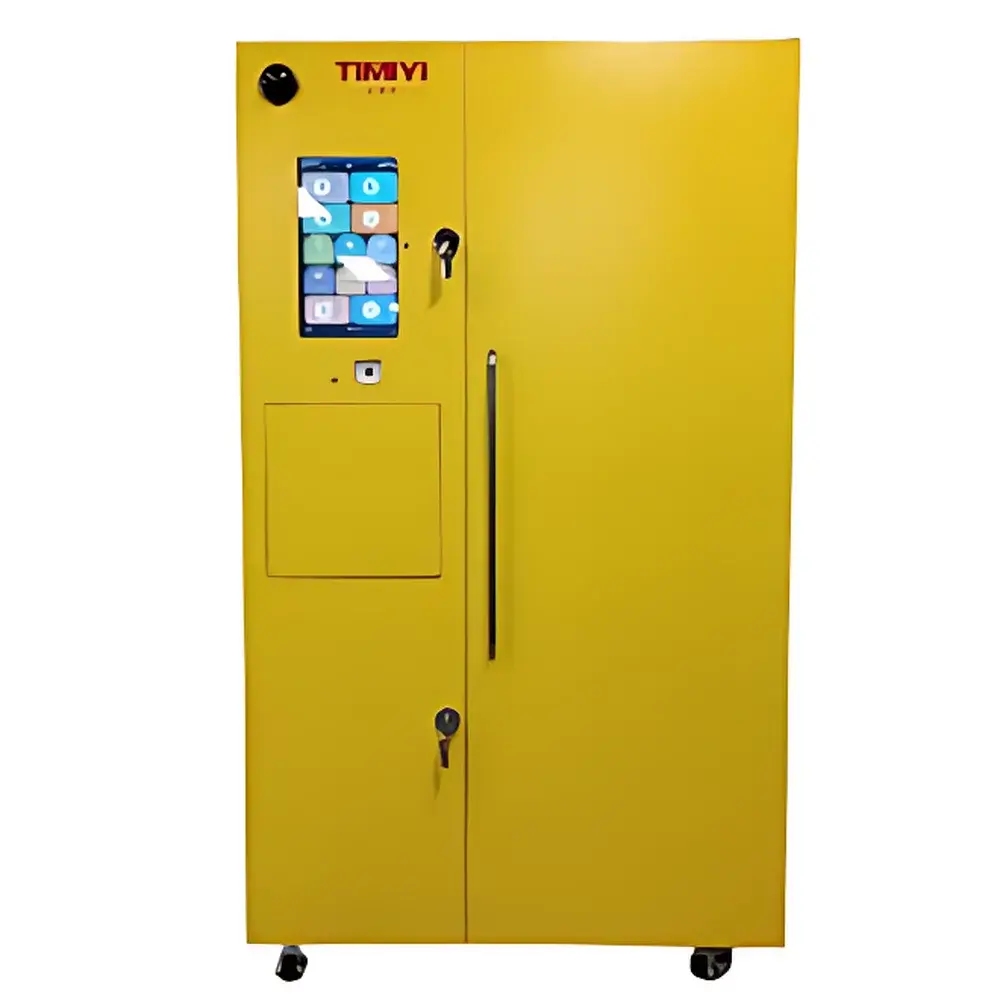
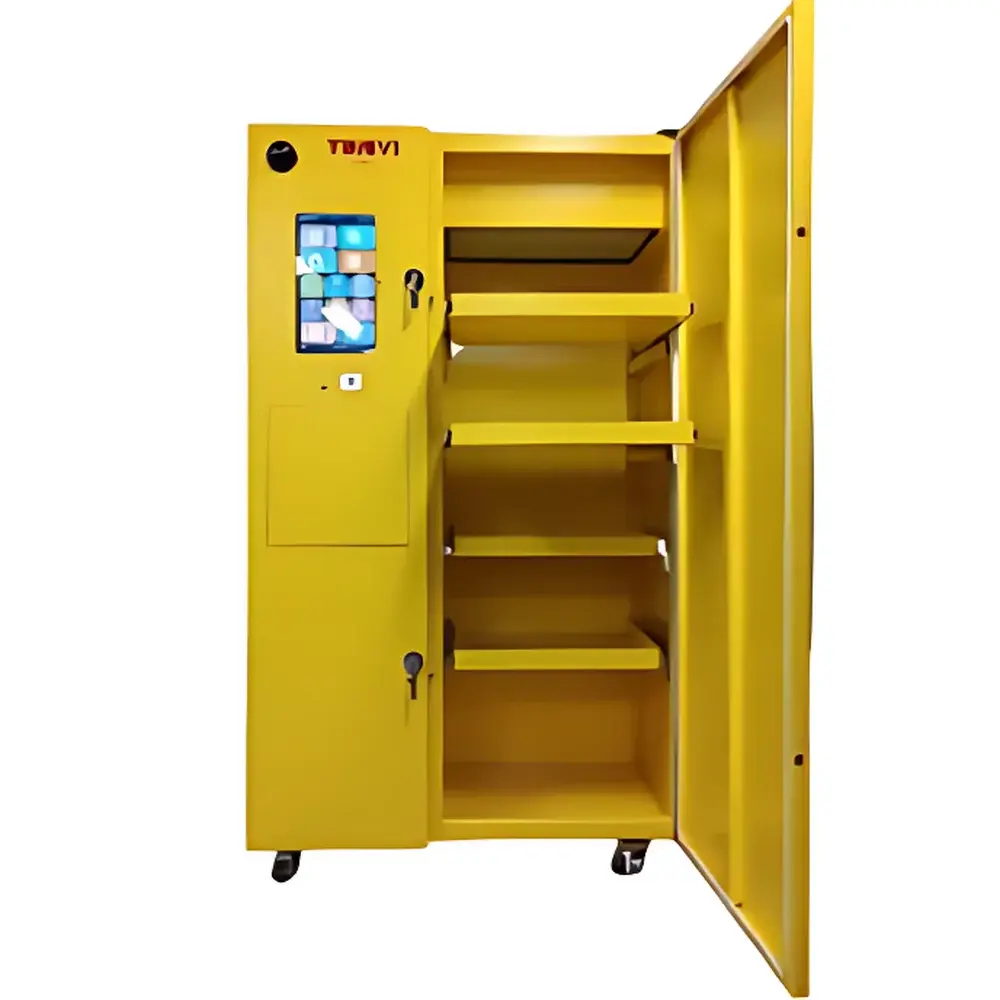
TIMIYI T0910-SI Smart Reagent Cabinet (Customizable Model)
| Brand | TIMIYI |
|---|---|
| Origin | Fujian, China |
| Manufacturer Type | Direct Manufacturer |
| Country of Origin | China |
| Model | T0910-SI (Customizable) |
| Price Range | USD 4,200 – 7,000 |
| Cabinet Dimensions (L×W×H) | 1000 × 600 × 1900 mm (incl. 100 mm casters) |
| Net Volume | 480 L |
| Weight Capacity per Shelf | Up to 2200 g (optional integrated precision balance, resolution 0.01 g) |
| RFID Frequency | 902–928 MHz |
| RFID Protocol | ISO 18000-6C |
| Barcode Reader | Integrated 1D/2D scanner |
| Operating System | Android |
| Display | 15.6″ capacitive touchscreen, 1920 × 1080 resolution |
| Environmental Monitoring | Built-in temperature & humidity sensor |
| Access Control | Triple-authentication — PIN code, facial recognition, mechanical key |
| Power Supply | AC 220 V ±10 %, 50 Hz ±1 Hz |
| Max Power Consumption | <200 W |
| Cabinet Construction | 2.0 mm cold-rolled steel, anti-spill telescopic shelves |
| Surface Treatment | Degreasing → rust removal → surface conditioning → phosphating → rinsing → passivation → corrosion-resistant epoxy-polyester powder coating |
| Optional Modules | RFID module, precision balance (0.01–2200 g), active ventilation system with exhaust port interface |
| Compliance | Designed for alignment with GLP laboratory infrastructure requirements, supports audit-ready digital traceability per ISO/IEC 17025 Annex A.5 and USP <1058> Analytical Instrument Qualification principles |
Overview
The TIMIYI T0910-SI Smart Reagent Cabinet is an engineered solution for secure, auditable, and data-integrated chemical inventory management in regulated research, quality control, and analytical laboratories. Unlike conventional storage cabinets, it functions as a networked endpoint within a laboratory’s digital infrastructure—leveraging embedded sensors, real-time identification technologies, and role-based access control to enforce procedural compliance at the point of use. Its core architecture implements a closed-loop material lifecycle framework: from initial receipt and barcode/RFID-tagged registration, through controlled dispensing and usage logging, to final disposition (return, transfer, or disposal). The cabinet operates on a deterministic Android-based terminal OS, ensuring deterministic boot sequences, application-level sandboxing, and firmware-updatable logic—critical for maintaining configuration integrity during GLP/GMP audits.
Key Features
- Triple-factor physical access control: Mechanical key + numeric PIN + live facial recognition—each authenticated session logged with timestamp, user ID, and action type.
- Integrated high-resolution 15.6″ capacitive display with glove-compatible touch response, supporting multi-language UI and contextual workflow prompts.
- Real-time environmental monitoring: Onboard temperature and relative humidity sensors provide continuous ambient condition logging (±0.5 °C, ±3 % RH accuracy), with configurable alert thresholds.
- Modular identification subsystems: Simultaneous support for ISO 18000-6C RFID interrogation (902–928 MHz), 1D/2D barcode scanning (up to QR Code, DataMatrix, Code 128), and optional precision weighing (0.01 g resolution, 0–2200 g range).
- Corrosion-resistant structural design: 2.0 mm cold-rolled steel housing with multi-stage pre-treatment (phosphating + passivation) and electrostatically applied epoxy-polyester coating (film thickness ≥75 µm), validated for >1,000-hour salt-spray resistance (ASTM B117).
- Configurable ventilation interface: Optional internal fan assembly with external ducting port (Ø100 mm) enables integration into central fume extraction systems per ANSI Z9.5 laboratory ventilation standards.
Sample Compatibility & Compliance
The T0910-SI accommodates standard laboratory reagent containers—including HDPE/PP bottles (10 mL–2 L), glass vials (4–50 mL), and aluminum-sealed ampoules—within its adjustable, spill-containment shelves (depth-adjustable up to 450 mm). Its design aligns with ISO 55001 asset management principles and supports implementation of ALCOA+ data integrity criteria (Attributable, Legible, Contemporaneous, Original, Accurate, Complete, Consistent, Enduring, Available). All electronic records—including access logs, weight deltas, scan events, and environmental snapshots—are time-stamped via NTP-synchronized clock and stored locally with SHA-256 hash integrity verification. The system architecture permits export of CSV/Excel reports compatible with LIMS integration and satisfies documentation requirements under FDA 21 CFR Part 11 (electronic signatures), EU Annex 11, and ISO/IEC 17025:2017 Clause 7.5.2 (data management).
Software & Data Management
The proprietary TIMIYI Reagent Intelligence Platform (TRIP) runs natively on the cabinet’s embedded terminal. It provides role-defined interfaces for administrators (system configuration, user provisioning, audit log review), lab managers (inventory forecasting, consumption analytics, expiry alerts), and end users (check-out/check-in workflows). All transactions generate immutable entries with cryptographic hash linkage to preceding and subsequent events—enabling full chain-of-custody reconstruction. Data export supports SFTP, USB mass storage, or direct API-driven synchronization with enterprise LIMS (e.g., LabWare, STARLIMS) via RESTful endpoints compliant with OpenAPI 3.0. Audit trails retain minimum 12-month retention by default and are exportable in PDF/A-2b format for regulatory submission.
Applications
- Regulated QC/QA labs requiring adherence to ICH Q7, USP <1058>, or ISO/IEC 17025 for reference standard and assay reagent control.
- Pharmaceutical R&D facilities managing high-value cytotoxic or controlled substances under DEA/EMA traceability mandates.
- Academic core facilities deploying shared-resource models where usage attribution, cost recovery, and safety accountability are enforced at the cabinet level.
- Contract testing laboratories needing automated evidence generation for ISO/IEC 17025 accreditation assessments.
- Environmental and food safety labs tracking certified reference materials (CRMs) and matrix-matched standards across multi-year stability studies.
FAQ
Does the T0910-SI support integration with existing LIMS or ERP systems?
Yes—via configurable REST API endpoints and scheduled CSV exports; documentation includes Swagger-compliant specification and sample Python/PowerShell integration scripts.
Is the facial recognition module compliant with GDPR or CCPA biometric data handling requirements?
All biometric templates are stored locally on-device only, encrypted at rest using AES-256, and never transmitted to cloud services or third-party servers.
Can the cabinet operate offline, and how long are logs retained without network connectivity?
Full functionality remains available offline; transaction logs buffer locally (≥50,000 entries) and auto-sync upon network restoration with conflict-resolution logic.
What validation documentation is provided for GxP environments?
Deliverables include Factory Acceptance Test (FAT) report, IQ/OQ protocol templates, calibration certificates for optional balance module, and cybersecurity hardening checklist aligned with NIST SP 800-53 Rev. 5.
Are custom dimensions or electrical configurations (e.g., 110 V / 60 Hz) available?
Yes—custom engineering is supported for volume, footprint, voltage, and hazardous location ratings (Class I Div 2 pending certification).



