
Anton Paar MCR 72 and MCR 92 Modular Rotational Rheometers
| Brand | Anton Paar |
|---|---|
| Origin | Austria |
| Model | MCR 72 / MCR 92 |
| Instrument Type | Rotational Rheometer |
| Sample State | Liquid |
| Motor Bearing | Ball Bearing (MCR 72) / Air Bearing (MCR 92) |
| Minimum Rotational Speed | 0.001 rpm |
| Frequency Range | 0.0001–628 rad/s |
| Maximum Rotational Speed | 1500 rpm |
| Maximum Torque | 125 mNm |
| Torque Resolution | 100 nNm |
Overview
The Anton Paar MCR 72 and MCR 92 are high-precision modular rotational rheometers engineered for fundamental and applied rheological characterization of complex fluids and soft solids. Based on Couette and parallel-plate geometries, these instruments operate on the principle of controlled shear deformation—applying defined torque or rotational velocity to quantify material response in both steady-state (rotational) and dynamic (oscillatory) modes. The MCR platform implements true direct-drive EC motor technology with integrated high-resolution optical encoders, enabling precise control of angular displacement, velocity, and stress without gear backlash or belt slippage. This architecture supports accurate measurement across an exceptionally broad dynamic range—from ultra-low-viscosity Newtonian liquids (e.g., solvents, coatings) to highly structured viscoelastic gels and polymer melts—while maintaining traceable compliance with ISO 16520, ASTM D4402, and ISO 3219 standards for rheological testing.
Key Features
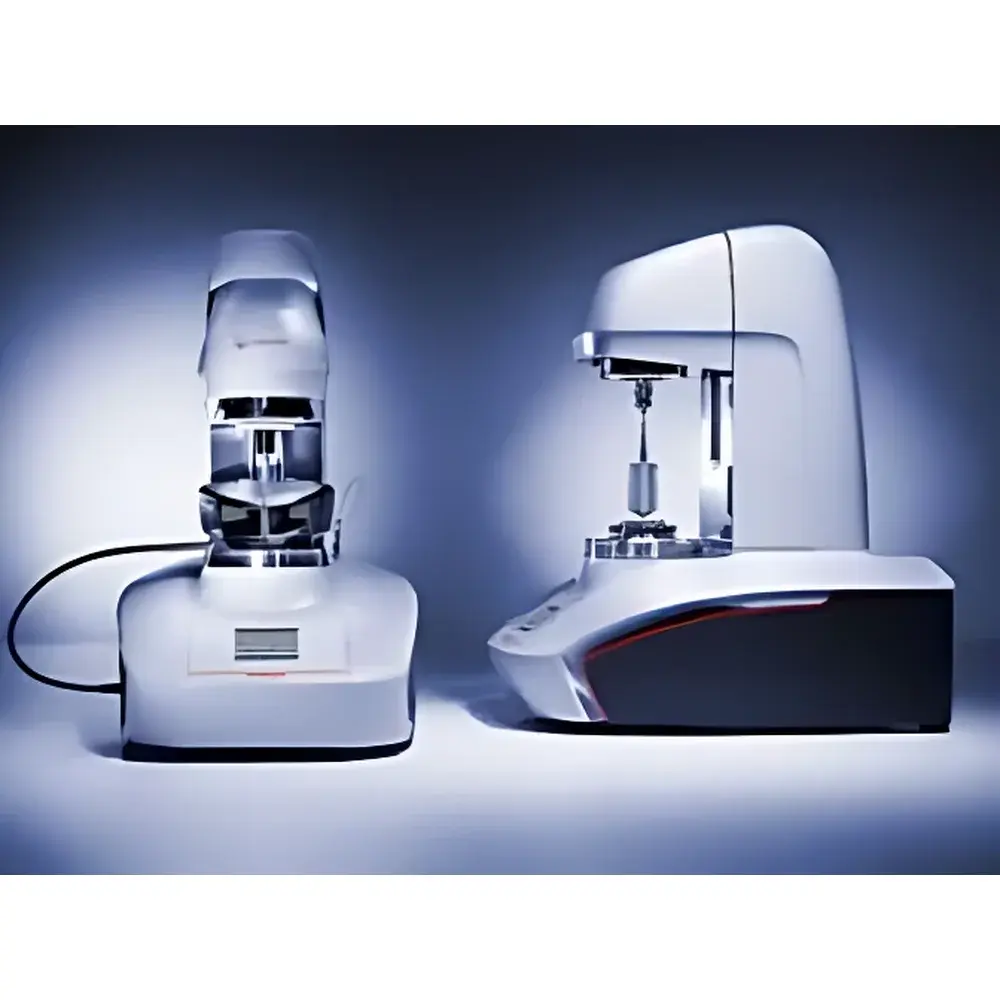
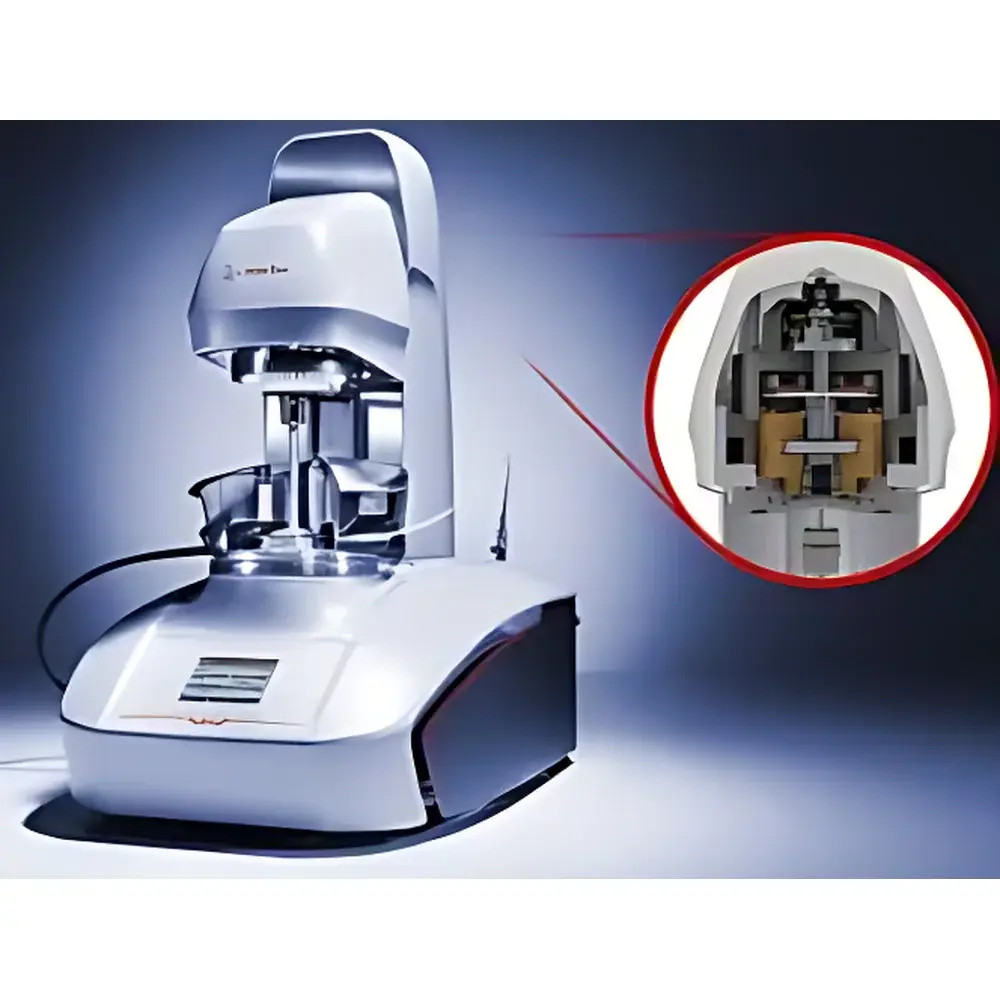
- Modular motor design: MCR 72 employs a robust ball-bearing-supported EC motor suitable for routine QC and academic teaching; MCR 92 integrates an air-bearing motor delivering sub-nanoradian angular resolution and near-frictionless operation—critical for low-stress measurements of fragile structures (e.g., protein aggregates, colloidal gels).
- True gap control: SafeGap™ technology ensures repeatable, operator-independent gap setting via real-time normal force monitoring during head descent—guaranteeing <1 µm gap reproducibility across hundreds of measurements.
- Intelligent hardware recognition: Toolmaster™ automatically identifies mounted measuring systems (cone-plate, parallel-plate, concentric cylinder), temperature modules (Peltier, liquid-circulated, furnace), and accessories—loading calibrated geometry parameters and thermal limits directly into RheoCompass™ software.
- One-hand sample handling: QuickConnect™ enables tool-free, single-handed attachment/detachment of measuring systems—reducing setup time and eliminating cross-threading risks.
- Visual sample assessment: TruRay™ adjustable LED illumination provides uniform, glare-free lighting across the measurement gap—facilitating visual inspection of sample homogeneity, sedimentation, or phase separation prior to testing.
- Thermal versatility: Compatible with temperature-controlled accessories spanning −40 °C to 400 °C—including CoolPeltier™ (−5 to 200 °C), Peltier-based environmental chambers (−40 to 200 °C), and high-temperature furnaces—enabling full thermorheological profiling under ISO 6721-10 conditions.
Sample Compatibility & Compliance
The MCR 72/92 accommodates liquid, paste, gel, and semi-solid samples requiring precise shear history control. Its geometry library supports standard DIN/ISO-compliant fixtures (e.g., CP50-1, PP25, CC27) as well as custom geometries for non-Newtonian fluid analysis, emulsion stability, and food texture evaluation. All instruments comply with GLP/GMP documentation requirements through RheoCompass™ audit trails, electronic signatures, and 21 CFR Part 11–ready configuration options. Data integrity is maintained via automatic calibration logging, timestamped metadata embedding, and encrypted raw data storage. Temperature modules meet IEC 61000-4-3 EMC standards and carry CE, UKCA, and cULus certifications.
Software & Data Management
RheoCompass™ v4.x serves as the unified control, analysis, and reporting environment—designed for multi-user laboratories operating under regulated workflows. It includes pre-validated test templates aligned with ASTM D2196 (viscosity), ISO 3219 (dynamic moduli), and USP (rheology of pharmaceutical suspensions). Users can build custom test sequences using drag-and-drop logic blocks, apply real-time Fourier transform analysis for transient data, and export results in ASTM E1447-compliant CSV, PDF, or XML formats. Role-based access control allows administrators to assign permissions per user group (e.g., “Operator”, “Analyst”, “Admin”), while version-controlled method libraries ensure inter-laboratory consistency. All raw data files (.rhd) contain embedded instrument configuration, calibration certificates, and environmental metadata—fully traceable for internal audits or regulatory submissions.
Applications
- Quality control of paints, inks, adhesives, and personal care formulations (yield stress, thixotropy, recovery)
- Structure–property relationships in polymer melts and composites (melt elasticity, relaxation spectra)
- Food texture engineering (gelation kinetics, starch retrogradation, dairy product stability)
- Pharmaceutical formulation development (injectable hydrogels, ointment spreadability, suspension redispersion)
- Biological macromolecule characterization (protein aggregation onset, fibril formation dynamics)
- Academic rheology education (EDU packages include instructor guides, student worksheets, and video-assisted tutorials)
FAQ
What distinguishes the MCR 72 from the MCR 92?
The MCR 72 uses a precision ball-bearing motor optimized for robustness and cost-effective routine testing; the MCR 92 features an air-bearing motor delivering superior sensitivity for low-torque oscillatory measurements—ideal for structural analysis of weak gels or dilute biopolymer solutions.
Can both models perform oscillatory tests?
Yes—both support amplitude sweeps, frequency sweeps, time sweeps, and temperature ramps in oscillatory mode. However, the MCR 92 achieves lower minimum torque (1 µNm vs. 200 µNm) and higher angular resolution, enabling reliable detection of subtle structural transitions.
Is RheoCompass™ compatible with LIMS integration?
Yes—via standardized RESTful API and ODBC drivers, allowing bidirectional data exchange with major LIMS platforms (e.g., LabWare, Thermo Fisher SampleManager) and ELN systems.
Do the instruments support automated cleaning protocols?
While not fully automated, RheoCompass™ includes customizable cleaning sequence templates that guide users through solvent flushing, drying cycles, and verification steps—with all actions logged in the audit trail.
What temperature accuracy is achievable with Peltier-based modules?
CoolPeltier™ modules maintain ±0.1 °C stability over the −5 to 200 °C range; furnace modules achieve ±0.5 °C at 400 °C—verified per ISO/IEC 17025-accredited calibration procedures.



