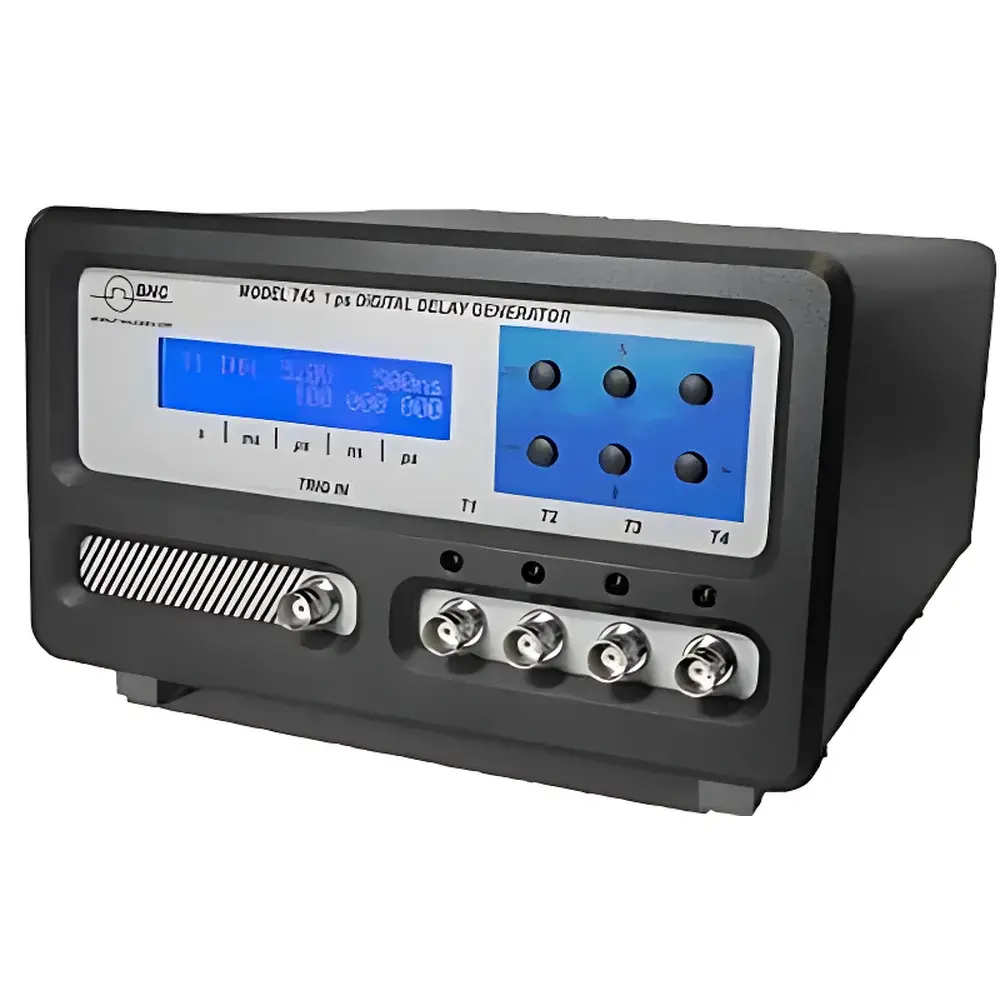
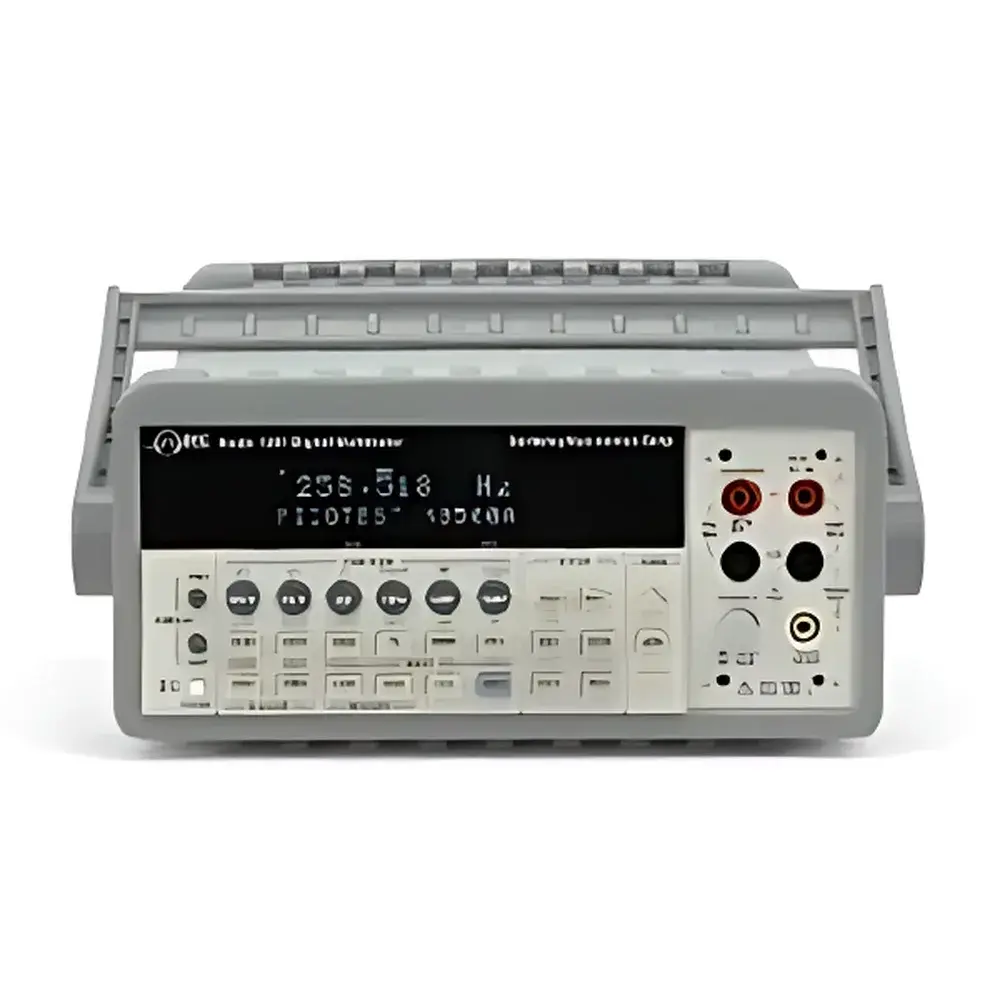
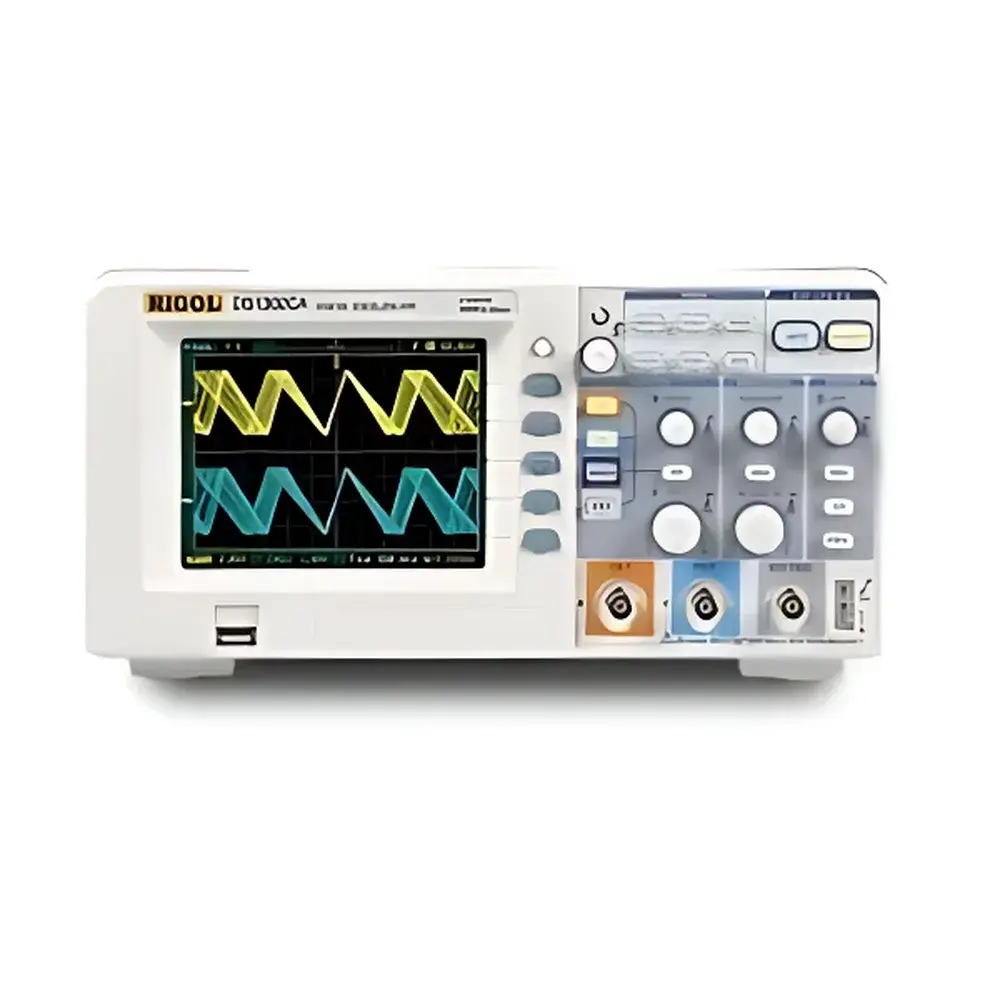
BNC 745 Digital Pulse Delay Generator
| Brand | BNC |
|---|---|
| Origin | USA |
| Model | BNC 745, 1201, 1302CA |
| Time Resolution | 250 fs |
| Jitter (Internal Trigger) | ≤5 ps |
| Jitter (External Trigger) | ≤25 ps |
| Output Rise Time | ~1 ns |
| Clock Input Range | 10 MHz to 80 MHz (user-selectable in 100 kHz increments) |
| Interface | Ethernet GUI |
| Max Channels per Unit | 64 |
| Compliance | RoHS, CE, FCC Class A |
Overview
The BNC 745 Digital Pulse Delay Generator is a high-precision timing instrument engineered for sub-nanosecond synchronization and deterministic delay control in demanding scientific and industrial applications. Based on Berkeley Nucleonics Corporation’s proven digital delay architecture, the 745 implements time interpolation with 250 femtosecond resolution using proprietary phase-locked loop (PLL) and time-to-digital converter (TDC) circuitry. It operates as a deterministic digital delay engine—accepting trigger inputs (either internal or external), applying programmable delays and widths with picosecond-level repeatability, and generating precisely timed logic-level or TTL-compatible output pulses. Its design emphasizes low-jitter timing integrity, thermal stability, and channel-to-channel skew minimization—critical for multi-instrument synchronization in ultrafast laser labs, time-of-flight diagnostics, and pulsed power systems.
Key Features
- 250 fs time resolution enabled by high-speed TDC interpolation and adaptive clock recovery
- ≤5 ps RMS jitter with internal triggering; ≤25 ps RMS jitter with external triggering (measured over 10⁶ triggers at 1 Hz repetition rate)
- Typical output rise time of 1 ns into 50 Ω, supporting fast-edge-driven loads such as Pockels cells, photodiodes, and RF switches
- Programmable clock input range from 10 MHz to 80 MHz, configurable in 100 kHz steps to match mode-locked laser repetition rates or system master clocks
- Ethernet-based graphical user interface providing real-time visualization of all channel parameters—including delay, width, polarity, trigger source, and status flags
- Simultaneous display and configuration of up to 64 independent delay channels on a single GUI instance, with support for group synchronization and hierarchical triggering
- Robust front-panel controls and non-volatile memory for saving up to 16 user-defined configurations
Sample Compatibility & Compliance
The BNC 745 interfaces seamlessly with standard laboratory instrumentation via SMA or BNC coaxial connectors (50 Ω impedance), delivering TTL/CMOS-compatible logic outputs (0–5 V) with programmable polarity and pulse polarity inversion. It supports both single-shot and repetitive triggering modes, with trigger sensitivity optimized for TTL, ECL, and LVDS signal levels. The unit complies with RoHS Directive 2011/65/EU, CE marking requirements under EMC Directive 2014/30/EU and Low Voltage Directive 2014/35/EU, and FCC Part 15 Class A emissions limits. While not certified for medical device integration under IEC 62304 or IEC 60601-1, its timing performance meets typical requirements for GLP-compliant test setups where traceable, auditable delay settings are required.
Software & Data Management
Configuration and operation are managed through a browser-based Ethernet GUI (accessible via IPv4 on default port 80), eliminating dependency on proprietary software installations. All delay, width, and trigger parameters are stored in non-volatile memory with timestamped versioning. The GUI logs configuration changes and supports export of channel parameter sets in CSV format for documentation and audit purposes. Remote control is available via SCPI-compliant TCP/IP commands (port 5025), enabling integration into LabVIEW, Python (pyvisa), MATLAB, or custom C++ automation frameworks. Audit trails—including user login history, parameter modification timestamps, and firmware update records—are retained for up to 30 days and exportable upon request, aligning with basic 21 CFR Part 11 data integrity expectations for non-GMP environments.
Applications
- Synchronization of mode-locked lasers with tunable repetition rates via selectable external clock input
- Delay and gate control of intensified CCD (ICCD) cameras for time-resolved spectroscopy and plasma imaging
- Q-switch and flashlamp triggering in solid-state and dye laser systems
- Gating of high-speed framing cameras operating at >1 Mfps frame rates
- Ballistics event sequencing—including projectile launch detection, shockwave arrival, and impact registration
- Pulsed time-of-flight rangefinding and lidar receiver gating in atmospheric and target characterization experiments
- Radar cross-section measurement systems requiring precise RF pulse alignment and echo windowing
FAQ
What is the minimum programmable delay step size?
The BNC 745 offers 250 fs time resolution across its full delay range (0–1000 s), achieved via digital interpolation—not fixed-step hardware delay lines.
Can multiple BNC 745 units be synchronized to a common reference clock?
Yes—each unit accepts an external 10 MHz reference input, and internal PLLs lock to it with sub-picosecond phase alignment across units when configured identically.
Is optical output available on the BNC 745?
No—the BNC 745 provides only electrical (TTL/CMOS) outputs; optical pulse generation requires interfacing with external laser drivers or fiber-coupled modulators.
Does the device support triggering from analog signals?
It accepts only digital trigger inputs (TTL, ECL, or LVDS); analog-to-digital threshold triggering is not implemented.
How many delay channels can operate simultaneously at full resolution?
All 64 channels maintain 250 fs resolution and ≤5 ps jitter simultaneously—no performance degradation occurs with full channel utilization.
Related Products