
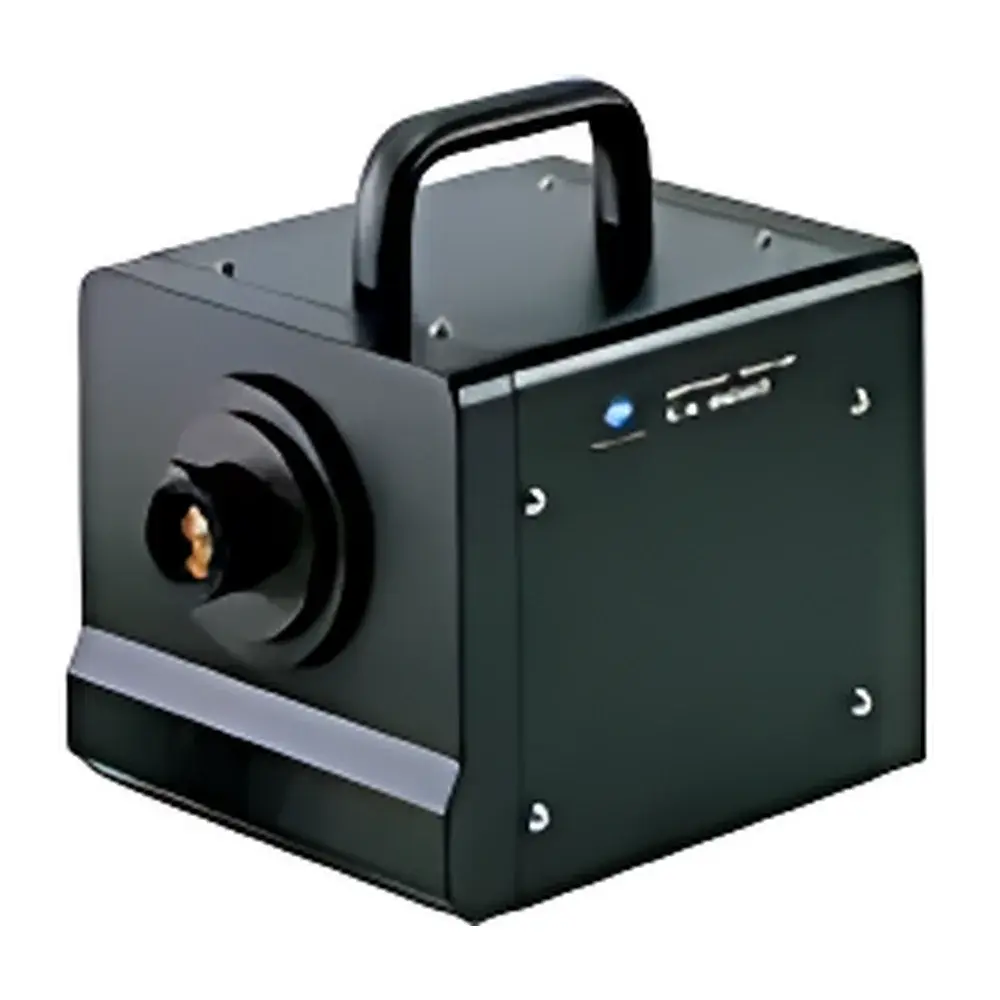
Konica Minolta CA-2500 Two-Dimensional Color Analyzer
| Brand | Konica Minolta |
|---|---|
| Origin | Japan |
| Model | CA-2500 |
| Type | Portable Color Analyzer |
| Light Source | Standard White Reference Illuminant |
| Luminance Repeatability | ±0.5% |
| Chromaticity Repeatability | ±0.001 |
| Measurement Range (with ND filter) | 0.05–100,000 cd/m² |
| Sensor | 2/3-inch Monochrome CCD, 1000 × 1000 Pixels, Integrated XYZ Tristimulus Filter (CIE 1931 Match) |
| Resolution Options | 980 × 980, 490 × 490, or 196 × 196 (via CA-S25w Software) |
| Interface | USB 2.0 |
| Operating Temperature/Humidity | 10–30°C, ≤70% RH (non-condensing) |
Overview
The Konica Minolta CA-2500 Two-Dimensional Color Analyzer is an industrial-grade imaging photometer engineered for high-fidelity spatial characterization of luminance and chromaticity distributions across self-luminous and reflective surfaces. Unlike conventional spot colorimeters or RGB-based imaging systems, the CA-2500 employs a monochrome CCD sensor coupled with precision-engineered XYZ tristimulus optical filters—spectrally calibrated to closely replicate the CIE 1931 standard observer function. This photometric architecture ensures measurement fidelity aligned with human visual perception, enabling traceable, repeatable evaluation of display uniformity, chromaticity shift, and white point stability in R&D, production QA, and regulatory compliance workflows. Designed for integration into automated test benches or handheld verification protocols, the CA-2500 supports synchronized acquisition of pulsed light sources—including OLED, microLED, and PDP panels—at frequencies ranging from 4 Hz to 2,000 Hz. Its native measurement range extends down to 0.05 cd/m², doubling the low-light capability of its predecessor (CA-2000), and accommodates large-area displays up to 1.77 m diagonal when paired with the telephoto lens configuration.
Key Features
- XYZ-filtered 2/3-inch monochrome CCD sensor with 1,000 × 1,000 effective pixels, delivering CIE-compliant photometric data without interpolation or spectral mismatch error.
- Interchangeable optical system comprising standard, wide-angle, and telephoto lenses—with optional macro coupling rings—enabling optimized field-of-view selection for panels ranging from smartphone-sized OLEDs to 85-inch TV modules.
- Factory-calibrated optical path per lens and focus position; eliminates user-dependent calibration drift and ensures metrological consistency across instrument lifetime and field deployment.
- Integrated neutral density (ND) filtering and auto-exposure control, supporting stable measurement across five orders of magnitude (0.05–100,000 cd/m²) without manual gain adjustment.
- Real-time synchronization engine for pulsed emission sources; configurable trigger frequency input enables phase-locked integration, critical for evaluating flicker, PWM dimming, and temporal color stability.
- Dedicated CA-S25w software suite featuring assisted focusing, automatic ROI detection, and one-click analysis templates for luminance uniformity (ΔL%), chromaticity deviation (Δu’v’), CCT mapping, and spectral centroid tracking.
- Comprehensive SDK (Software Development Kit) compliant with Windows-based environments, supporting custom automation via COM interface, batch scripting, and integration into MES or LabVIEW-controlled test stations.
Sample Compatibility & Compliance
The CA-2500 is validated for use across flat-panel display technologies including LCD, OLED, QD-LCD, microLED, and automotive HUDs—as well as general lighting products (LED modules, backlights, architectural luminaires) and instrumentation clusters. Its XYZ spectral response meets the fundamental requirements of ISO/CIE 11664-4 (colorimetry), IEC 62341-6-3 (OLED optical testing), and VESA DisplayHDR™ measurement guidelines. While not inherently FDA 21 CFR Part 11–compliant, audit-ready data export (CSV, TIFF, XML) and full metadata logging—including timestamp, lens ID, exposure parameters, and environmental conditions—support GLP/GMP-aligned documentation practices. All factory calibrations are traceable to NMIJ (National Metrology Institute of Japan) standards, with certificate-of-conformance provided per unit.
Software & Data Management
CA-S25w provides a deterministic, non-destructive workflow: raw sensor data is preserved in 16-bit linear format, while processed outputs include false-color luminance maps, u’v’ chromaticity overlays, cross-sectional intensity profiles, and statistical summaries (min/max/mean/std dev per channel). Export formats include CSV (for statistical process control), TIFF (georeferenced image data), and XML (structured metadata compatible with enterprise LIMS). The software enforces version-controlled measurement protocols, logs all user actions (including parameter changes and ROI edits), and supports password-protected operator roles—facilitating alignment with internal quality management systems. Optional API extensions allow direct ingestion into Python-based analytics pipelines or MATLAB-based optical modeling environments.
Applications
- Display development: Quantification of Mura defects, backlight leakage, viewing-angle-dependent chromaticity shift, and grayscale tracking across gamma curves.
- Production line QA: Pass/fail evaluation against luminance uniformity thresholds (e.g., ≥85% center-to-corner ratio) and Δu’v’ tolerances (e.g., <0.003 for premium monitors).
- Automotive electronics: Spatial validation of instrument cluster legibility under varying ambient illuminance and temperature gradients.
- Lighting design: CCT homogeneity assessment across LED arrays and optical diffuser performance verification.
- Regulatory submission: Generation of photometric datasets required for ENERGY STAR®, TCO Certified, and UL 62368-1 Annex Q compliance reports.
FAQ
What distinguishes the CA-2500 from RGB-based imaging colorimeters?
The CA-2500 uses physically realized XYZ optical filters matched to CIE 1931, eliminating metamerism-related errors inherent in RGB sensor systems. This yields spectrally accurate tristimulus values without reliance on matrix-based correction algorithms.
Can the CA-2500 measure flicker or temporal instability?
It does not perform time-resolved photometry natively; however, its synchronized acquisition mode captures single-frame snapshots at defined phase intervals, enabling frame-by-frame analysis of periodic luminance modulation when combined with external timing triggers.
Is remote operation supported over Ethernet or GPIB?
No—communication is exclusively via USB 2.0. For networked deployment, integration requires a host PC running CA-S25w or custom software leveraging the provided SDK.
How often is recalibration required?
Konica Minolta recommends annual factory recalibration. Field verification using certified reference tiles (e.g., NIST-traceable luminance standards) is advised before critical measurement campaigns.
Does the CA-2500 comply with ISO 13406-2 or ISO 9241-307?
While not certified to those ergonomic display standards, its spatial resolution, dynamic range, and angular sampling capabilities satisfy the instrumental requirements specified in Annex B of ISO 9241-307 for display uniformity assessment.






