
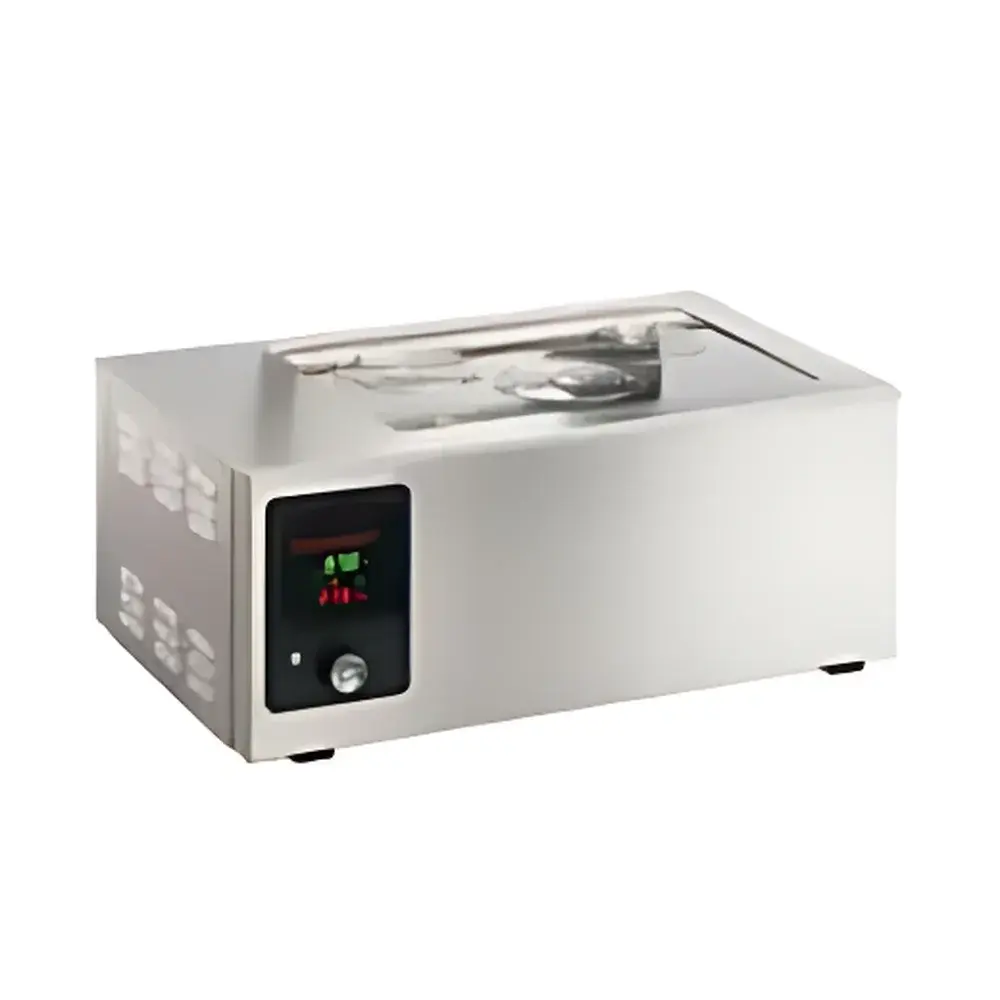
MEMMERT WNB10 Water Bath Circulator
| Brand | MEMMERT |
|---|---|
| Origin | Germany |
| Model | WNB10 |
| Instrument Type | Water Bath Circulator |
| Circulation | Internal Recirculation |
| Temperature Control | Heating-Only |
| Bath Volume | 10 L |
| Temperature Range | 10–95 °C (with dedicated boiling mode at 100 °C) |
| Temperature Stability | ±0.1 °C (typical, under standard lab conditions) |
| Temperature Resolution | 0.1 °C |
| Time Setting Range | B-type controller: 1 min – 99 h 59 min |
| E-type controller | 1 min – 999 h |
| Overtemperature Protection | Dual (B-type) or Triple (E-type), including electronic and mechanical safety cutoffs |
| Construction | AISI 304 stainless steel bath and housing |
| Compliance | CE-marked, tested to IEC 61010-1 for laboratory equipment safety |
Overview
The MEMMERT WNB10 Water Bath Circulator is a precision-engineered, internally recirculating temperature control system designed for reproducible thermal conditioning of samples in life science, pharmaceutical, chemical, and materials laboratories. Operating on the principle of forced convection via an integrated circulation pump, the WNB10 maintains uniform thermal distribution across its 10-liter stainless steel bath chamber—eliminating hot/cold stratification commonly observed in static water baths. Its temperature regulation is based on high-fidelity Pt100 resistance thermometry (four-wire configuration in E-type models), coupled with adaptive PID control logic that dynamically compensates for load changes, ambient fluctuations, and evaporation losses. The unit supports operation from 10 °C up to 95 °C (with a dedicated 100 °C boiling mode), with a minimum setpoint constrained to ≥5 °C above ambient—ensuring stable closed-loop control under variable environmental conditions. All electrical and thermal safety mechanisms comply with IEC 61010-1 and carry full CE marking for use within EU and internationally harmonized regulatory frameworks.
Key Features
- Precision temperature control with 0.1 °C resolution and typical stability of ±0.1 °C at setpoint, validated under ISO/IEC 17025-accredited calibration practices.
- Dual- or triple-stage overtemperature protection: B-type units feature dual safeguards (electronic + mechanical); E-type units add user-configurable electronic limit (TWW/TWB) for application-specific thermal risk mitigation.
- Four-wire Pt100 sensor architecture (standard on E-type; optional upgrade for B-type) minimizes lead resistance error—critical for GLP/GMP-compliant temperature traceability.
- Programmable time control: B-type supports three operational modes (start, delay start, hold); E-type extends functionality with time-dependent hold profiles and extended runtime up to 999 hours.
- AISI 304 stainless steel bath and housing ensure long-term corrosion resistance, compatibility with aqueous and mild organic media, and ease of decontamination per USP and FDA 21 CFR Part 11 requirements.
- LED display with alarm indicators provides real-time status feedback—including heater fault, sensor disconnect, and overtemperature events—with non-volatile event logging capability (E-type).
Sample Compatibility & Compliance
The WNB10 accommodates a broad range of sample vessels—including Erlenmeyer flasks (100–500 mL), test tubes (14.5–32 mm diameter), and custom jigs—via interchangeable support accessories such as conical flask holders, adjustable-height racks, and optional liquid-level controllers. Its flat or gabled lid configurations (L0/L1) support integration with shakers (L4 accessory) while maintaining thermal integrity. The unit meets essential safety standards including EN 61010-1:2019 and carries CE certification for use in laboratories adhering to ISO/IEC 17025, GxP, and ISO 9001 quality systems. While not intrinsically rated for hazardous environments, it is routinely deployed in QC labs performing ASTM D1557 (soil compaction), USP (aseptic processing support), and ISO 11137 (radiation sterilization validation prep).
Software & Data Management
The WNB10 operates as a standalone instrument with no proprietary software dependency. However, E-type controllers support RS232 serial output (optional USB-to-serial adapter) for external data acquisition into validated LIMS or ELN platforms. Logged parameters include setpoint, actual bath temperature, elapsed time, and alarm history—formatted as ASCII text for direct import into Excel or LabArchives. Audit trail functionality complies with FDA 21 CFR Part 11 when paired with appropriate system-level controls (e.g., user access management, electronic signatures). Calibration records—including as-found/as-left data and uncertainty budgets—can be maintained manually or imported from accredited calibration service providers.
Applications
- Enzyme kinetics assays requiring precise 37 °C incubation with minimal thermal drift.
- Sample preheating prior to HPLC injection or GC analysis to prevent condensation in transfer lines.
- Controlled evaporation of solvent fractions during natural product isolation (e.g., rotary evaporation support).
- Thermal equilibration of viscosity standards before Brookfield rheometer calibration.
- Stability testing of pharmaceutical formulations per ICH Q1A(R3) guidelines (long-term and accelerated conditions).
- Cell culture reagent warming under sterile hood conditions, avoiding microwave-induced hotspots.
FAQ
What is the difference between the B-type and E-type controllers?
The B-type offers basic PID control with dual overtemperature protection and time programming up to 99 h 59 min. The E-type adds a second four-wire Pt100 sensor, configurable electronic overtemperature limits, extended timer (up to 999 h), event logging, and RS232 interface.
Can the WNB10 be used for oil baths?
No—the WNB10 is specifically engineered for aqueous media. For oil-based applications, MEMMERT’s OB series (e.g., OB10) is recommended due to higher thermal stability and compatible sealing materials.
Is the circulation pump adjustable?
The internal recirculation pump operates at a fixed flow rate optimized for thermal homogeneity in a 10 L bath; no user-adjustable speed control is provided.
Does the unit support external temperature probes?
No—temperature regulation and monitoring are exclusively performed via the integrated Pt100 sensor(s). External probe input is not supported.
How often should calibration be performed?
Annual calibration is recommended for GxP environments; more frequent verification (e.g., daily or per-shift) using NIST-traceable reference thermometers is advised for critical applications.



