
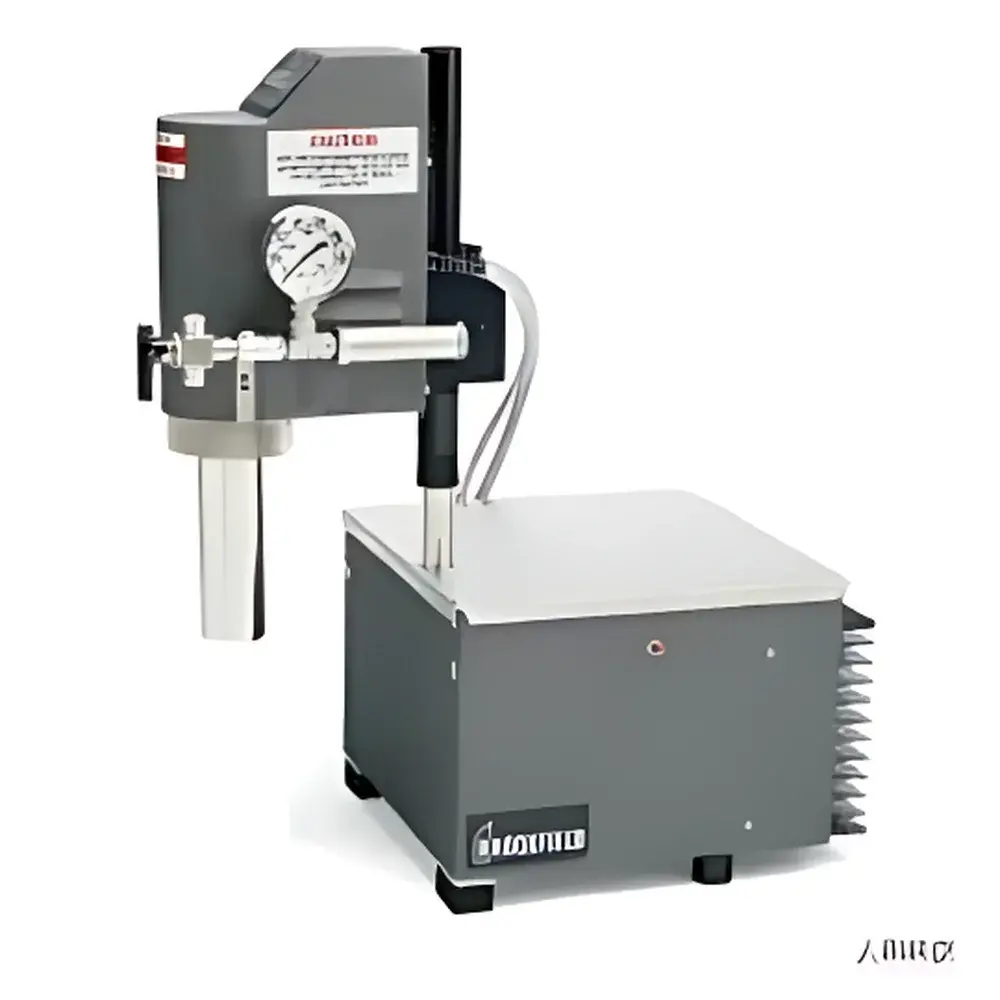
Brookfield PVS Portable High-Pressure Rotational Rheometer
| Brand | Brookfield |
|---|---|
| Origin | USA |
| Model | PVS |
| Instrument Type | Rotational Rheometer |
| Sample State | Liquid |
| Bearing Type | Mechanical Bearing |
| Minimum Speed | 0.05 rpm |
| Maximum Speed | 1000 rpm |
| Shear Rate Range | 0.02–1700 s⁻¹ |
| Pressure Range | Vacuum to 1000 psi |
| Temperature Range | −40 °C to +260 °C |
| Viscosity Range | 0.5–36×10⁶ mPa·s (cP) |
| Geometry | Couette (rotating outer cup, stationary inner bob) |
| Temperature Sensor | RTD mounted on inner bob surface |
| Construction Material | Hastelloy C outer cup and bob |
| Compliance | ASTM D2196, ISO 3219, USP <911> |
Overview
The Brookfield PVS Portable High-Pressure Rotational Rheometer is an engineered solution for in-situ and laboratory-based rheological characterization of liquids under extreme thermal and pressure conditions. Operating on the Couette principle—where the outer cylindrical cup rotates while the inner bob remains stationary—the PVS delivers stable, reproducible shear rate control across a broad dynamic range (0.02–1700 s⁻¹). This geometry minimizes end-effects and ensures uniform shear field development, critical for accurate low-shear-rate viscosity (LSRV) measurements and non-Newtonian flow curve analysis. Designed for operational flexibility, the PVS integrates a high-torque brushless motor capable of sustained rotation up to 1000 rpm, enabling rapid ramp tests and transient response evaluation. Its compact, portable chassis supports field deployment in pilot plants, refinery labs, or offshore platforms without compromising metrological integrity.
Key Features
- Couette Geometry with Hastelloy C Construction: Outer cup and bob fabricated from corrosion-resistant Hastelloy C alloy, ensuring chemical compatibility with aggressive solvents, acid slurries, and high-temperature hydrocarbons.
- Wide Operational Envelope: Validated performance from −40 °C to +260 °C and vacuum to 1000 psi, supporting rheology testing under process-relevant conditions (e.g., polymer melt processing, drilling fluid formulation, catalyst slurry stability).
- Precision Low-Shear Measurement: Capable of controlled shear rates down to 0.02 s⁻¹ using calibrated bob geometries—essential for yield stress estimation, thixotropy quantification, and structural recovery kinetics.
- Integrated RTD Temperature Sensing: Platinum resistance thermometer embedded directly on the inner bob surface provides real-time, contact-based sample temperature measurement with ±0.2 °C accuracy, eliminating lag associated with external jacket sensors.
- Mechanical Bearing Architecture: Robust mechanical bearing system optimized for long-term stability under continuous high-load operation; no reliance on air bearings or active magnetic levitation, reducing maintenance complexity and cost of ownership.
- Onboard Safety Systems: Integrated pressure relief valve rated at 1000 psi, redundant overpressure cutoff, and sealed chamber design compliant with ASME B31.4 and API RP 14C requirements for hazardous environment use.
Sample Compatibility & Compliance
The PVS accommodates Newtonian and non-Newtonian liquid samples—including polymer melts, asphalt binders, pharmaceutical suspensions, oil-based drilling fluids, and ceramic slurries—without modification to core hardware. Its sealed, pressurizable cell enables testing of volatile or oxygen-sensitive materials under inert gas blanket or controlled partial vacuum. The instrument meets essential regulatory and industry-standard requirements: ASTM D2196 (viscosity of paints and related materials), ISO 3219 (rotational viscometers), USP (rheological characterization of semisolid dosage forms), and supports GLP/GMP data integrity through audit-trail-ready firmware logging. While not intrinsically rated for Class I Div 1 environments, it may be deployed in classified zones when housed within certified explosion-proof enclosures per NEC Article 500.
Software & Data Management
Controlled via Brookfield’s Rheo3000 software platform (Windows-based), the PVS supports automated test sequencing—including steady-state flow sweeps, oscillatory amplitude/frequency sweeps, creep-recovery, and hysteresis loops—with full parameter scripting and real-time graphing. All raw torque, angular displacement, temperature, and pressure data are timestamped and stored in vendor-neutral CSV and HDF5 formats. Software features include 21 CFR Part 11-compliant user access controls, electronic signature capture, and immutable audit trails for raw data edits and calibration events—facilitating FDA submission readiness and internal quality audits. Optional API integration allows direct ingestion into LIMS or MES systems via RESTful endpoints.
Applications
- Quality control of high-viscosity industrial lubricants and gear oils under simulated operating pressures
- Rheokinetic profiling of thermosetting resins during cure cycles in composites manufacturing
- Yield stress mapping of bentonite-based drilling muds across temperature/pressure gradients
- Stability assessment of nanoparticle dispersions and biopolymer gels under shear history protocols
- Validation of computational fluid dynamics (CFD) boundary conditions for pipeline transport modeling
- Accelerated aging studies of bituminous binders per AASHTO T315 and EN 13583
FAQ
What sample volume is required for a standard PVS measurement?
Typical fill volume ranges from 15–25 mL depending on bob geometry; minimum usable volume is 10 mL with the small-diameter “S” series bob.
Can the PVS perform oscillatory rheology (e.g., G′, G″)?
No—the PVS is a steady-shear rotational rheometer optimized for viscosity and flow curve acquisition; it does not support controlled-strain or controlled-stress oscillatory modes.
Is third-party calibration traceable to NIST standards available?
Yes—Brookfield-certified calibration services include torque, speed, temperature, and pressure transducers, all traceable to NIST or equivalent national metrology institutes (e.g., PTB, NPL) with documented uncertainty budgets.
How is temperature uniformity maintained across the sample gap?
The PVS relies on conductive heating/cooling through the Hastelloy C outer cup wall; axial temperature gradients are minimized by slow ramp rates (<2 °C/min) and validated via embedded RTD cross-checks at multiple radial positions.
Does the system support automated cleaning protocols between runs?
Not natively—the PVS requires manual disassembly and solvent rinsing; however, optional heated purge gas manifolds can be integrated for semi-automated residue removal in production environments.



