
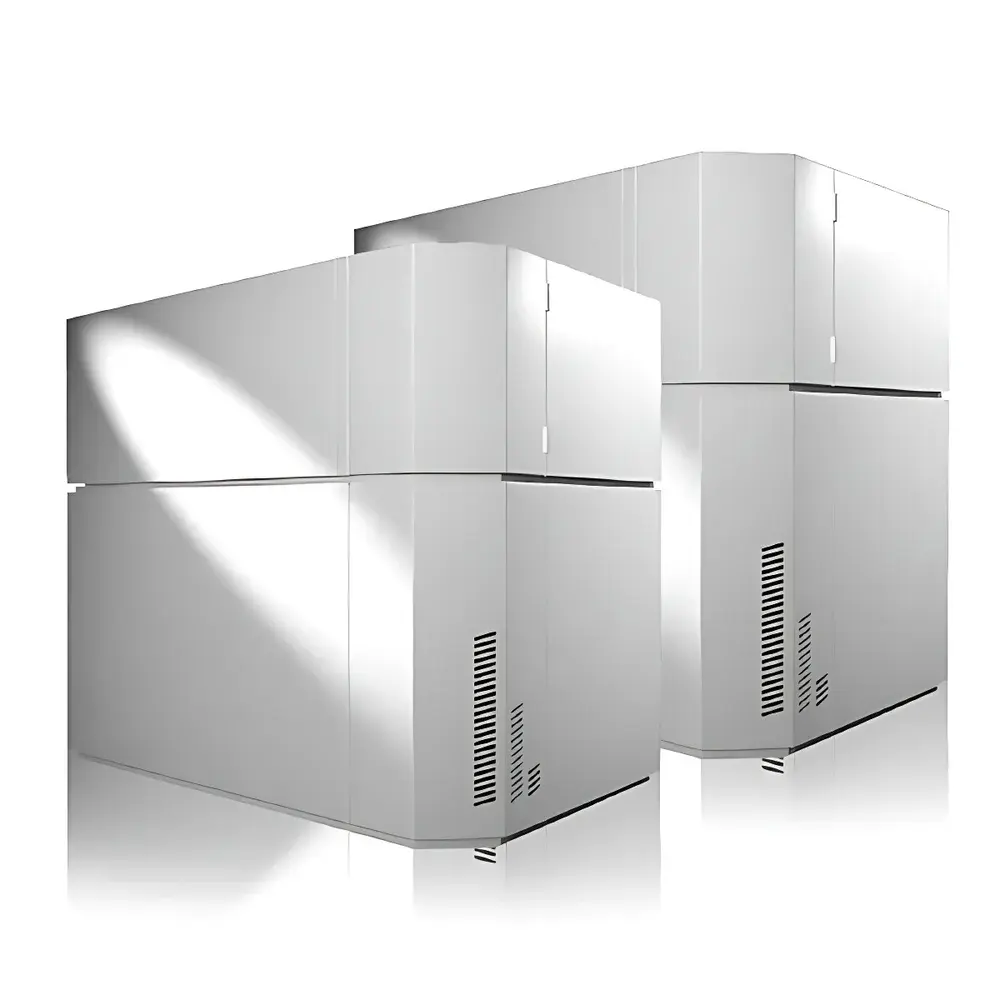
SPECTRUMA GDA 750 / GDA 550 High-Resolution Glow Discharge Optical Emission Spectrometer
| Brand | SPECTRUMA |
|---|---|
| Country of Origin | Germany |
| Model | GDA 750 / GDA 550 |
| Optical Resolution | <20 pm (FWHM) |
| Spectral Range | 190–800 nm (PMT), 200–800 nm (CCD option) |
| Maximum Analysis Depth | >200 µm |
| Depth Resolution | ≤1 nm |
| Detection Limits | Sub-ppm |
| Excitation Source | DC (0–1500 V, 0–250 mA), RF (up to 150 W, pulsed mode optional for GDA 750) |
| Sample Diameter Range | 1–8 mm |
| Vacuum System | Dual-stage rotary vane pump (oil-free for source), optional turbomolecular pump |
| Software Platform | WinGDOES (Windows XP or later) |
| Weight | ~580 kg |
| Dimensions | 1380 × 1440 × 890 mm |
Overview
The SPECTRUMA GDA 750 and GDA 550 are high-resolution, direct-current and radio-frequency glow discharge optical emission spectrometers (GD-OES) engineered for quantitative depth profiling and bulk compositional analysis of conductive and non-conductive solid materials. Based on the Paschen–Runge optical layout with a 750 mm focal length, these instruments employ a high-stability hollow-cathode glow discharge plasma to sputter material from the sample surface in a controlled, layer-by-layer manner. Emitted atomic line spectra are dispersed via a holographically ruled 2400 lines/mm grating and detected either by photomultiplier tubes (PMTs) across up to 79 pre-aligned channels—or optionally, by a high-sensitivity CCD detector enabling true simultaneous full-spectrum acquisition from 200 nm to 800 nm. The system operates under high-vacuum conditions (<10⁻³ mbar) using an all-stainless-steel optical chamber and oil-free vacuum pumping for the discharge source—critical for accurate quantification of light elements including H, O, N, C, and Cl without hydrocarbon contamination.
Key Features
- Two-tier platform architecture: GDA 550 optimized for routine DC-based depth profiling; GDA 750 extends capability with fully programmable RF excitation (150 W max, pulsed mode optional), enabling reliable analysis of insulators such as ceramics, glasses, polymer coatings, and oxide films.
- Depth resolution down to ≤1 nm with sputter rates precisely calibrated against certified reference materials (CRMs); analytical depth exceeding 200 µm achievable with sub-nanometer layer definition.
- Dual detection configuration: Standard PMT array supports up to 63 fixed channels (expandable to 79 with 400 mm add-on module); optional high-resolution CCD system provides unlimited spectral channel flexibility and real-time line selection without hardware reconfiguration.
- Integrated thermal management: Direct sample cooling allows stable analysis of heat-sensitive substrates—including 50 µm stainless steel foils, organic thin films, and thermally labile multilayers—without distortion or interdiffusion artifacts.
- Automated source conditioning: Patented in-situ electrode cleaning mechanism ensures long-term signal stability and measurement reproducibility (RSD < 2% over 8-hour runs).
- Modular vacuum architecture: Base system uses low-noise dual-stage rotary vane pumps (<50 dB); optional turbomolecular pump upgrade enables ultra-high vacuum operation for trace-level N and O quantification in metallurgical and semiconductor applications.
Sample Compatibility & Compliance
The GDA 750/GDA 550 accommodates flat, curved, and irregularly shaped samples (50 µm to 45 mm thickness) using universal sample holders—no dedicated electrodes required. Conductive samples (metals, alloys, carbides) are analyzed via DC mode; non-conductors (glass, enamel, SiO₂, PVDF, Al₂O₃) require RF excitation (GDA 750 only). All configurations comply with ISO/IEC 17025 requirements for testing laboratories and support GLP/GMP data integrity protocols through WinGDOES audit-trail logging (21 CFR Part 11 compliant when configured with electronic signatures and role-based access control). Calibration traceability is maintained per ASTM E2774–22 (Standard Practice for GD-OES Depth Profiling of Metallic Coatings) and ISO 14707:2021 (Quantitative Analysis of Thin Films by GD-OES).
Software & Data Management
WinGDOES is a modular, Windows-native application supporting method development, calibration, acquisition, and post-run reprocessing. It features guided workflow templates for QDP (Quantitative Depth Profile) analysis, multi-matrix calibration libraries, and customizable reporting (PDF, Excel, CSV, XML). Real-time spectral visualization, automatic background correction, and intensity-to-concentration conversion using matrix-matched standards are standard. The software includes built-in uncertainty estimation per ISO/IEC Guide 98-3 (GUM), supports user-defined report layouts with embedded metadata (operator ID, instrument log, environmental conditions), and permits language switching during active measurement—essential for multinational R&D and QA/QC environments. Data archives are stored in encrypted SQLite databases with SHA-256 hash verification for forensic integrity.
Applications
- Coating & Surface Engineering: Quantitative depth profiling of PVD/CVD layers (TiN, CrN, DLC), electroplated stacks (Ni/Cu/Sn, Zn-Ni), and passivation films (Cr₂O₃ on stainless steel), including interface chemistry and interdiffusion kinetics.
- Photovoltaics & Thin-Film Devices: Composition mapping of CIGS (Cu(In,Ga)Se₂), perovskite precursors, and transparent conductive oxides (ITO, AZO), with ppm-level sensitivity for dopants and impurities.
- Aerospace & Automotive Alloys: Bulk and near-surface analysis of Ni-based superalloys, aluminum-lithium sheets, and surface-hardened steels—detecting segregation of B, Mg, or rare earths at grain boundaries.
- Ceramics & Functional Materials: Oxygen stoichiometry determination in YBCO, ZrO₂-tetragonal phases, and SiC composites using RF-GD-OES with inert gas stabilization.
- Battery Materials: Depth-resolved Li distribution in cathode coatings (NMC, LFP), SEI layer composition on anodes, and current collector corrosion products.
FAQ
What light elements can be quantified with the GDA 750/GDA 550?
Hydrogen (H), oxygen (O), nitrogen (N), carbon (C), and chlorine (Cl) are routinely measured using vacuum UV optics and oil-free source pumping—achieving detection limits of 10–100 ppm depending on matrix and sputter rate.
Is RF excitation available on both models?
No. RF source capability—including pulsed mode—is exclusive to the GDA 750 platform. The GDA 550 operates in DC mode only.
Can the instrument analyze ultra-thin films (<100 nm)?
Yes. With optimized argon flow, low-power DC sputtering, and real-time signal normalization, sub-5 nm resolution is attainable on well-characterized reference standards.
Does the system support automated sample handling?
An optional 100-position auto-sampler is available, fully integrated into WinGDOES scheduling and QC flagging logic.
How is calibration traceability ensured?
Certified reference materials (CRMs) from NIST, BAM, and JRC are supported; calibration curves are validated per ISO 80000-9 and documented with uncertainty budgets aligned to EURACHEM/CITAC guidelines.



