
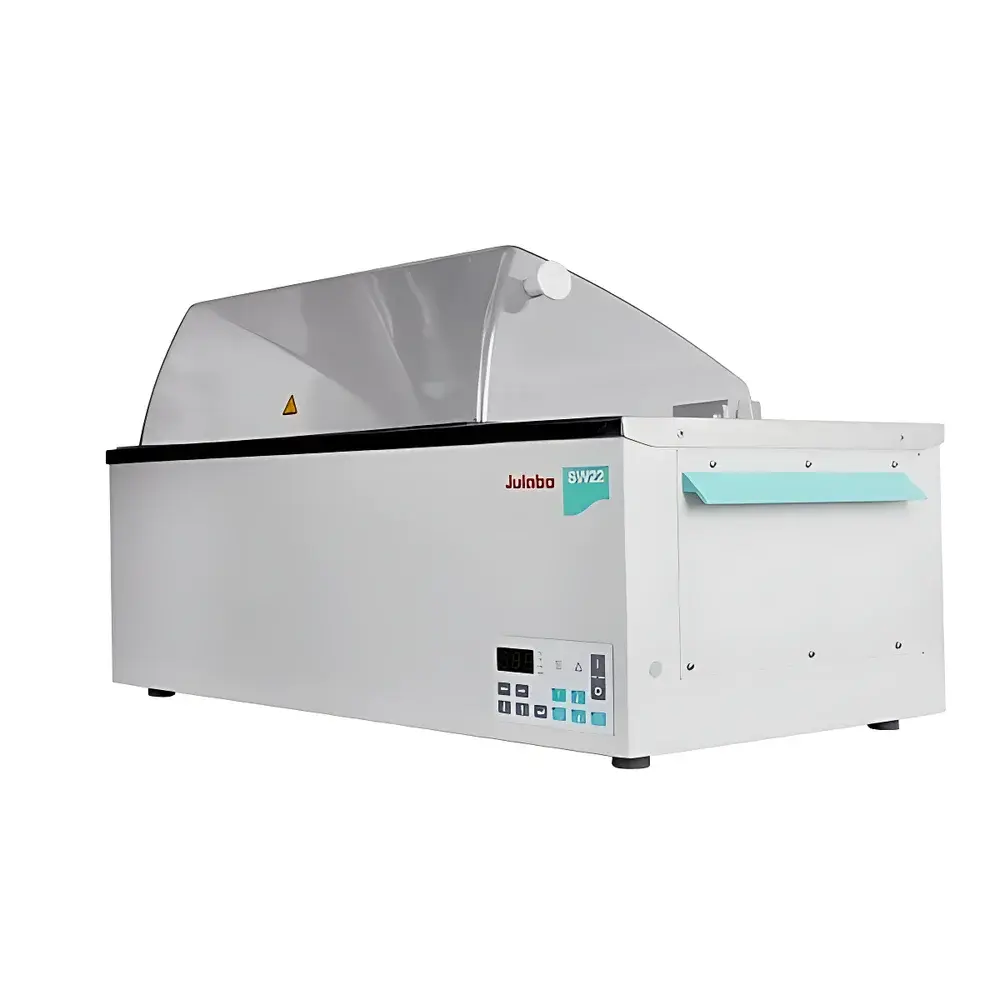
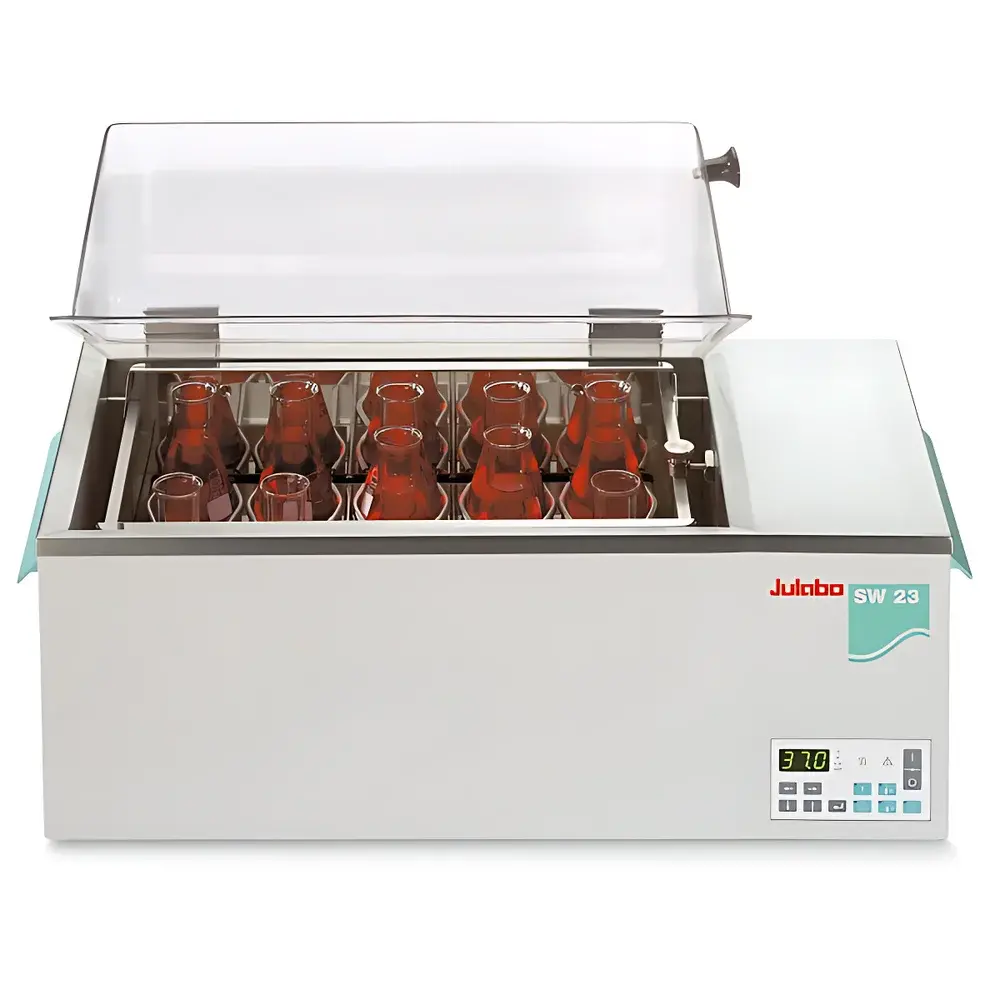
JULABO SW Series Constant-Temperature Orbital Shaking Water Bath / Incubation Shaker
| Brand | JULABO |
|---|---|
| Origin | Germany |
| Model | SW Series |
| Temperature Range | Ambient +5 °C to +99.9 °C |
| Temperature Stability | ±0.2 °C (SW22, SW22-40, SW40, SW24) or ±0.02 °C (SW23, SW23-40) |
| Temperature Resolution | 0.1 °C |
| Oscillation Frequency Range | 20–200 rpm |
| Oscillation Amplitude | 15 mm or 25 mm |
| Display Resolution | 0.1 °C / 1 rpm |
| Timer Range | 0–10 h |
| Heating Power | 250 W (SW22/SW23) or 550 W (SW24) or up to 2100 W (SW40) |
| Bath Volume | 8–40 L |
| Bath Opening Dimensions | 250 × 30 / 18 cm (SW22/SW23) or 1000 × 60 / 18 cm (SW40) |
| External Dimensions (W×L×H) | 70 × 35 × 26 cm (SW22/SW23) or 120 × 35 × 26/43 cm (SW40) |
| RS232 Interface | Yes |
| Dry-run Protection | Yes, with audible/visual alarm and automatic power cutoff |
| Optional Accessories | Makrolon bath cover, tube racks, Erlenmeyer flask clamps, circulation pump (SW23 only) |
Overview
The JULABO SW Series Constant-Temperature Orbital Shaking Water Bath is an engineered platform for precise temperature-controlled agitation of liquid samples in life science, pharmaceutical, and quality control laboratories. Designed around a robust orbital shaking mechanism and high-fidelity PID temperature regulation, the SW series integrates thermal stability with mechanical reproducibility—critical for applications requiring both uniform heat distribution and consistent mixing kinetics. Unlike passive water baths, the SW units combine thermostatic control with programmable oscillation, enabling dynamic incubation conditions that emulate physiological shear stress or accelerate dissolution kinetics. The system operates exclusively in heating mode (no refrigeration), making it ideal for microbiological growth studies, enzyme assays, solubility profiling, and USP dissolution testing where elevated temperatures and controlled motion are required. Units are manufactured in Germany to ISO 9001-certified standards and comply with IEC 61010-1 for laboratory electrical safety.
Key Features
- Microprocessor-based digital controller with waterproof membrane keypad for reliable operation in humid environments
- High-brightness LED display showing setpoint temperature, real-time bath temperature, oscillation speed, and user-defined high/low temperature alarm thresholds
- Dual-level dry-run protection: immediate acoustic and visual alert plus automatic heater deactivation upon detected low fluid level
- Precision temperature stability of ±0.02 °C (SW23 variants) achieved via optimized heater placement, high-resolution Pt100 sensor feedback, and adaptive PID tuning
- Orbital motion with selectable amplitudes (15 mm or 25 mm) and continuously adjustable frequency (20–200 rpm) for application-specific shear control
- Integrated electronic timer (0–10 hours) with auto-shutdown function for unattended overnight runs
- RS232 serial interface enables remote parameter setting, real-time data logging, and integration into LIMS or GLP-compliant audit trails
- Optional circulation pump (SW23 only) enhances thermal homogeneity across large-volume baths—essential for ASTM D5293 or ISO 13320-compliant particle dispersion protocols
Sample Compatibility & Compliance
The SW series accommodates standard labware including test tubes (13–25 mm diameter), microcentrifuge tubes, culture flasks (up to 2 L), and USP-approved dissolution vessels. All models support accessories such as stainless-steel flask clamps, universal tube holders, and transparent Makrolon bath covers to minimize evaporation during extended runs. From a regulatory standpoint, the SW platform supports Good Laboratory Practice (GLP) and Good Manufacturing Practice (GMP) workflows through traceable temperature calibration records, configurable alarm logs, and electronic signature-ready software interfaces. While not intrinsically 21 CFR Part 11 compliant, the RS232 output allows connection to validated third-party data acquisition systems meeting FDA requirements for electronic records and signatures.
Software & Data Management
No proprietary software is bundled; however, the RS232 port delivers ASCII-formatted real-time streams of temperature, RPM, and status flags (e.g., “HEATING”, “ALARM”, “TIMER_EXPIRED”). This facilitates direct integration with LabVIEW, Python-based logging tools, or enterprise-grade SCADA platforms. Users may configure custom CSV export routines with timestamping at user-defined intervals (1 s to 60 s). Firmware updates are performed via PC-connected terminal emulation (e.g., PuTTY) using XMODEM protocol. Calibration constants—including sensor offset and heater gain—are stored in non-volatile memory and can be reloaded after service events to maintain metrological continuity.
Applications
- Pharmaceutical dissolution testing per USP , , and under controlled agitation and temperature
- Bacterial and yeast culture expansion in nutrient broth under defined thermal and kinetic conditions
- Protein solubilization and aggregation studies requiring precise thermal ramping and constant orbital mixing
- Chemical reaction kinetics monitoring where temperature-dependent rate constants must be isolated from convective artifacts
- Standardization of viscosity reference materials using calibrated oscillatory shear profiles
- Pre-analytical sample homogenization prior to HPLC, GC, or spectrophotometric analysis
FAQ
Is refrigeration available on any SW model?
No. The SW series is a heating-only system. For sub-ambient operation, JULABO recommends pairing the SW23 with an external FD200 recirculating chiller (model SW23L configuration).
What is the maximum recommended fill level for optimal thermal uniformity?
For SW22/SW23 units, maintain fluid volume between 8 L and 20 L. For SW40, operate between 16 L and 40 L. Overfilling beyond the marked max line compromises circulation efficiency and temperature homogeneity.
Can the SW series be used with oil instead of water?
Yes—silicone or mineral oil may be used up to +85 °C (SW40) or +80 °C (SW24). Note that oil viscosity affects oscillation dynamics; reduced amplitude settings may be necessary for high-viscosity media.
Does JULABO provide NIST-traceable calibration certificates?
Factory calibration is performed using PTB-certified reference standards. Optional NIST-traceable certificates (with uncertainty budgets) are available upon request at time of order.
How often should preventive maintenance be scheduled?
Annual inspection of heater elements, seal integrity, and sensor response time is recommended. JULABO’s certified service centers perform full functional verification against DIN EN 61000-4-3 immunity standards.
Related Products



