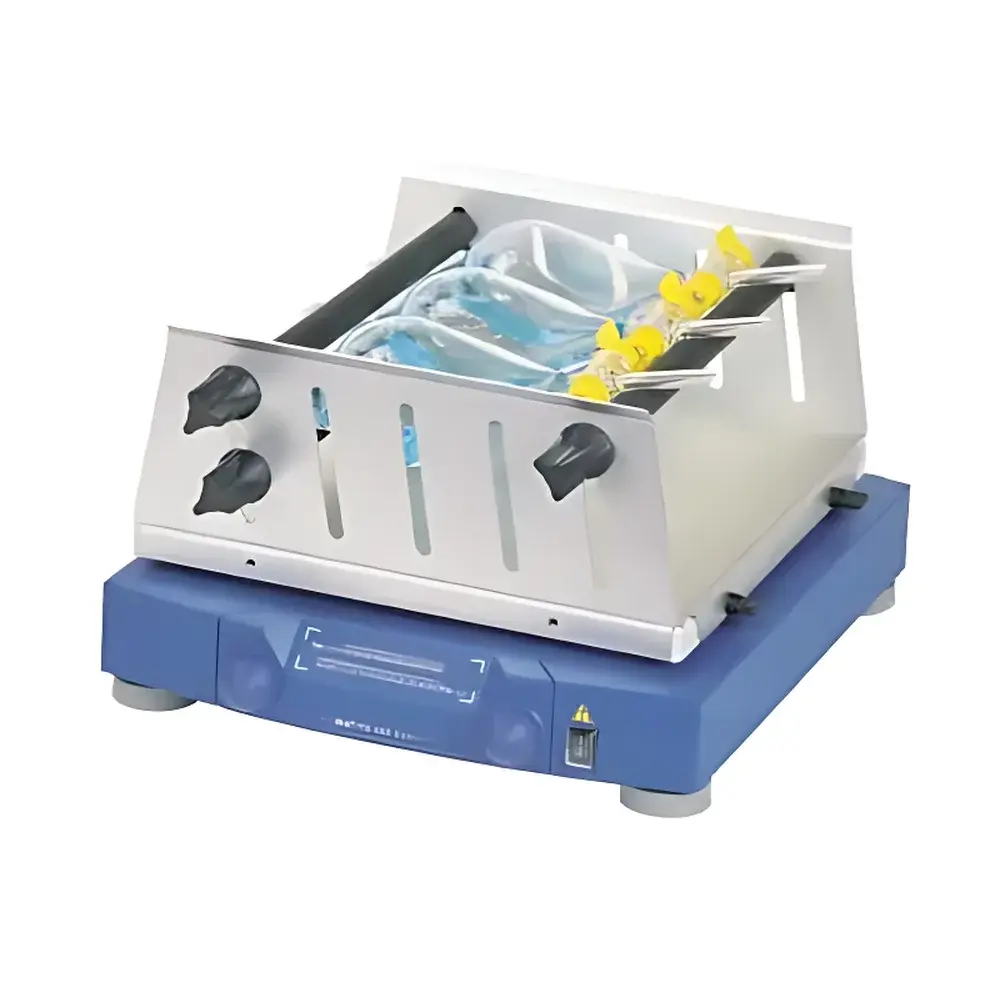
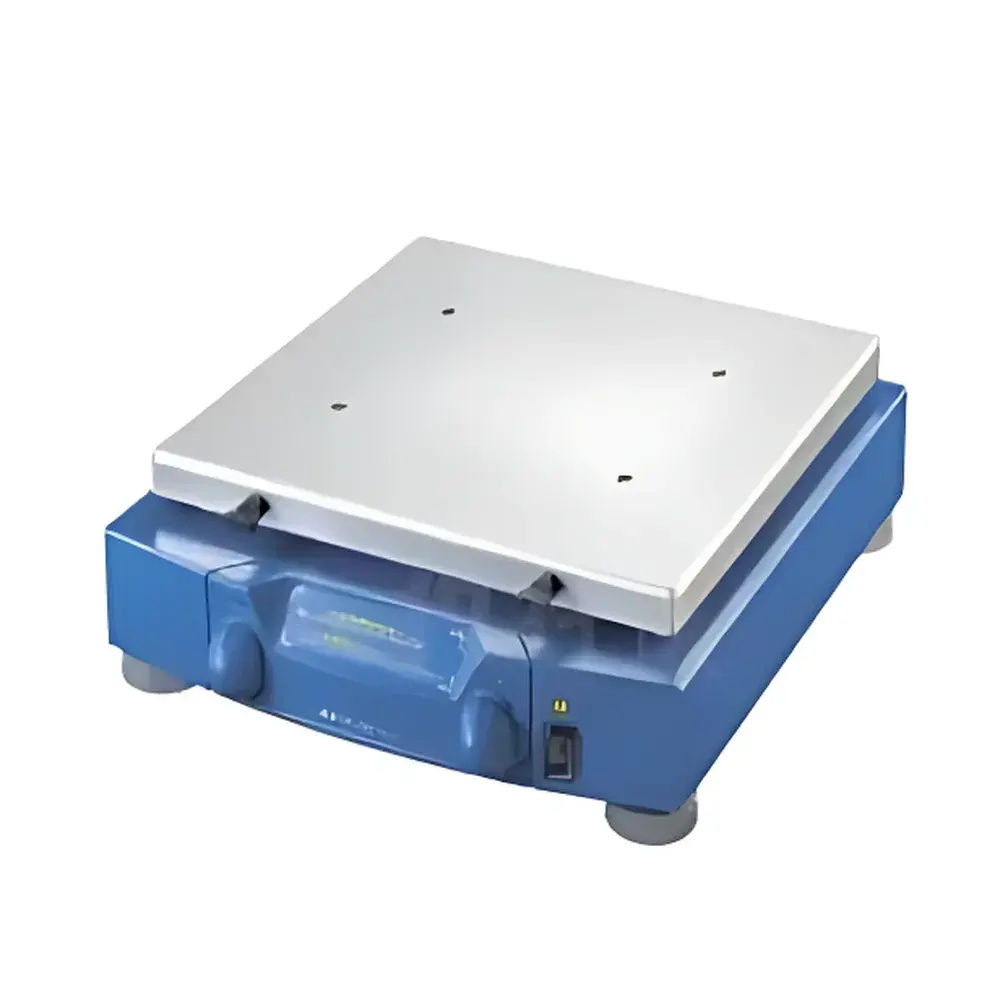
IKA HS 260 basic Reciprocal Shaker
| Brand | IKA |
|---|---|
| Origin | Germany |
| Model | HS 260 basic |
| Timer Range | 5–50 min |
| Oscillation Frequency | 0–300 rpm |
| Stroke Length | 20 mm |
| Platform Quantity | 1 |
| Max Load Capacity (incl. clamp) | 7.5 kg |
| Input Power | 45 W |
| Dimensions (W×H×D) | 360 × 420 × 100 mm |
| Weight | 8.5 kg |
| Ambient Temperature Range | 5–50 °C |
| Relative Humidity Limit | ≤80 % |
| Protection Class | IP21 |
| Voltage | 220–240 V / 100–120 V, 50/60 Hz |
| Motor Output Power | 10 W |
| Minimum Adjustable Speed | 20 rpm |
| Display | LED for speed and timer |
| Operation Modes | Timed or continuous |
| Platform Type | Flat reciprocating platform |
Overview
The IKA HS 260 basic is a compact, benchtop reciprocal shaker engineered for reliable, low-maintenance oscillation in routine life science laboratories. It operates on a linear reciprocating motion with a fixed stroke length of 20 mm—ideal for applications requiring gentle yet consistent mixing of liquid samples in tubes, flasks, and microplates. Unlike orbital or rotary shakers, the HS 260 basic generates unidirectional back-and-forth movement, minimizing vortex formation while ensuring uniform suspension of particulates, cell cultures, or immunoassay reagents. Its robust brushless motor delivers stable rotational output across the full speed range (20–300 rpm), with electronic speed control enabling precise reproducibility between runs. Designed for continuous duty (100 % duty cycle), the unit supports extended incubation-compatible workflows when paired with external environmental chambers—though it lacks integrated temperature control. The device complies with DIN EN 60529 for ingress protection (IP21), confirming resistance to vertically falling drips and limited finger contact, making it suitable for standard laboratory environments under ISO 15190-compliant lab safety frameworks.
Key Features
- Reciprocating motion with 20 mm stroke length ensures uniform sample agitation without excessive shear stress—critical for fragile biological suspensions.
- Digitally adjustable speed range from 20 to 300 rpm, displayed in real time via dual LED indicators (speed and timer).
- Programmable timer function with selectable intervals from 5 to 50 minutes; also supports continuous operation mode for extended assays.
- Single flat platform (360 × 100 mm) optimized for compatibility with universal clamps—designed for rapid tool-free attachment and removal.
- Compact footprint (360 × 420 × 100 mm) and lightweight construction (8.5 kg) facilitate placement on crowded benches or inside biosafety cabinets.
- Energy-efficient design: 10 W mechanical output from a 45 W input, minimizing heat dissipation and reducing ambient thermal load during prolonged use.
- Rated for continuous operation at ambient temperatures between 5 °C and 50 °C and relative humidity up to 80 % (non-condensing).
Sample Compatibility & Compliance
The HS 260 basic accommodates a wide variety of container formats—including Erlenmeyer flasks (up to 2 L), centrifuge tubes (15–50 mL), Petri dishes, and multi-well plates—when used with IKA-certified accessory clamps (e.g., universal flask holders, microplate adapters, or tube racks). Clamps are sold separately to allow customization based on experimental throughput and vessel geometry. The shaker meets essential electrical safety requirements per IEC 61010-1 and carries CE marking for conformity with EU directives. While not inherently GLP/GMP-qualified, its stable performance, traceable speed calibration (via external tachometer), and absence of analog signal outputs support integration into validated workflows where manual parameter logging satisfies 21 CFR Part 11 documentation requirements. No RS232 or analog output interfaces are provided; data recording requires external timing devices or digital loggers.
Software & Data Management
The HS 260 basic is a standalone hardware device with no embedded firmware, network interface, or proprietary software suite. All operational parameters—speed and timer—are set manually via front-panel controls and verified visually through dual LED displays. This architecture eliminates software validation overhead and reduces cybersecurity exposure, aligning with risk-based instrument qualification strategies outlined in Annex 15 of the EU GMP Guidelines. For laboratories implementing electronic record systems, speed and duration settings may be documented manually in lab notebooks or entered into LIMS via standardized SOP templates. Periodic verification using an NIST-traceable optical tachometer is recommended to ensure ongoing accuracy—particularly before critical batch releases or regulatory audits.
Applications
- Cell culture maintenance: Gentle resuspension of adherent cells post-trypsinization and homogenization of suspension cultures prior to passaging.
- Immunological assays: Uniform mixing during ELISA plate coating, washing, and conjugate incubation steps.
- Molecular biology: Hybridization buffer agitation in Southern/Northern blotting protocols and genomic DNA shearing pre-library prep.
- Environmental microbiology: Extraction and dispersion of biofilm samples from solid substrates prior to CFU enumeration.
- Pharmaceutical QC: Dissolution testing support for non-temperature-sensitive formulations where mechanical agitation replaces magnetic stirring.
- Educational labs: Foundational instruction in kinetic mixing principles, parameter optimization, and equipment calibration practices.
FAQ
Does the HS 260 basic include clamps or sample holders?
No—clamps are optional accessories and must be ordered separately according to vessel type and quantity.
Can this shaker be used inside a CO₂ incubator or cold room?
It is rated for ambient operation between 5 °C and 50 °C; however, internal condensation or corrosion risks in high-humidity enclosures (e.g., CO₂ incubators) are not mitigated by its IP21 rating. Use only in dry, climate-controlled spaces.
Is speed calibration traceable to national standards?
The unit itself does not provide factory calibration certificates, but speed accuracy can be independently verified using a calibrated optical tachometer compliant with ISO/IEC 17025.
What safety certifications does the HS 260 basic hold?
It conforms to IEC 61010-1 for laboratory electrical equipment safety and bears the CE mark for EMC and Low Voltage Directive compliance.
Can multiple HS 260 basic units be synchronized?
No synchronization capability is built in; each unit operates independently with no master-slave or network coordination functionality.