
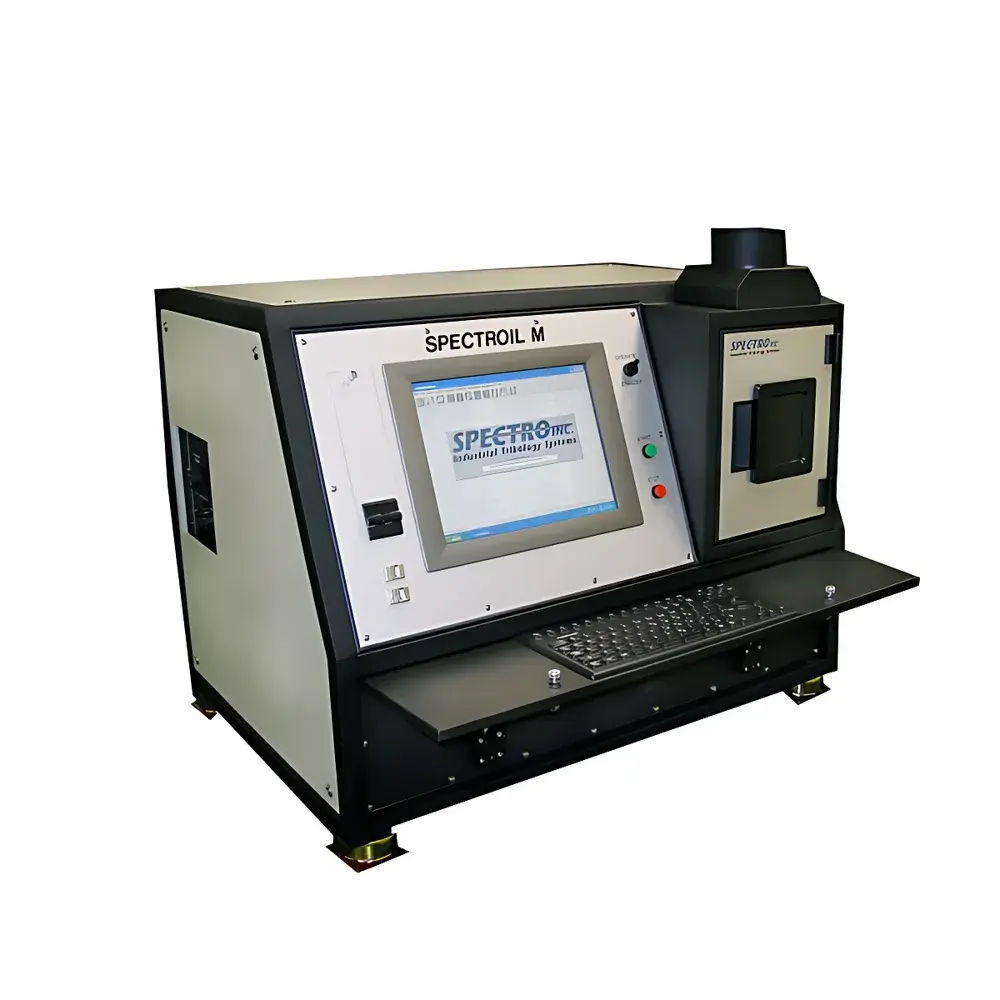
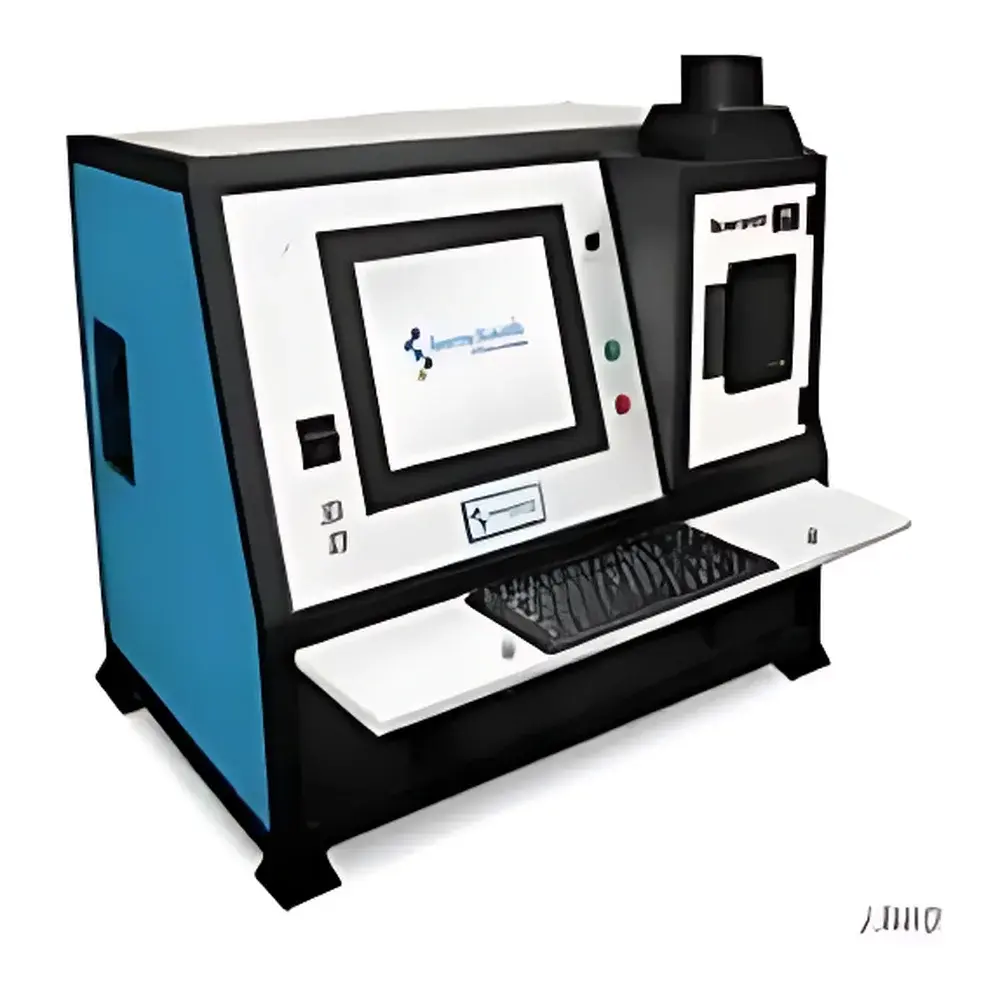
Spectro Scientific SpectrOil M Series Oil Spectrometer
| Brand | Spectro Scientific |
|---|---|
| Origin | USA |
| Model | SpectrOil M/C-W |
| Compliance | ASTM D6595 |
| Detection Principle | Rotating Disc Electrode Atomic Emission Spectrometry (RDE-AES) |
| Elements Analyzed | Up to 32 elements per run (default 24) |
| Analysis Time | ≤30 seconds per sample |
| Optical System | High-Resolution CCD Spectrometer |
| Sample Preparation | None required |
| Operating Environment | Benchtop, no inert gas or auxiliary utilities needed |
| Software Platform | Windows-based instrument control and data management suite with optional grease, sulfur, and coolant analysis modules |
| Certification | JOAP (Joint Oil Analysis Program) Qualified |
| Dimensions | 77.5 cm (H) × 63.5 cm (W) × 70 cm (D) |
| Weight | ~114 kg |
Overview
The Spectro Scientific SpectrOil M Series Oil Spectrometer is a benchtop rotating disc electrode atomic emission spectrometer (RDE-AES) engineered for rapid, precise elemental quantification in used lubricants, hydraulic fluids, fuels, and coolants. Based on the ASTM D6595 standard method, it detects and quantifies metallic wear debris (e.g., Fe, Cu, Al, Cr, Pb), contaminant elements (e.g., Si, Na, B), and additive package constituents (e.g., Ca, Mg, Zn, P, Mo) at sub-ppm concentrations. Unlike ICP-OES or XRF systems, the RDE-AES technique employs direct vaporization of an oil-coated rotating graphite electrode under argon-free arc excitation—eliminating the need for sample digestion, dilution, or external purge gases. This enables true field-deployable operation while maintaining laboratory-grade reproducibility (RSD <5% for key wear metals at 10 ppm). The instrument’s compact footprint, short warm-up time (<5 minutes), and robust mechanical architecture make it suitable for both fixed-site laboratories and mobile maintenance units operating under industrial or military conditions.
Key Features
- ASTM D6595-compliant RDE-AES optical system with thermally stabilized high-resolution CCD detector
- Simultaneous multi-element analysis: default configuration supports 24 elements; upgradable to 32-element capability via software license
- No sample preparation required—direct analysis of neat oil, grease emulsions, diesel, jet fuel, and glycol-based coolants
- Full JOAP qualification: the only RDE-AES spectrometer approved by the U.S. Department of Defense for Joint Oil Analysis Program reporting
- Integrated Windows-based software with audit-trail-enabled data handling compliant with FDA 21 CFR Part 11 and GLP/GMP documentation requirements
- Modular functionality: optional add-ons include dedicated grease analysis algorithms, sulfur quantification module (for fuel sulfur compliance), and coolant chemistry extension
- Benchtop design with integrated transport case option (IP65-rated ruggedized enclosure)
- Low operational cost: minimal consumables (graphite electrodes, cleaning solvents); no high-purity gases, plasma generators, or vacuum pumps required
Sample Compatibility & Compliance
The SpectrOil M/C-W accepts undiluted samples across ISO VG 10–680 lubricants, synthetic esters, polyalphaolefins (PAOs), mineral oils, turbine oils, gear oils, engine oils, hydraulic fluids, aviation fuels (Jet A, JP-8), and antifreeze/coolant formulations. It complies with ASTM D6595 for wear metal detection limits (e.g., 0.1 ppm Fe, 0.05 ppm Cu) and demonstrates linearity over 0.1–1000 ppm ranges for all calibrated elements. All calibration curves are traceable to NIST SRM 2720a (used oil reference material) and certified through annual interlaboratory proficiency testing per ISO/IEC 17043. The system meets MIL-STD-810G for shock/vibration resistance and operates reliably in ambient temperatures from 10–35°C and relative humidity up to 80% non-condensing.
Software & Data Management
The SpectroSoft™ v5.x platform provides instrument control, spectral acquisition, calibration management, and trend-based condition monitoring. Each analysis generates a fully annotated report including elemental concentrations, statistical uncertainty estimates, historical comparison overlays, and customizable alarm thresholds aligned with OEM recommendations (e.g., SAE, Caterpillar, GE Power, MAN Diesel). Raw spectral data files (.spc) are stored with embedded metadata (operator ID, sample ID, timestamp, instrument serial number) and support automated export to LIMS via ASTM E1384-compliant XML or CSV formats. Audit trails record all user actions—including method edits, calibration updates, and result overrides—with time-stamped digital signatures for regulatory review.
Applications
This instrument serves as the analytical core in predictive maintenance programs across critical rotating equipment domains: gas and steam turbine lube oil monitoring; diesel engine crankcase analysis in marine propulsion and rail traction; gearbox wear tracking in wind turbines and mining conveyors; hydraulic fluid integrity assessment in aerospace actuators and steel mill roll stands; and fuel contamination screening in power generation and defense logistics. Its JOAP certification ensures seamless integration into DoD maintenance workflows, while its low skill-barrier operation enables deployment in remote field labs operated by Level II-certified oil analysts per ISO 18473.
FAQ
Does the SpectrOil M/C-W require argon or other shielding gases during analysis?
No. The RDE-AES process uses atmospheric air as the excitation environment; no external gas supply is needed.
Can the instrument analyze grease samples directly?
Yes—using the optional grease dispersion protocol and dedicated calibration model, it quantifies wear metals and additives in NLGI #0 to #3 greases without solvent extraction.
Is remote software support and firmware updates available?
Yes. Spectro Scientific provides secure remote diagnostics and quarterly software releases via authenticated HTTPS portal access.
What is the typical calibration interval and verification procedure?
Calibration stability is verified daily using a QC check standard; full recalibration is recommended every 90 days or after 200 analyses, per ASTM D6595 Section 9.3.
Are there regulatory limitations on exporting this instrument outside the U.S.?
The SpectrOil M series is EAR99-classified; no BIS license is required for most destinations, though end-use restrictions apply per ITAR Annex §120.10 for military applications.






